
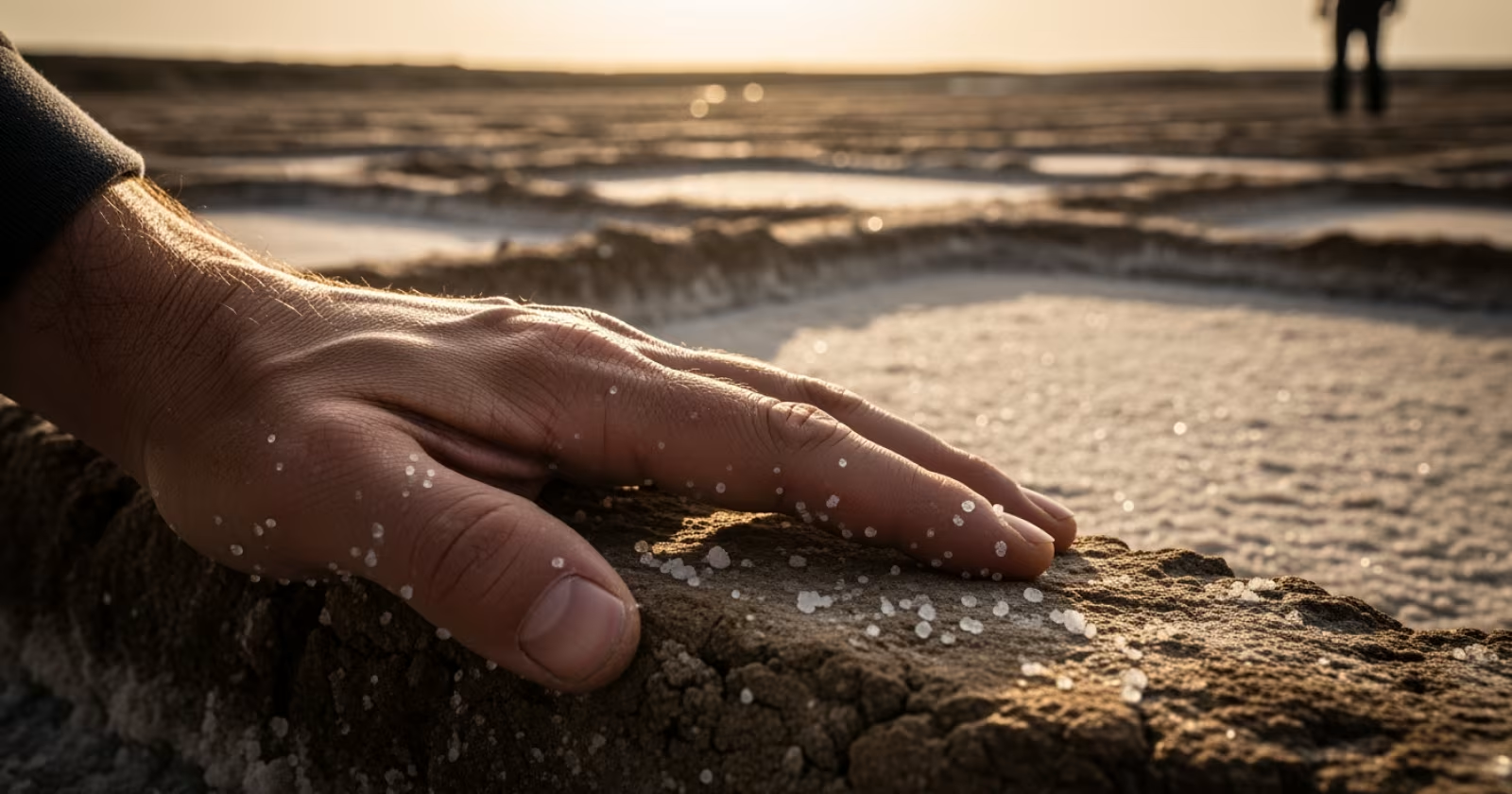
Somewhere on the cracked, white-crusted flats west of Jaipur, a 62-year-old Kharwal salt worker named Magan Lal scrapes crystallised salt into a mound with a wooden tool his grandfather once used. He earns approximately ₹180 for a day that begins before sunrise and ends when the Rajasthan heat becomes physically dangerous. His cooperative membership card — faded, laminated in peeling plastic — is the only institutional proof that his labour has ever been formally recognised by anyone.
Why a Forgotten Salt Cooperative Deserves National Attention
I first encountered the story of the Sambhar Lake salt cooperative while researching Rajasthan’s dying artisan cooperatives for IICTF. What I found stunned me. This wasn’t some marginal footnote. Sambhar Lake, spread across roughly 230 square kilometres in the Jaipur and Nagaur districts, is India‘s largest inland saltwater lake. It has produced salt for over a thousand years — supplying Mughal armies, British colonial warehouses, and eventually independent India’s domestic market. And the cooperative society formed by its salt workers is among the earliest examples of labour-based cooperative organisation in the country.
Yet in 2026, almost nobody in the mainstream cooperative discourse talks about it. The conversations revolve around dairy, sugar, credit societies. Salt cooperatives — particularly inland ones — have been written out of the narrative.
A Cooperative Born from Colonial Exploitation
Salt production at Sambhar predates formal record-keeping. Historical accounts trace organised extraction to at least the 10th century, when local Rajput rulers taxed salt as a royal commodity. Under British rule, the infamous salt tax turned Sambhar into a controlled revenue site. The Kharwal community — the hereditary salt workers of the region — were effectively bonded labourers with no ownership rights over the salt they produced.
After independence, two things happened in parallel. The central government established Sambhar Salts Limited in 1964 as a joint venture between Hindustan Salts Limited and the Rajasthan state government, industrialising a portion of salt production. Simultaneously, grassroots organisers helped Kharwal workers form cooperative societies to collectively bargain for better wages, access government rations, and secure housing plots near the lake’s periphery.
The Sambhar Salt Workers Cooperative Society, registered under the Rajasthan Cooperative Societies Act, became one of the earliest labour cooperatives in the salt sector. At its peak in the 1980s, the cooperative reportedly had over 3,000 active members and handled procurement, grading, and local distribution of unrefined salt. It was a genuine success — workers who had no institutional identity suddenly had credit access, group insurance, and a collective voice.
How the Cooperative Functions Today — Barely
I wish I could report that the cooperative thrives. It does not. Active membership has fallen to an estimated 800-1,000 workers, mostly aged above 50. The younger generation of Kharwal families has migrated to Jaipur, Ajmer, and even Gujarat’s industrial towns. Revenue from cooperative-managed salt pans has dropped sharply as private operators and illegal encroachments have eaten into the lake’s productive zones.
The structure, on paper, still exists. Members pay a nominal annual fee of ₹50-100. The cooperative is supposed to aggregate salt production, negotiate bulk prices with traders, and distribute a share of profits. In practice, middlemen dominate the chain. A kilogram of Sambhar salt sells for ₹8-12 at the pan level but retails in urban markets at ₹20-30 after processing and packaging — margins the cooperative never captures.
| Parameter | Peak (1980s) | Current (2026 est.) |
|---|---|---|
| Active members | 3,000+ | 800-1,000 |
| Annual salt output (cooperative share) | ~50,000 tonnes | ~12,000 tonnes |
| Daily worker wage | ₹35-40 | ₹150-200 |
| Middleman price per kg | ₹1.5 | ₹8-12 |
| Retail price per kg | ₹4 | ₹20-30 |
| Average member age | 30-40 years | 50+ years |
The Triple Threat: Ecology, Encroachment, and Apathy
Three forces are strangling this cooperative simultaneously. First, Sambhar Lake’s ecology is collapsing. Illegal brine extraction by private operators, diversion of feeder rivers for irrigation, and urban waste discharge from nearby towns have reduced the lake’s salinity and water levels. In some years, large sections of the lake dry up entirely before the salt crystallisation season even begins.
Second, encroachment is rampant. Reports from Rajasthan’s revenue department have flagged illegal construction and farming on the lake’s catchment area. The cooperative’s traditional salt pans are being squeezed from all sides.
Third — and perhaps most damaging — is institutional apathy. Sambhar Salts Limited itself has been a loss-making entity for years. The NCDC and state cooperative department have not prioritised salt worker cooperatives in their funding cycles. When the Ministry of Cooperation was established in 2021, salt cooperatives were not mentioned in any of the early policy documents. The cooperative exists in a governance blind spot.
What Gujarat’s Salt Cooperatives Did Differently
For contrast, consider Gujarat’s Agaria salt worker cooperatives in the Little Rann of Kutch. Facing similar caste-based marginalisation, Gujarat’s salt workers benefited from sustained NGO intervention, NABARD-backed credit linkages, and eventually a GI Tag push for their traditional salt. Some cooperatives there now export directly. The difference wasn’t talent or geography — it was institutional attention. Rajasthan’s salt workers received almost none of it.
An international parallel exists too. In Guérande, France, salt workers formed a cooperative in the 1970s that now markets artisanal fleur de sel at premium prices globally. The product is essentially the same — hand-harvested, sun-dried salt. The branding and cooperative infrastructure made the difference.
Can Policy and Technology Still Save Sambhar’s Cooperative?
There are thin but real reasons for hope. The National Cooperative Policy framework now acknowledges the need to revive non-agricultural cooperatives. If the Rajasthan state government classifies Sambhar’s hand-harvested salt under a GI Tag or geographical branding initiative, cooperative members could access premium markets — much like Mahabaleshwar’s strawberry cooperatives or Darjeeling’s tea estates did.
Technology offers another opening. Solar-assisted evaporation pans, simple quality-testing kits, and direct-to-consumer e-commerce platforms could allow the cooperative to bypass middlemen entirely. The cost of such an intervention is modest — estimates suggest ₹2-3 crore could modernise the entire cooperative’s infrastructure. That is less than what a single urban PACS digitalisation project costs.
Back to the Salt Flats
Magan Lal does not think in terms of policy frameworks. He thinks about whether his knees will hold through another season. His son works in a garment factory in Jaipur and sends money home. Nobody in the family expects the next generation to touch salt.
This is what forgetting looks like in the cooperative sector. Not a dramatic collapse but a slow, quiet erosion — of members, of purpose, of institutional memory. The Sambhar Lake salt cooperative proved, decades ago, that collective organisation could give dignity to India’s most invisible workers. Whether that proof still matters to anyone in power is the question that remains unanswered in 2026. If you work in the cooperative space — as a policymaker, researcher, or advocate — I urge you to look beyond dairy and credit. Some of India’s most important cooperative stories are drying up in the sun, waiting for someone to notice.