
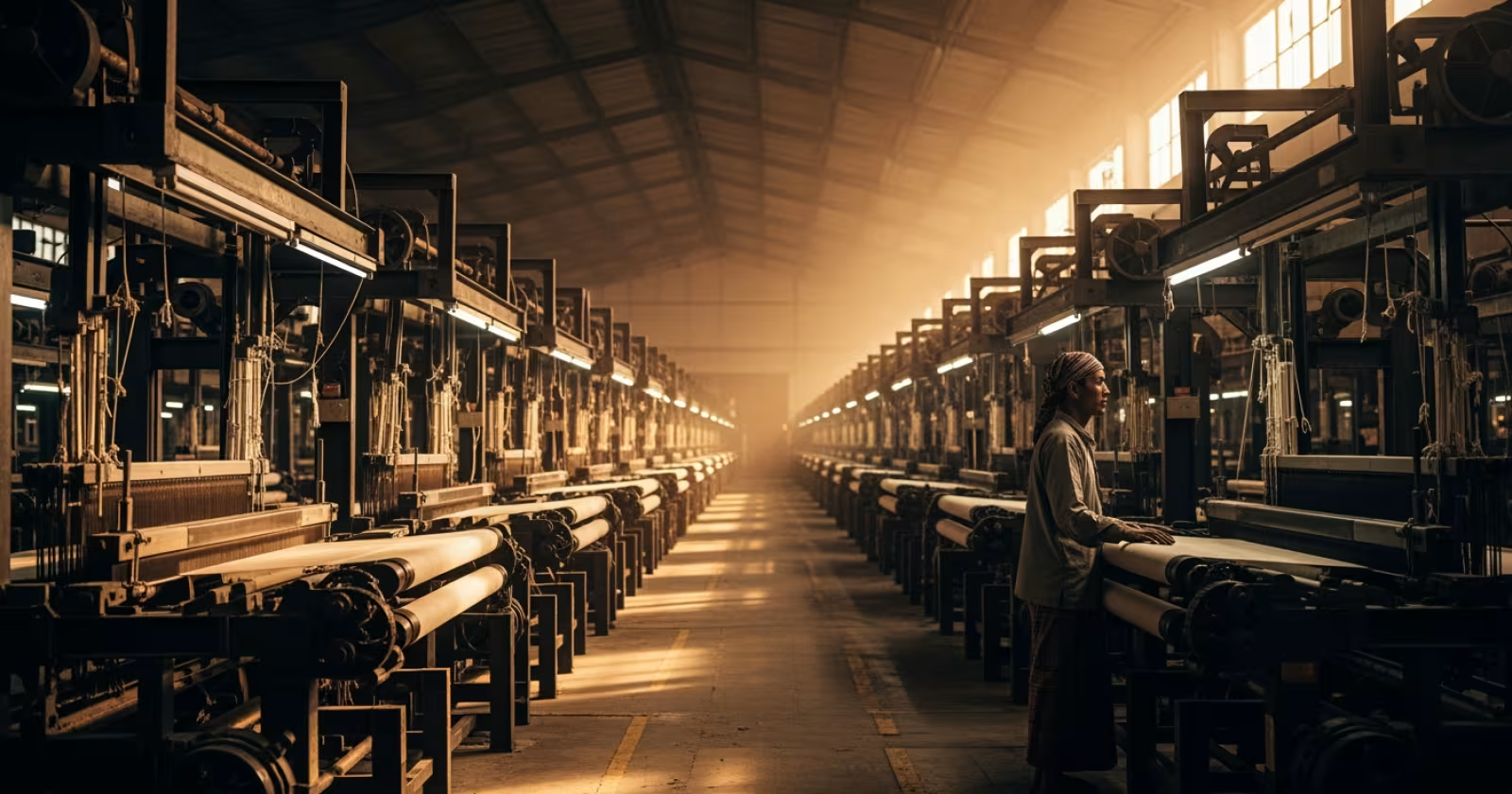
On a damp morning in Singanallur, a suburb that bleeds into Coimbatore’s sprawling industrial belt, I watched Ramasamy Gounder, a 72-year-old retired mill worker, point at a row of concrete buildings stretching along the Noyyal River. “Every one of those structures,” he told a local reporter in 2023, “was built with money that belonged to weavers, not to any Seth.” That single observation captures something extraordinary — an entire industrial geography shaped not by private capital but by cooperative spinning mills that Tamil Nadu began building over six decades ago.
The Yarn That Built a City
I have spent considerable time studying India’s cooperative textile belt, and nothing quite compares to what happened in Coimbatore. By the late 1950s, Tamil Nadu’s handloom weavers faced a brutal squeeze. Private spinning mills controlled yarn supply, prices swung wildly, and weavers in districts like Salem, Erode, and Kanchipuram had no bargaining power. The state’s visionary Chief Minister K. Kamaraj championed a radical idea: let weavers own spinning mills collectively, produce their own yarn, and sell the surplus commercially.
The first cooperative spinning mill in Tamil Nadu was registered in 1961. Coimbatore was the natural home — it already had a cotton-trading ecosystem, proximity to hydel power from the Pykara project, and a semi-arid climate that kept humidity manageable for yarn production. By 1975, the Tamil Nadu Cooperative Spinning Mills Federation, known widely as TANCOSPIN, was coordinating a network that would eventually include over 20 mills across the state, with the densest cluster right here in the Coimbatore region.
How Cooperative Spinning Mills Actually Work
I find that most people outside the textile sector have no mental model for how a cooperative spinning mill operates. Let me break it down. Each mill is owned by its member weavers — typically handloom and powerloom cooperative societies. These societies subscribe to share capital, which funds the mill’s establishment alongside loans from NCDC (National Cooperative Development Corporation) and NABARD. The mill produces cotton yarn — counts ranging from 20s to 80s — and sells it at a concessional rate to member weavers. The surplus yarn goes to the open market at commercial rates, generating revenue that covers operational costs and builds reserves.
At peak capacity, a single TANCOSPIN-affiliated mill employs approximately 300 to 500 workers and processes roughly 10 to 15 tonnes of raw cotton daily. Across the network, these mills collectively provide affordable yarn to an estimated 1.5 lakh handloom weavers in Tamil Nadu. The concessional pricing — often 10 to 15 per cent below open-market rates — is the invisible subsidy that keeps Tamil Nadu’s handloom sector competitive against mill-made fabric.
| Parameter | TANCOSPIN Network (Approximate, 2026) |
|---|---|
| Total cooperative spinning mills | 20+ |
| Installed spindles (combined) | Over 7 lakh |
| Workers employed directly | Approximately 8,000–10,000 |
| Weavers served (member societies) | Approximately 1.5 lakh |
| Concessional yarn price advantage | 10–15% below market rate |
| Key yarn counts produced | 20s, 40s, 60s, 80s cotton |
| Primary raw material sourcing | Gujarat, Maharashtra, Telangana cotton |
The Coimbatore Effect — Industry Begets Industry
What I find genuinely remarkable is the secondary economy these mills spawned. Cooperative spinning mills needed machinery — ring frames, carding engines, blow rooms. Coimbatore’s private engineering firms, many of them small-scale, stepped in to supply these. By the 1980s, the city had become India‘s largest hub for textile machinery manufacturing, a status it retains in 2026. Foundries, pump manufacturers, motor winding shops — an entire ecosystem grew in concentric circles around the cooperative mills.
The Singanallur-Peelamedu-Ganapathy corridor today houses hundreds of ancillary units whose origin story traces back to cooperative mill demand. Local estimates suggest the textile and textile-machinery sector accounts for nearly 35 per cent of Coimbatore district’s industrial output. That is the cooperative multiplier effect at work — not just providing yarn to weavers, but generating an industrial town.
What Threatens This Model Today
I would be dishonest if I painted this as an uncomplicated success. Several cooperative spinning mills in Tamil Nadu are financially stressed. Raw cotton prices have surged — the benchmark Shankar-6 variety touched approximately ₹63,000 per candy in recent seasons — while yarn prices have not kept pace. Mills caught between honouring concessional commitments to weavers and covering input costs find their margins evaporating.
Political interference remains a chronic ailment. Board appointments in some mills have historically reflected party affiliations rather than managerial competence. A few mills have accumulated losses running into crores, and at least two in the TANCOSPIN network were reportedly non-operational for extended periods due to machinery obsolescence and governance failures. The Ministry of Cooperation‘s push to modernise PACS (Primary Agricultural Credit Societies) has not yet extended with equal vigour to cooperative spinning mills, which sit in a policy grey zone between agriculture and industry.
A Lesson from Maharashtra — And a Warning
Tamil Nadu’s model has a useful comparator in Maharashtra’s cooperative sugar mills, which similarly created industrial towns across western Maharashtra. But many of those sugar cooperatives eventually fell to political capture and debt spirals, with several converting to private ownership. The warning for Coimbatore’s cooperative spinning mills is clear: without governance reform and technology upgradation, the same fate awaits. On the brighter side, some Tamil Nadu mills have begun investing in compact spinning technology and auto-doffing systems, which reduce labour costs by approximately 20 per cent and improve yarn quality. The National Handloom Mission‘s yarn supply component continues to channel subsidised yarn through the cooperative network, providing a fiscal lifeline.
Where the Next Decade Leads
I see two divergent futures. In the optimistic scenario, the Government of Tamil Nadu and the central Ministry of Cooperation jointly fund a technology modernisation package — estimates suggest approximately ₹500 crore would be needed to re-equip the entire TANCOSPIN network with energy-efficient machinery. Mills that modernise could produce value-added yarns (organic cotton, blended yarns) and tap export markets. NABARD’s refinancing window and NCDC’s direct lending could underwrite this transformation.
In the pessimistic scenario, continued neglect leads to more mill closures, and private spinning units — already dominant in Coimbatore’s Sulur and Palladam belts — absorb the cooperative workforce at lower wages without the social security that cooperative membership provided. The handloom weavers who depend on concessional yarn would face the same market squeeze their grandparents faced in the 1950s.
Back to Singanallur
Ramasamy Gounder retired from a cooperative spinning mill in 2009. His pension — modest, but regular — still comes from the mill’s provident fund. His grandson now works in Coimbatore’s IT sector, a career path made possible, Ramasamy has noted, because the cooperative mill gave his family economic stability for three decades. That trajectory — from landless weaver family to urban middle class in two generations — is the cooperative spinning mill’s truest product. Whether Coimbatore can keep manufacturing that product depends on choices being made right now, in boardrooms and state secretariats, about the future of cooperative industry in India.
If you are involved in the cooperative textile sector, or simply care about India’s industrial commons, I encourage you to follow IICTF’s ongoing coverage of these developments. The story of cooperative spinning mills is not history — it is unfolding, and it needs informed citizens paying attention.