
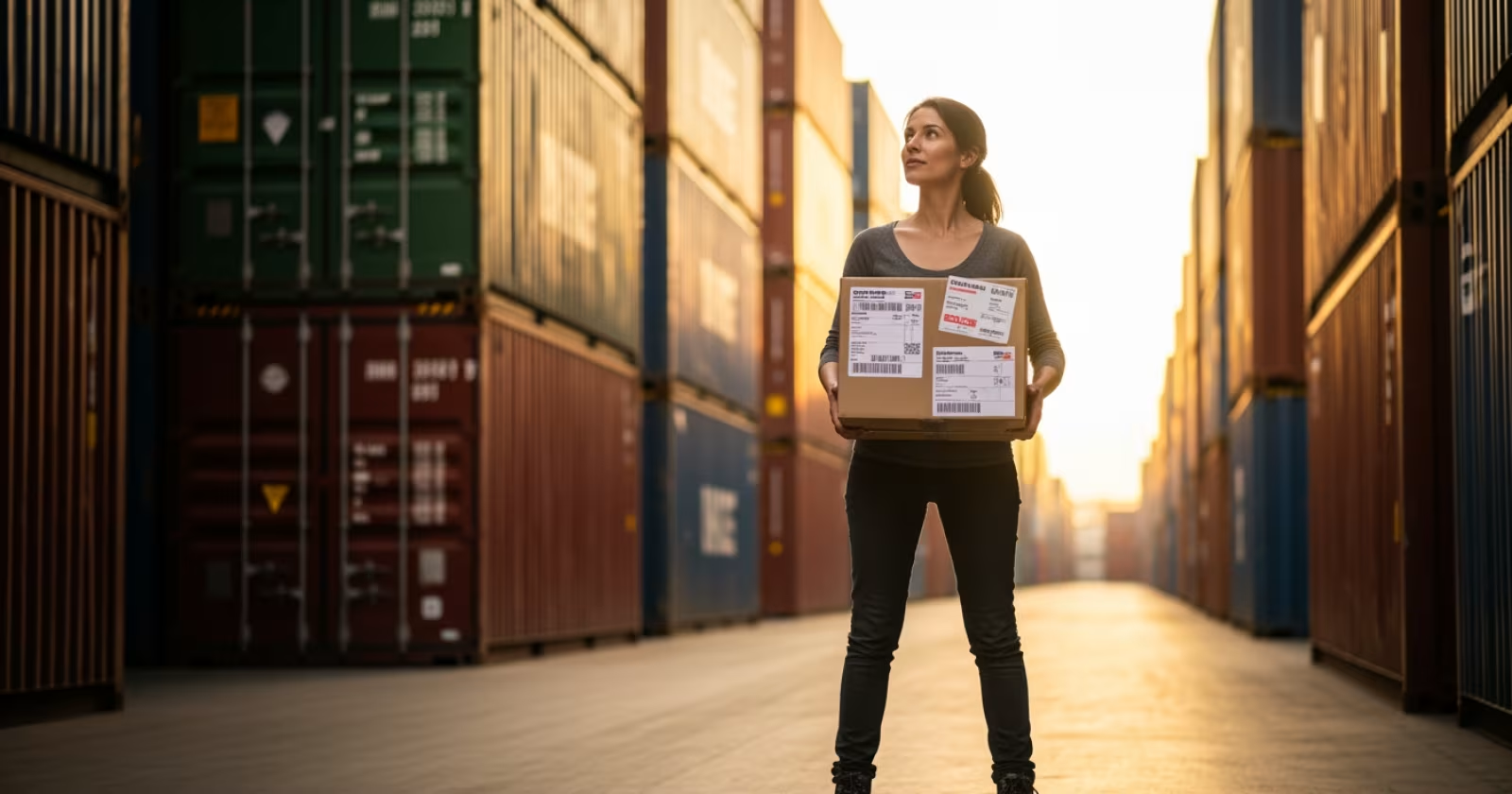
In the summer of 1998, a twenty-three-year-old woman in Bhujodi village, Kutch district, Gujarat, walked into her local cooperative society office and asked for a loan of ₹200. The clerk hesitated — the amount was so small it barely covered the paperwork. She wanted to buy raw cotton yarn and natural dyes to weave shawls the way her mother had taught her. Today, in 2026, Rukmini Devi operates a cooperative-backed artisan enterprise that ships handwoven textiles and home décor products to 12 countries, including Germany, Japan, and the United States. Her annual turnover, according to the cooperative federation’s records, crossed ₹4.7 crore last financial year. I first heard her story at a cooperative summit in Ahmedabad, and it refused to leave my mind.
What struck me wasn’t just the rags-to-exports arc — India has thousands of those. It was the fact that every inflection point in her journey traced back to a cooperative institution. Not a bank. Not a venture fund. A cooperative. And that says something profound about a system most urban Indians dismiss as outdated.
Why This Story Reflects a National Shift
India’s cooperative sector touches approximately 290 million members across more than 8.5 lakh registered societies, according to NABARD estimates. Yet the image of cooperatives in mainstream media remains frozen somewhere between sugarcane politics and milk procurement. What gets missed is the quiet revolution in women-led cooperative enterprises — particularly in handicrafts, food processing, and organic agriculture — that are now plugging directly into global supply chains. The Ministry of Cooperation, established in 2021, has since 2023 actively pushed for export-readiness programmes routed through cooperative federations. Rukmini’s trajectory is not an anomaly. It is the leading edge of a pattern I’ve been tracking across Gujarat, Rajasthan, and the northeastern states.
Where It All Began: The Cooperative Roots of Kutch’s Artisan Economy
Kutch’s handloom and handicraft tradition is centuries old, but its cooperative infrastructure dates to the post-independence era. The Kutch Mahila Vikas Sangathan, a women’s cooperative, was among the earliest attempts to organise female artisans in the region. By the 1980s, SEWA (Self Employed Women’s Association) had extended its network into Kutch, establishing savings-and-credit cooperatives that gave women like Rukmini’s mother access to small working capital loans without requiring land titles or male guarantors.
The ₹200 loan Rukmini took in 1998 came from a SEWA-affiliated cooperative thrift society. She used it to buy yarn and dyes, wove four shawls over three weeks, and sold them at a local market for ₹1,100. She repaid the loan with interest within a month. Over the next two years, she borrowed incrementally — ₹500, then ₹2,000, then ₹10,000 — each time expanding her production and recruiting neighbouring women. By 2003, her informal group had formalised into a registered women’s cooperative with 34 members.
What made the cooperative model work here was not charity — it was structure. Members contributed ₹10 per month to a common fund. Loans were peer-guaranteed. The NCDC provided a matching grant under its weaker section programme, which funded two looms and a natural dye unit.
How the Cooperative Export Model Works Today
I visited Rukmini’s unit in late 2026, and the scale surprised me. The cooperative now has 178 women members across six villages. The production centre in Bhujodi houses 22 handlooms, a quality-testing room, and a packaging unit that meets international shipping standards. Here is a snapshot of the cooperative’s current structure:
| Parameter | Details (2026-26) |
|---|---|
| Total Members | 178 women artisans |
| Annual Turnover | ₹4.7 crore (approx.) |
| Export Countries | 12 (including Germany, Japan, USA, UAE, UK) |
| Product Lines | Handwoven shawls, table linen, cushion covers, wall hangings |
| Average Monthly Earning per Member | ₹12,000–₹18,000 |
| Initial Loan (1998) | ₹200 |
| Key Support Institutions | SEWA, NCDC, NABARD, NAFED |
The revenue model is straightforward. International buyers — mostly fair-trade retailers and boutique home décor brands — place orders through a NAFED-facilitated export channel. The cooperative handles production, quality control, and packaging. Export logistics are managed through a partnership with a Mundra port-based freight consolidator. Members receive 70% of the product price as wages, with 20% going to the cooperative’s operational fund and 10% to a member welfare corpus that covers healthcare and children’s education.
What I found remarkable is that every artisan member has a passbook — not unlike a bank passbook — that records her production, earnings, and cooperative dividends. Financial literacy, enforced through the cooperative’s own weekly meetings, is baked into the model.
The Cracks Beneath the Surface
None of this means the system is frictionless. The biggest challenge I heard about — from Rukmini and from the district cooperative officer — is succession and scale. Younger women in Kutch increasingly prefer garment factory jobs in Ahmedabad or Surat, which offer fixed salaries and urban life. The cooperative’s average member age has crept up to 41 years in 2026, compared to 33 a decade ago.
Second, export compliance costs are rising. Meeting EU sustainability documentation requirements and US import labelling norms requires expertise that village cooperatives simply don’t have in-house. The cooperative currently pays ₹1.8 lakh annually to a Rajkot-based consultant for compliance paperwork — money that members feel could go to wages instead.
Third, there is the perennial issue of credit access for expansion. Despite the cooperative’s export track record, scheduled banks remain reluctant to extend large working capital loans to cooperative societies. NABARD refinance lines help, but the processing timelines — often four to six months — clash with the tight turnaround buyers demand.
A Comparison That Sharpens the Point
Consider Bangladesh’s BRAC, which has built an entire export-ready handicraft supply chain through cooperative-style clusters, complete with in-house design teams and dedicated shipping infrastructure. Their artisan cooperatives export to over 30 countries. The difference is not talent — Kutch artisans are arguably more skilled. The difference is institutional investment in export infrastructure at the cooperative level. India’s Primary Agricultural Credit Societies (PACS) modernisation programme, which aims to convert PACS into multi-service centres, could theoretically bridge this gap — but as of 2026, implementation in Gujarat’s artisan districts remains patchy.
What the Next Five Years Could Look Like
The policy winds are favourable. The Ministry of Cooperation’s 2026 guidelines on cooperative-led exports explicitly mention handicrafts and handlooms as priority sectors. The NCDC has earmarked approximately ₹900 crore for the current plan period to support cooperative enterprises in export-oriented production. If even a fraction of this reaches cooperatives like Rukmini’s directly — rather than getting absorbed by state-level federations — the impact could be transformative.
Technology adoption is another frontier. Rukmini’s cooperative began listing products on the Government e-Marketplace (GeM) in 2024 and received its first institutional order — cushion covers for a hotel chain — worth ₹6.2 lakh. Digital cataloguing, which NABARD is piloting through its cooperative digitisation initiative, could open B2B channels that were previously unimaginable for village-level societies.
Back to Bhujodi
When I asked Rukmini what that first ₹200 meant to her, she didn’t talk about money. She described the feeling of walking into a cooperative office where the people behind the counter looked like her — women from her own community, speaking her language, understanding that a shawl takes twenty days and not five. That sense of institutional belonging, I believe, is what separates cooperative credit from every other form of micro-finance. It is not just capital. It is recognition.
Her story tells us that India’s cooperative movement does not need reinvention. It needs what Rukmini needed — a small, timely push, delivered with dignity, and then the freedom to build. If you know of a cooperative story in your district that deserves to be told, reach out to us at IICTF. These stories are the real infrastructure of India’s cooperative future, and I want to make sure none of them go unheard.