
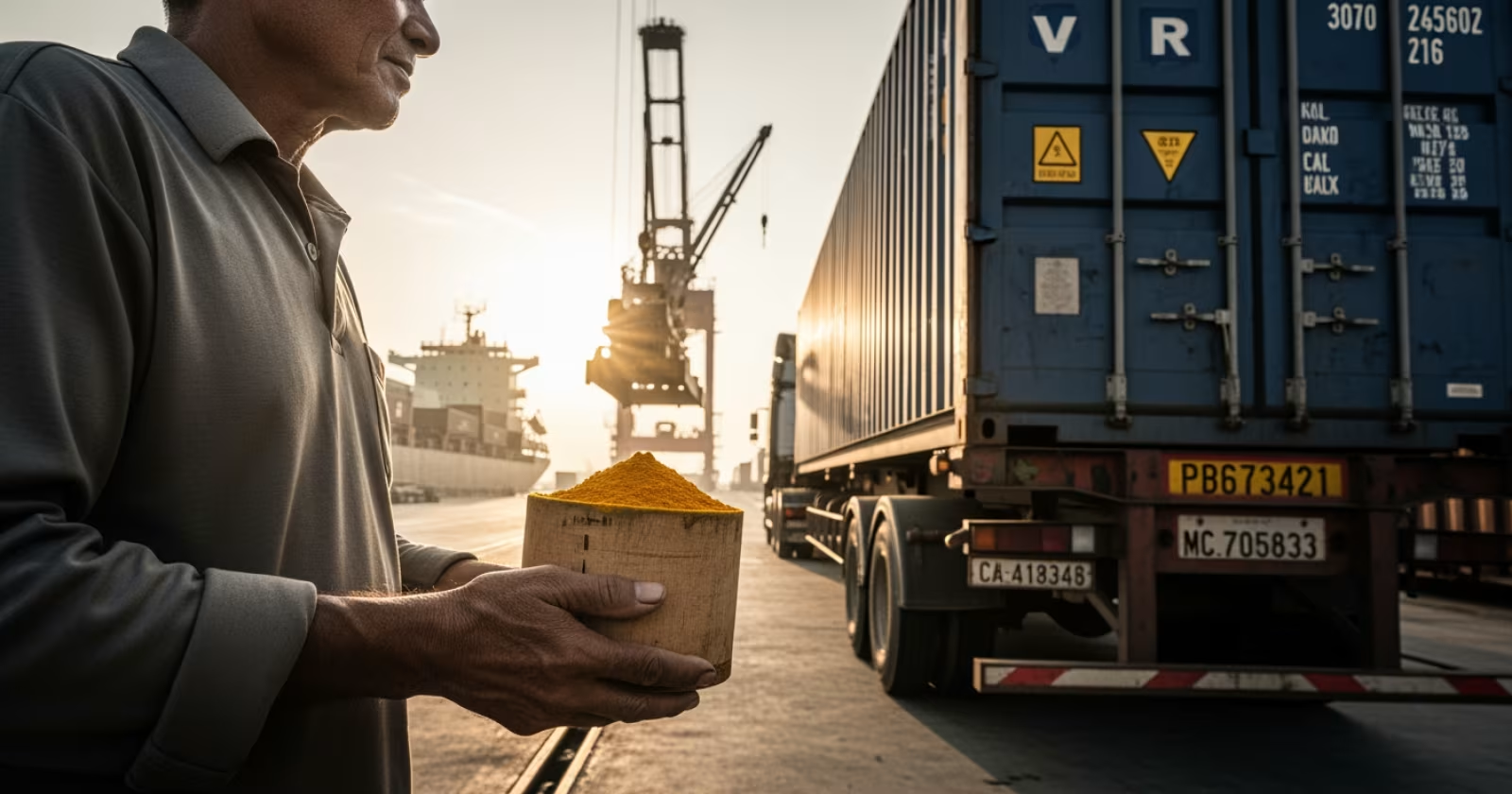
In a small drying yard in Laskein block, West Jaintia Hills, I watched a woman named Rikynti Suchiang spread freshly boiled turmeric rhizomes across bamboo mats, the late-March sun turning each finger-shaped piece into something almost golden enough to be currency. She told me her cooperative had shipped 3.2 tonnes of organic Lakadong turmeric to a buyer in Hamburg last November — and that not a single government agency had helped them get there. No NCDC loan. No NABARD subsidy. No state agriculture department handholding. Just forty-seven farmers, a shared processing unit they built themselves, and a German organic food distributor who found them through an Instagram post.
That detail — the Instagram post — is what pulled me into this story. In a country where cooperative success stories are almost always narrated through the lens of government schemes and policy interventions, here was a group of Khasi-Jaintia farmers who had essentially built their own export pipeline from scratch. And they were thriving in 2026, quietly, in one of India‘s least-covered states.
Why This Story Matters Beyond Meghalaya
India is the world’s largest producer of turmeric, accounting for roughly 75-80% of global production. Yet the country captures a disproportionately small share of the premium organic turmeric market in Europe and North America. Most Indian turmeric exports are bulk, commodity-grade, and priced low. The premium segment — where a kilogram of certified organic turmeric powder can fetch ₹800-₹1,200 at the farmgate compared to ₹120-₹180 for conventional — remains dominated by smaller origins like Peru, Madagascar, and increasingly, Northeast India.
What the Jaintia Hills cooperative has done is essentially what India’s cooperative policy ecosystem has been promising for decades but rarely delivering: direct market linkage, farmer-owned value addition, and export-grade quality control — all without the bureaucratic overhead that typically accompanies government-backed cooperative ventures.
The Lakadong Advantage and How It All Began
To understand this cooperative, I first had to understand Lakadong turmeric itself. Named after the Lakadong area in Jaintia Hills, this indigenous variety contains curcumin levels between 7% and 12% — compared to the 2-3% found in common varieties like Salem or Erode turmeric from Tamil Nadu. That curcumin concentration is what makes it extraordinarily valuable in European nutraceutical and food markets, where curcumin content directly determines price.
Farmers in Jaintia Hills have cultivated Lakadong for generations, mostly for local use and small-scale trade. The variety was formally documented by researchers at ICAR’s North Eastern Hill Region centre in the early 2000s, but commercial interest remained sporadic. Around 2018, a group of farmers in Laskein — most of them women from the Suchiang and Lyngdoh clans — formed a loose collective to pool their harvest and negotiate better prices with traders in Shillong. By 2020, they registered as the Jaintia Organic Farmers Cooperative Society, with 32 founding members.
The critical turning point came in 2022, when two members used personal savings — approximately ₹4.5 lakh collectively — to fund an organic certification process through IMO Control (now part of Ecocert), an internationally recognised body. That certification opened the EU market door. I find it remarkable that this investment came entirely from the members themselves, with no external grant or subsidy.
How the Cooperative Operates in 2026
Today, the cooperative has 47 active members farming across approximately 85 hectares in West Jaintia Hills. The membership structure is straightforward: each member pays an annual fee of ₹500, contributes their harvest to the cooperative’s common processing unit, and receives payment based on the weight and quality grade of their rhizomes.
The processing unit — a modest concrete building with solar-assisted dryers, a pulveriser, and vacuum-packing equipment — was built incrementally between 2021 and 2024. Total investment stands at roughly ₹18 lakh, funded through member contributions and a small private loan from a Shillong-based lender. No institutional cooperative finance was involved.
| Parameter | Conventional Route | Cooperative Export Route |
|---|---|---|
| Farmgate price per kg (raw) | ₹40-₹60 | ₹150-₹220 |
| Final sale price per kg (powder) | ₹120-₹180 | ₹800-₹1,200 |
| Value addition at source | Minimal | Drying, grinding, packaging |
| Market destination | Shillong/Guwahati traders | Hamburg, Amsterdam, London |
| Certification | None | EU Organic (Ecocert) |
| Annual volume (2026-26) | Varies | Approximately 5 tonnes |
The revenue model is simple but effective. The cooperative retains 15% of net sale proceeds for operational costs, certification renewal, and a reserve fund. The remaining 85% is distributed to members proportionally. In the 2026-26 season, the cooperative estimates total revenue of approximately ₹48-₹55 lakh from EU and domestic premium sales combined — a figure that would be unremarkable for a large cooperative in Maharashtra or Gujarat, but is transformative for a 47-member society in one of India’s poorest districts.
What Remains Broken
I would be dishonest if I painted this as a frictionless success story. The cooperative faces genuine structural problems. First, logistics. Getting vacuum-packed turmeric from Laskein to Kolkata port involves a 14-16 hour road journey through some of India’s worst-maintained national highways. Freight costs eat into margins significantly — members estimate 12-15% of the final price goes to transportation alone.
Second, certification costs. Maintaining EU organic certification requires annual audits costing approximately ₹2.5-₹3 lakh — a substantial recurring expense for a small cooperative. Any lapse means losing market access entirely. Third, there is the ever-present risk of climate variability. Meghalaya’s rainfall patterns have grown increasingly erratic, and Lakadong turmeric requires specific moisture conditions during its 8-9 month growing cycle. Two consecutive poor harvests could financially cripple the society.
Perhaps most frustrating, according to what members have reported publicly, is the complete absence of institutional support. Despite the Ministry of Cooperation‘s stated push to modernise Primary Agricultural Credit Societies and strengthen export-linked cooperatives, this society has received no outreach, no technical assistance, and no financing from any government cooperative body as of early 2026.
A Parallel from Manipur — and from Peru
The Jaintia cooperative is not entirely alone in the Northeast. In Manipur’s Ukhrul district, a smaller group of Tangkhul Naga farmers has been experimenting with organic ginger exports to South Korea through a similar self-funded cooperative model. Their volumes are smaller, but the pattern is identical: indigenous crop variety, farmer-owned processing, international certification funded privately, zero government involvement.
Internationally, the closest comparison might be Peru’s organic turmeric cooperatives in the San Martín region, which scaled from near-zero exports in 2015 to becoming the EU’s second-largest organic turmeric supplier by 2023. Crucially, Peruvian cooperatives received substantial technical support from NGOs and development agencies. The Meghalaya cooperative has achieved its results without even that advantage, which makes the accomplishment more impressive — and the fragility more concerning.
What the Next Five Years Could Look Like
If the cooperative can scale to 100+ members and 12-15 tonnes of annual export volume, the economics become significantly more robust. Fixed costs like certification and processing infrastructure get spread across a larger base, and the cooperative gains negotiating leverage with freight forwarders and international buyers.
Technology adoption is already underway in a modest way. Members began using a basic mobile app in late 2026 to log harvest weights, moisture readings, and payment records — a digitalisation effort that, ironically, mirrors what the Ministry of Cooperation’s PACS computerisation programme aims to achieve nationally but has not yet reached Meghalaya’s tribal cooperatives.
The real question is whether this model can be replicated. Meghalaya alone has dozens of indigenous crop varieties — black rice, Khasi mandarin, lakadong ginger — that could support similar cooperative export ventures. But replication requires at minimum what this cooperative built on its own: processing infrastructure, quality certification, and direct buyer relationships. Without institutional scaffolding, each new cooperative would need to reinvent the wheel.
Back to That Drying Yard in Laskein
When I last checked in with the cooperative in early 2026, Rikynti Suchiang mentioned that her personal income from turmeric had increased roughly threefold since joining the cooperative in 2020. She was using the additional income to fund her daughter’s nursing course in Shillong. Another member had invested in a small greenhouse for off-season vegetable cultivation.
These are not dramatic, headline-grabbing transformations. But they represent exactly what the cooperative movement in India is supposed to deliver — incremental, dignified economic improvement driven by collective action. The uncomfortable truth this story surfaces is that the most innovative cooperative work in India may be happening precisely where the institutional cooperative ecosystem is absent. That should concern every policymaker in Delhi who believes that top-down schemes alone can revive the sector.
If you are involved in the cooperative movement — as a member, a policymaker, or simply someone who cares about India’s rural economy — I encourage you to look closely at what small, self-organised cooperatives in the Northeast are achieving. Share their stories, connect them with markets, and push for institutional frameworks that support rather than smother grassroots cooperative innovation. The cooperative idea does not need rescuing. It needs room to breathe.