
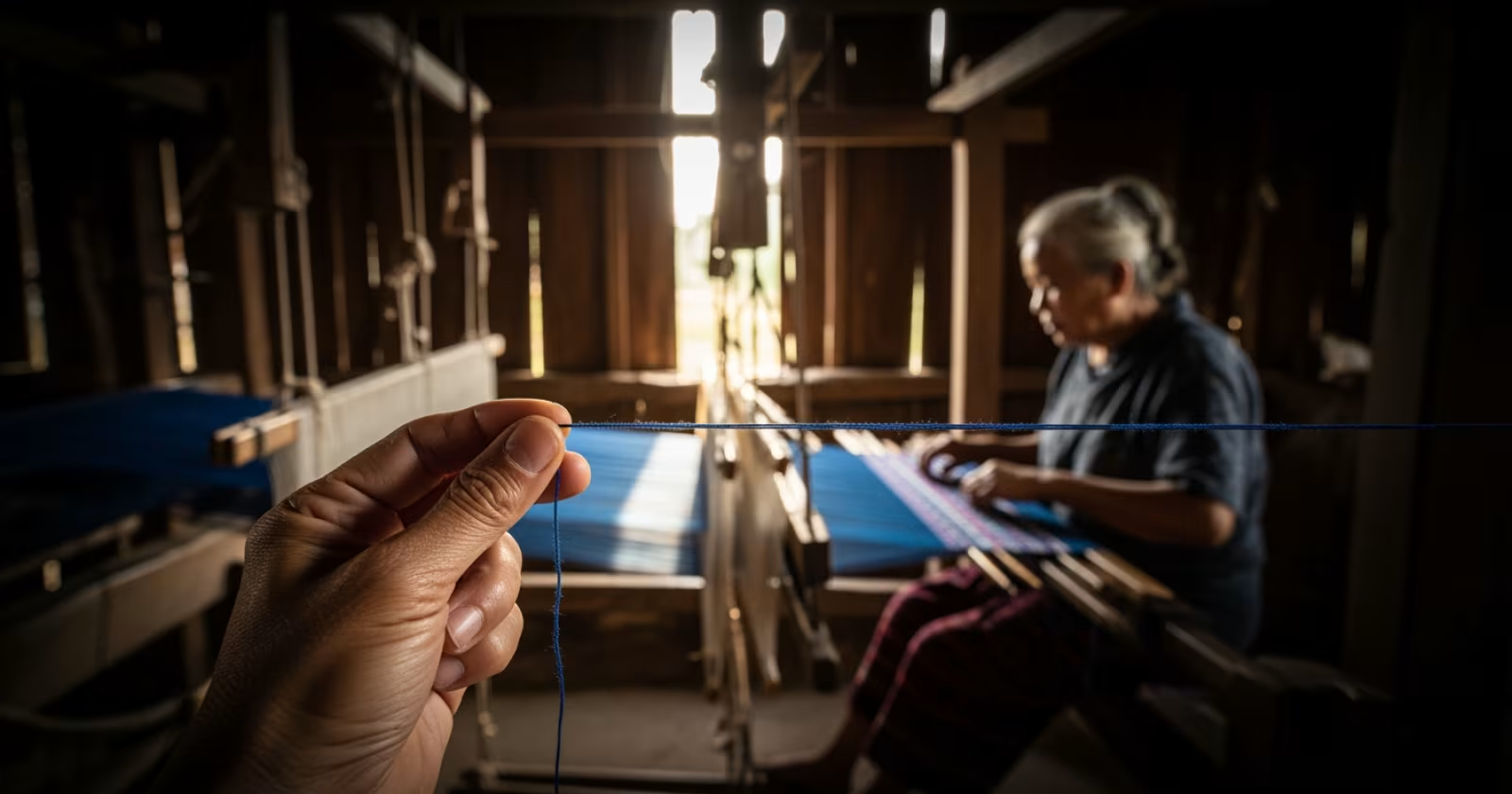
In a small cement-floored shed in Kanchipuram district, a woman named Lakshmi operates a pit loom that is older than most startups’ founding documents. She earns approximately ₹9,000 a month weaving silk sarees — each one taking four to twelve days — and she has never heard the phrase “series A funding.” Yet the organisation that buys her fabric, markets it across India, and deposits money into her bank account operates at a scale that would make many venture-backed D2C brands envious. I find that irony impossible to ignore.
That organisation is Co-optex — formally known as the Tamil Nadu Handloom Weavers’ Co-operative Society — and it connects roughly 65,000 weavers across the state to consumers through a network of showrooms, exhibitions, and increasingly, digital channels. It has no equity investors, no cap table, and no Silicon Valley pitch deck. It runs on membership fees, government support, and the sheer stubbornness of a model that was born in 1935.
Why This Cooperative Model Matters in 2026
I’ve spent years covering India’s cooperative sector, and Co-optex keeps surfacing as a case study that defies easy categorisation. At a time when the Ministry of Cooperation is pushing to modernise Primary Agricultural Credit Societies (PACS) into multi-service centres, and when direct-to-consumer handloom brands raise crores on Instagram aesthetics alone, Co-optex sits at a strange intersection. It is neither a relic nor a disruptor. It is a cooperative that simply works — imperfectly, bureaucratically, but persistently.
India’s handloom sector employs over 31 lakh workers, making it the second-largest source of rural employment after agriculture. Tamil Nadu alone accounts for a significant share of the country’s handloom output. Understanding how Co-optex sustains this ecosystem is not an academic exercise — it is a policy question worth billions of rupees.
Born in the Freedom Struggle, Built for Survival
Co-optex was established in 1935, more than a decade before Indian independence, when the Swadeshi movement had already planted the idea that Indian textiles could be an act of resistance. The cooperative was set up to eliminate middlemen who were squeezing weavers on both ends — buying yarn at inflated prices and selling finished cloth at margins that left artisans in perpetual debt.
The founding logic was elegantly simple. Village-level primary weavers’ cooperative societies would aggregate production. Co-optex, as the apex marketing body, would handle branding, retail, and distribution. Weavers would receive fair procurement prices, and profits would cycle back into the system. Headquartered in Chennai, the organisation grew steadily through the post-independence decades, opening showrooms across India and becoming synonymous with authentic Tamil Nadu handloom.
What strikes me most is the durability. Many cooperatives founded in that era collapsed under political interference or financial mismanagement. Co-optex survived, partly because Tamil Nadu’s handloom tradition was too culturally significant to let fail, and partly because successive state governments — regardless of party — found it politically useful to support weavers.
How Co-optex Actually Functions Today
The structure is layered but logical. At the base are approximately 1,100 primary weavers’ cooperative societies spread across districts like Kanchipuram, Salem, Madurai, Thanjavur, and Erode. These primary societies are the direct interface with weavers. They supply yarn (often subsidised), collect finished products, and handle wage disbursement.
Co-optex sits atop this pyramid as the apex marketing cooperative. It operates over 100 retail showrooms across India, participates in national and international trade exhibitions, and has been expanding its e-commerce presence. Revenue comes from retail margins on handloom products — sarees, dhotis, towels, bed linen, dress materials, and home furnishings.
| Parameter | Detail |
|---|---|
| Year Established | 1935 |
| Headquarters | Chennai, Tamil Nadu |
| Registered Weavers | Approximately 65,000 |
| Primary Societies Linked | ~1,100 |
| Retail Showrooms | 100+ across India |
| Key Products | Silk sarees, cotton dhotis, home textiles |
| Annual Turnover (est.) | ₹500-700 crore range |
| Government Support | Yarn subsidy, rebate sales, NABARD refinance |
Weavers benefit through guaranteed procurement, subsidised raw materials, and access to welfare schemes including insurance, housing assistance, and education grants routed through NABARD and NCDC funding. The cooperative also conducts periodic rebate sales — events that are cultural phenomena in Tamil Nadu, drawing massive footfall.
What Is Broken and What Is at Risk
I would be dishonest if I painted Co-optex as a flawless institution. Several structural problems persist. First, the weaver demographic is ageing. Younger generations in districts like Salem and Kanchipuram are migrating to garment factories or urban service jobs. The loom feels like a sentence of low wages to a twenty-year-old when a smartphone assembly line pays more predictably.
Second, powerloom and mill-made imitations undercut handloom pricing relentlessly. A genuine Kanchipuram silk saree takes days to weave and costs ₹15,000 or more. A powerloom knockoff from Surat can look similar at ₹3,000. The Handloom Mark certification scheme exists to differentiate, but consumer awareness remains woefully low.
Third, political interference in cooperative governance is a perennial issue across India, and Co-optex is not immune. Board appointments, procurement pricing decisions, and showroom locations can be influenced by electoral calculations rather than weaver welfare. The 97th Constitutional Amendment and subsequent state-level reforms aim to professionalise cooperative management, but progress is uneven.
Chanderi vs. Kanchipuram — A Useful Comparison
To sharpen the picture, consider Chanderi in Madhya Pradesh. Chanderi weavers produce exquisite fabric but lack an apex marketing body as established as Co-optex. Several NGOs and government initiatives — including the National Handloom Development Programme — have tried to build market linkages, but the results are fragmented. Individual designers collaborate with Chanderi clusters; some weavers benefit, most do not.
Co-optex’s advantage is institutional memory and retail infrastructure built over nine decades. A Chanderi weaver selling through a designer’s Instagram store might get a higher per-piece rate, but has zero income security between orders. A Co-optex weaver gets less per saree but gets consistent work and welfare coverage. That tradeoff — stability versus upside — is the central tension in India’s artisan economy, and I think cooperatives still offer the more humane answer for the majority.
What the Next Five Years Could Look Like
The Ministry of Cooperation, established in 2021, has been pushing digital transformation across the cooperative sector. For Co-optex, this means e-commerce is no longer optional. The cooperative has already listed products on the Government e-Marketplace (GeM) and its own website, but the user experience lags behind private handloom platforms significantly.
If Co-optex can invest in better digital marketing, younger product design (think contemporary home décor, not just traditional sarees), and transparent supply-chain storytelling — showing the buyer exactly which weaver made their product — it could capture a growing conscious-consumer market. Failure to adapt, however, risks irrelevance within a generation as weaver attrition accelerates.
Back to Lakshmi’s Loom
When I think about Co-optex, I return to that shed in Kanchipuram. Lakshmi does not care about business models or cooperative theory. She cares that the society buys her sarees regularly, that the yarn arrives on time, and that her daughter’s school fees are partly covered by a weaver welfare scheme. That quiet, unsexy reliability is what Co-optex provides — and what no venture-capital-backed startup has figured out how to replicate at scale for 65,000 artisans simultaneously. The cooperative model is not glamorous. But for the people inside it, it remains the most credible structure of dignity that Indian rural economics has produced. If you care about India’s artisan future, I urge you to explore how cooperatives like Co-optex work — and advocate for their modernisation, not their replacement.