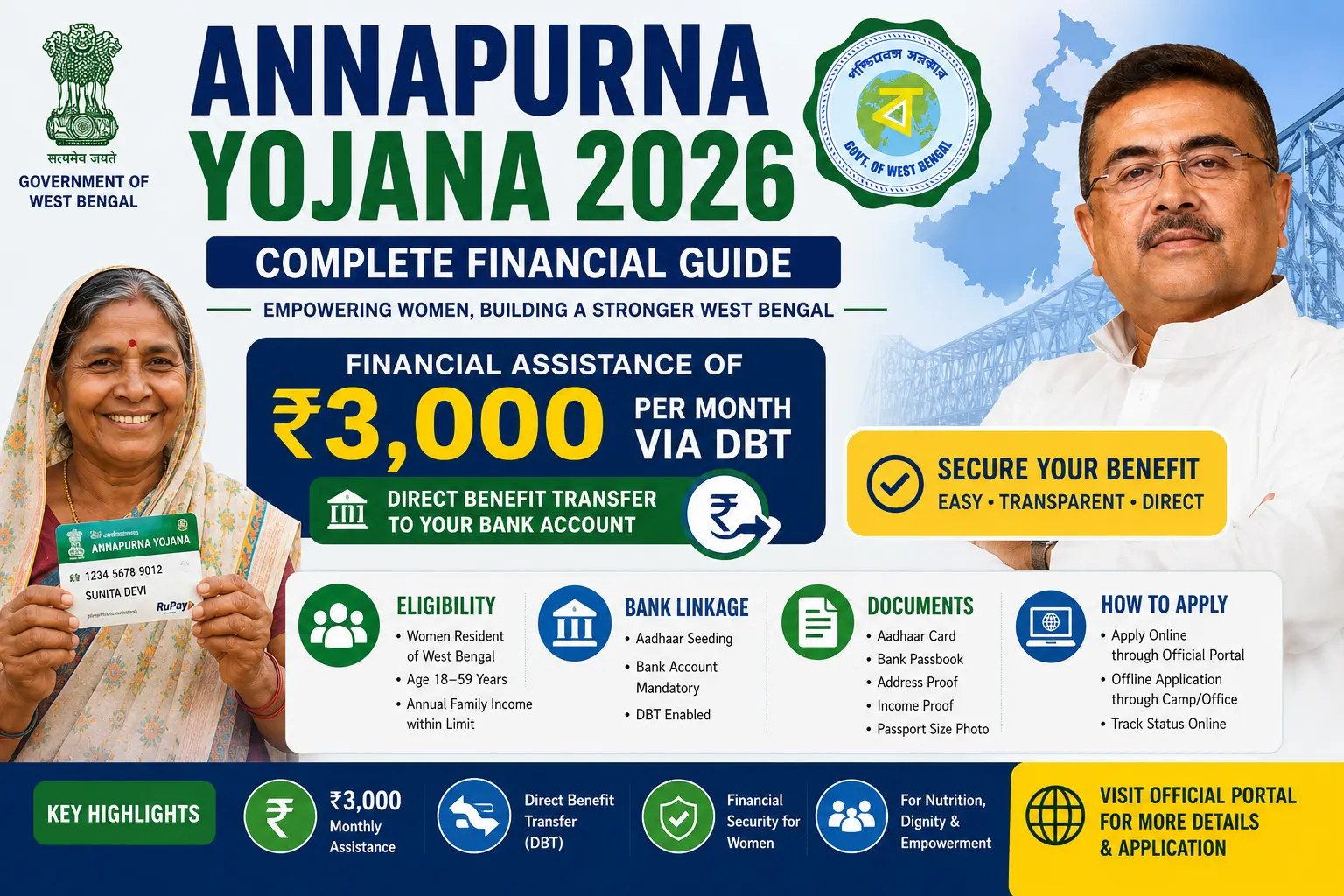
The West Bengal Government has officially rolled out the Annapurna Yojana 2026, one of the largest Direct Benefit Transfer (DBT) schemes in the state’s history. Under this scheme, eligible women will receive ₹3,000 per month directly into their Aadhaar-linked bank accounts — doubling the financial support previously offered under the Lakshmir Bhandar scheme (₹1,500–₹1,700/month).
For anyone seeking to understand not just how to apply, but how the money actually reaches your account, what financial conditions can block your payment, and how to safeguard your benefit — this is the most complete guide available.
Scheme Overview – Key Financial Facts at a Glance
| Particular | Details |
|---|---|
| Scheme Name | Annapurna Yojana / Annapurna Bhandar Scheme 2026 |
| Launched By | Chief Minister Suvendu Adhikari, West Bengal |
| Monthly Financial Benefit | ₹3,000 per month |
| Annual Benefit Per Woman | ₹36,000 per year |
| Payment Method | Direct Benefit Transfer (DBT) |
| Phase 1 Beneficiaries | 28.25 Lakh Women |
| Total Estimated Beneficiaries | ~2 Crore Women |
| Previous Scheme | Lakshmir Bhandar (₹1,500–₹1,700/month) |
| Benefit Increase | ~100% jump over previous scheme |
| Age Bracket | 25 to 60 Years |
| Official Portal | socialsecurity.wb.gov.in |
| Application Window | 90 Days from June 1, 2026 |
| Helpline | 82820-82820 (Mon–Sat, 9 AM–6 PM) |
| [email protected] |
What is the Annapurna Yojana 2026? – Financial Context
The Annapurna Bhandar Scheme is a direct cash transfer programme introduced by the BJP-led West Bengal government following the 2026 state assembly elections. It is a replacement for the TMC government’s Lakshmir Bhandar scheme, under which around 2.42 crore women received a maximum of ₹1,500 per month.
From a financial perspective, the Annapurna Yojana represents a significant upgrade — not just in amount, but in design. The scheme operates entirely on a DBT (Direct Benefit Transfer) framework, meaning no middlemen, no cash distribution, and no scope for leakage. The money flows directly from the state government treasury into the beneficiary’s Aadhaar-linked bank account.
The scheme was inaugurated at Nabanna by Minister Agnimitra Paul (Women, Child Development and Social Welfare) with Chief Minister Suvendu Adhikari present. In the first phase alone, ₹3,000 was transferred to over 28.25 lakh verified beneficiaries simultaneously.
Financial Impact Analysis – What ₹3,000/Month Means for Beneficiaries
Understanding the real-world financial value of this scheme is important for awareness:
| Financial Metric | Amount |
|---|---|
| Monthly Benefit | ₹3,000 |
| Quarterly Benefit | ₹9,000 |
| Annual Benefit | ₹36,000 |
| Increase Over Lakshmir Bhandar | +₹1,300 to ₹1,500/month |
| Percentage Increase | ~100% |
| Total Phase 1 Monthly Outflow (State) | ~₹846 Crore (28.25L × ₹3,000) |
| Estimated Annual Spend (2 Crore beneficiaries) | ~₹72,000 Crore |
For many rural households in West Bengal, ₹3,000 per month represents a meaningful supplementary income that can cover cooking gas refills, medicines, school stationery, and basic nutrition expenses — directly addressing the scheme’s stated goal of household financial stability.
Who is Eligible – Complete Financial Eligibility Criteria
The eligibility design of the Annapurna Yojana is built around financial exclusion principles — meaning those who already have access to formal income or government salaries are excluded to ensure benefits reach the most economically vulnerable.
Eligible Applicants Must:
- Be a woman and permanent resident of West Bengal
- Be between 25 and 60 years of age
- Not be an income taxpayer or professional tax payer
- Not be a permanent or retired government employee receiving salary or pension from state/central government, panchayats, statutory bodies, local bodies, municipalities, or government-aided educational institutions
- Not be employed in a teaching or non-teaching role in any government-aided educational institution
- Possess a valid Digital Ration Card (AAY/PHH/SPHH/RKSY categories)
- Have an Aadhaar-linked, active bank account for DBT receipt
Who is Financially Disqualified:
| Disqualification Criteria | Reason |
|---|---|
| Income Tax / Professional Tax payer | Indicates above-poverty income level |
| Government employee or pensioner | Already receives regular state/central income |
| Owns motorized non-commercial 4-wheeler | Asset-based exclusion indicator |
| House with 3+ pucca rooms | Property-based affluence indicator |
| High landholding (as per RoR records) | Agricultural asset exclusion |
| Does not lift monthly ration | Not dependent on PDS — excluded |
Understanding the DBT Payment Process
This is the most critical section for finance-aware readers. The ₹3,000 does not arrive automatically — it requires a correctly set up DBT-linked bank account. Here is how the payment pipeline works:
Step 1 – Application & Verification
The applicant submits the family data collection form online or offline. Block, GP, or Municipality-level officials verify the application against submitted documents and ground reality.
Step 2 – Beneficiary List Finalization
A ward-wise merit list of eligible families is prepared by the designated official. Sanction letters are issued to approved beneficiaries.
Step 3 – DBT Credit
Once sanctioned, ₹3,000 is credited directly to the Aadhaar-linked bank account of the beneficiary. The list is updated every seven days as new verifications are completed.
Step 4 – Status Tracking
Beneficiaries can track payment status online at socialsecurity.wb.gov.in using their Application Reference Number.
Bank Account Requirements – Critical for Payment Success
This is where many beneficiaries face payment failures. Your bank account must meet all of the following conditions for DBT credit to succeed:
| Requirement | Details |
|---|---|
| Aadhaar Linkage | Bank account must be seeded with your Aadhaar number |
| Account Status | Account must be active (not dormant or frozen) |
| Correct Information | Account number and IFSC must be entered correctly in the form |
| DBT Enabled | Account must be DBT-enabled (most nationalised bank accounts are) |
| Name Match | Account holder name should ideally match Aadhaar name |
Why DBT Payments Fail – Common Reasons:
Many Lakshmir Bhandar beneficiaries experienced payment failures due to inactive accounts, incorrect DBT information, or a change of bank. The same risks apply here. The most common failure reasons are:
- Dormant account: Bank accounts inactive for 12+ months get frozen. Reactivate by visiting your branch before applying.
- Aadhaar not seeded: Your Aadhaar must be linked to your bank account. Check via your bank’s net banking, app, or branch visit.
- Wrong IFSC/Account number entered: Double-check from your passbook before filling the form. Errors cannot be corrected after submission.
- Account closed: If you changed banks, ensure the new account is Aadhaar-linked and active.
- Name mismatch: Minor spelling differences between Aadhaar and bank records can sometimes trigger DBT rejection. Get these corrected before applying.
Pro Tip: Visit your bank branch before applying and confirm your account is Aadhaar-seeded and DBT-enabled. Ask for a printed confirmation if possible.
Documents Required – Complete Financial Documentation Guide
Mandatory Documents for All Applicants:
| Document | Who Needs It | Financial Relevance |
|---|---|---|
| Aadhaar Card | HOF & All Family Members | Primary identity for DBT linkage |
| Aadhaar-Linked Mobile Number | HOF | OTP login; must be active |
| Digital Ration Card | Family | Determines PDS eligibility category |
| Bank Passbook | HOF & All Adult Members | IFSC & Account Number for DBT credit |
| EPIC (Voter ID Card) | HOF & All Adult Members | Identity + electoral roll verification |
| Land Records (RoR/Mutation) | Family | Asset verification for eligibility |
| PAN Card | Any member who has one | Income/tax status verification |
Category-Specific Documents:
| Document | Required When |
|---|---|
| Caste Certificate (SC/ST/OBC) | Claiming category-based priority |
| EWS Certificate | UR-EWS category applicants |
| Creamy Layer Certificate | OBC inclusion/exclusion determination |
| PVTG Certificate | Particularly Vulnerable Tribal Group members |
| Vehicle RC Card | If family owns a 4-wheeler (for disclosure) |
| Income Tax / Professional Tax challan | If any member pays tax (disqualifying document) |
| Health Insurance policy | For health coverage disclosure in form |
For Children (Section F of Form):
- School documents (Grade, School Name, Type — Govt/Aided/Private/Madrasah)
- Vaccination Card with Card ID number
Document File Size: All scanned documents must be between 100–200 KB. Forms are available in English, Bengali, and Hindi.
How to Apply Online – Detailed Step-by-Step
Official Portal: socialsecurity.wb.gov.in
Step 1: Visit socialsecurity.wb.gov.in on your phone or computer
Step 2: Select your district from the dropdown (mandatory before login)
Step 3: Enter the 10-digit Aadhaar-linked mobile number of the Head of Family
Step 4: Click “Request OTP” — a 6-digit code will arrive via SMS within seconds
Step 5: Enter the OTP to log into your citizen dashboard
Step 6: Click on “Family Data Collection” under the Citizen Portal section
Step 7: Fill in HOF basic information — name as per Aadhaar, date of birth, gender, social category (UR/SC/ST/OBC/EWS/PVTG), and contact number
Step 8: Upload Aadhaar, Voter Card (EPIC with AC & Part Number), and Bank Details (IFSC and Account Number)
Step 9: Add up to 5 family members — Name, DOB, Gender, Relation, Aadhaar for each
Step 10: Fill remaining form sections — Ration Card details, asset information, income details, existing government scheme benefits, children’s school and vaccination records
Step 11: Tick the Declaration & Consent checkbox to confirm accuracy of submitted information
Step 12: Click “Submit” — download and save the acknowledgement receipt with your Application Reference Number
Critical Warning: Only one application is allowed per mobile number. No corrections are permitted after final submission. Review every detail carefully before clicking Submit.
How to Apply Offline
Applicants who cannot apply online have full offline support available. Forms are available at Block Development Offices (BDO), Municipal Offices, Panchayat Offices, and designated Government centres. MLAs are also assisting beneficiaries with form filling, while BDO teams are going door-to-door.
A “Janakalyan Shibir” camp will be organised across the state from June 15 to 17, 2026, where applicants can submit their forms in person.
Government employees will visit homes of those who are unable to complete the process on their own, as assured by the Chief Minister.
How to Check Application & Payment Status
Online:
Visit socialsecurity.wb.gov.in → Click “Track Application” → Enter your Application Reference Number → Check current status
Offline:
Visit your local Block or Municipal office with your acknowledgement receipt to verify status in person.
The government updates the verified beneficiary list every seven days, so if you have recently submitted your application, allow one update cycle before checking.
Protecting Your Financial Data – Scam Awareness
Given the scale of this scheme — targeting nearly 2 crore women — fraudulent websites and agents are actively attempting to exploit applicants. Here is what you must know:
| Risk | What to Watch For |
|---|---|
| Fake websites | Sites mimicking the official portal asking for Aadhaar/OTP |
| Paid agents | People charging ₹100–₹500 to “help” with form filling — the process is completely FREE |
| Phishing SMS/calls | Fraudsters claiming to be government officials asking for OTP |
| Fake “instant approval” sites | No legitimate site can guarantee instant approval |
Always remember:
- Apply only at socialsecurity.wb.gov.in
- Never share your OTP with anyone, including someone claiming to be a government official
- Government camps and BDO offices provide free assistance
- Official helpline: 82820-82820 | Email: [email protected]
Grievance Redressal – How to Raise a Complaint
If your application is incorrectly rejected, your payment fails, or someone fraudulently receives benefits in your name, you have formal recourse. Chief Secretary Manoj Kumar Agarwal confirmed that people can raise objections if someone’s eligibility to receive benefits under the scheme is cancelled. Government teams will investigate such objections at the block and municipal level.
Grievance Channels:
- Helpline: 82820-82820 (Mon–Sat, 9 AM–6 PM)
- Email: [email protected]
- In-person: Visit Block Development Office or Municipal Office with your acknowledgement receipt
Disclaimer: This article is intended for financial awareness and informational purposes only. All figures, dates, and processes are based on official announcements as of June 4, 2026. Always verify the latest information at socialsecurity.wb.gov.in before taking any action.