
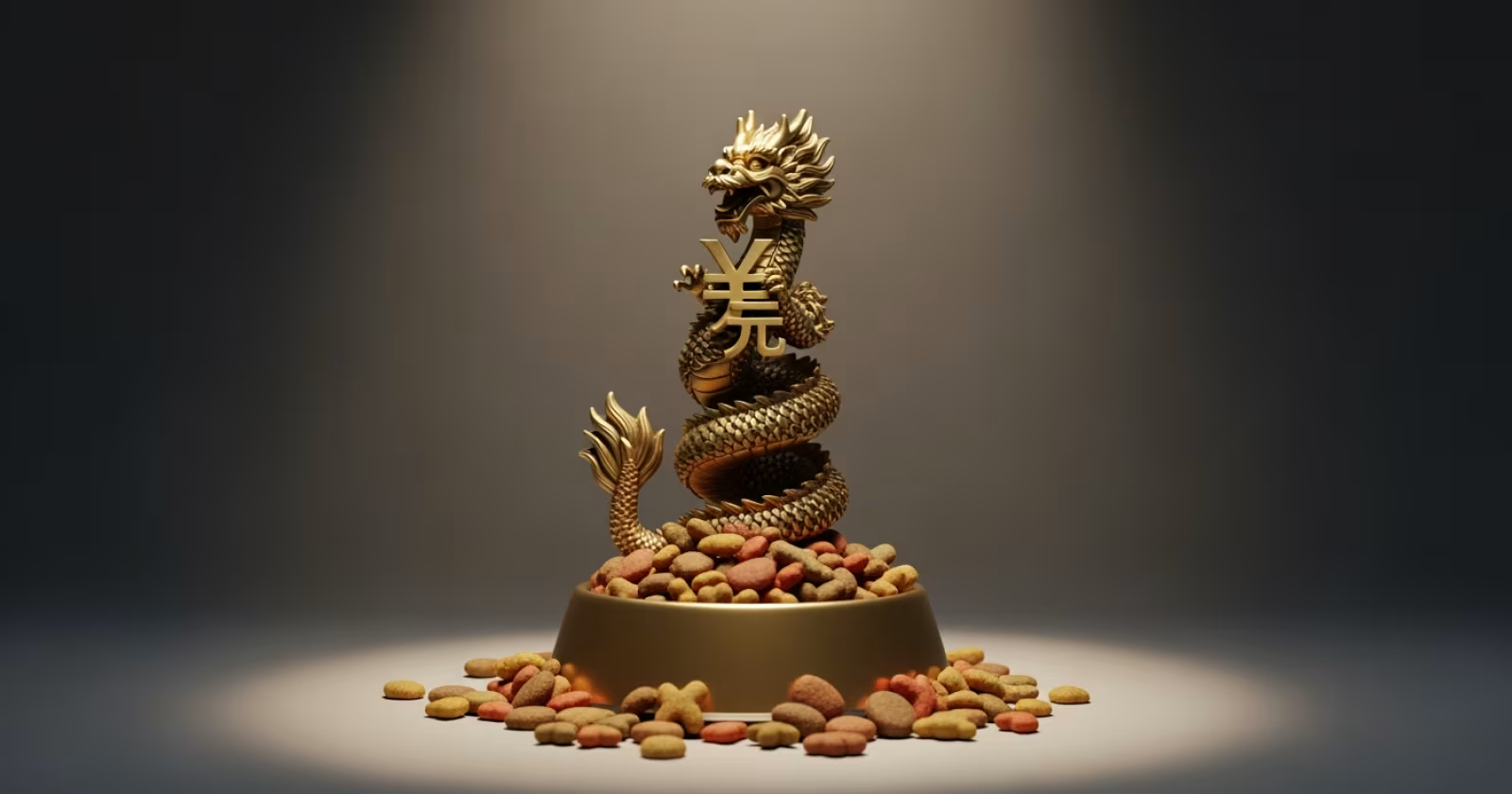
China’s pet food market is no longer a quiet import category. Local brands are taking share from global names as Chinese owners spend more on pets, even while they pull back elsewhere.
That shift matters well beyond China. It is changing the competitive playbook for premium pet food, pushing foreign brands to localise harder and forcing suppliers to rethink how much value sits in brand, protein content and distribution.
What is China’s pet food market and why it matters for FMCG
China’s pet food market has become one of the few bright spots in a consumer economy still weighed down by property stress, flat wages and job insecurity. Annual sales have risen sixfold between 2014 and 2024, and the market is now worth more than $24 billion. For FMCG executives, that makes it a useful case study in where discretionary spend still flows when consumers trade down in other categories.
It also shows how fast a category can move from import-led premiumisation to local competition. In pet care, the old advantage of a foreign label is fading unless it brings stronger ingredients, better distribution and a clear reason to pay up.
China pet food market local brands take share from global giants
In Beijing, shoppers like Liu Xin are choosing Chinese-made pet food with fresh ingredients and more variety. She spends at least $250 a month on food for her terrier and says she prefers domestic products because Western options are too expensive and not necessarily better.
That consumer view is driving a broader market reset. China produced 1.9 million metric tons of pet food in 2026, up 17.9 per cent year on year, according to the China Feed Industry Association. The association said pet food was the fastest-growing segment of the animal feed industry, and the expansion is pulling in players from liquor, pork, dairy and pharmaceuticals.
Among the most eye-catching entrants, Kweichow Moutai said it planned to develop pet food from protein byproducts from its fermentation process. Wens Foodstuff has bought pet food maker Qingdao Shuang’an Biotechnology Co, while WH Group invested in Zhongyu Pet Food last year. Mengniu, Yili and Yunnan Baiyao have also launched pet food lines in recent years.
The pressure is now visible in the imported segment. General Mills said on April 9 that Blue Buffalo had wound down operations in China. Germany’s Animonda Carny reported sales of its chicken cat food in China fell 30 per cent last year. Mars’ Royal Canin remains the top-selling brand, but it is winning through local manufacturing, pet-store distribution and vet education rather than relying on brand heritage alone.
| Brand or player | Position in market | Reported signal |
|---|---|---|
| Local Chinese brands | Gaining share across premium and mass tiers | Sales growth, more flavour choice, fresher ingredients |
| Mars Royal Canin | Leading imported brand | Still top-selling, helped by localisation |
| General Mills Blue Buffalo | Imported premium brand | China operations wound down on 9 April |
| Animonda Carny | German imported cat food | Sales fell 30 per cent last year |
How the category is being built at shelf and online
The local formula is commercially familiar to anyone who has watched a premium FMCG launch work. Producers are using sharper packaging, more flavour variety and different kibble shapes to win attention, then backing it with gifting and heavy digital spend on platforms including ByteDance’s Douyin.
Some are also moving further up the value chain. Steo International Trade Co says domestic firms can reach more than 90 per cent animal protein in some cat foods, while many foreign brands still rely on plant proteins such as soy. Steo said its sales jumped 40 per cent in 2026, which suggests that ingredient claims are now doing more of the work once done by imported branding.
For buyers, that is important. The shelf battle is no longer only about premium positioning; it is about whether the product can prove freshness, meat content and trust in a market where online visibility can move volume quickly.
What this does not change
This boom does not remove the safety question. Andy Wong of the China Association for Quality Inspection’s pet food and supplies committee said there is a low threshold for making pet food and that anyone can do it. He also said there are no national standards for the industry.
For now, the Ministry of Agriculture oversees pet food using livestock feed guidelines. That creates a mismatch, because livestock rules are designed for fattening animals for reproduction and slaughter, while pet owners want longer, healthier lives for companion animals.
The winners are likely to be domestic brands with the scale to invest in ingredient quality, digital visibility and retailer relationships. Mars and other incumbents can still defend share, but only if they keep localising production and building credibility with vets, breeders and pet-store networks. For suppliers and manufacturers, the next growth window is already shifting from export-style premium packaging to real product differentiation.
The bigger picture for FMCG in China and beyond
China’s pet food market is showing how quickly domestic brands can close the gap when consumers want value, freshness and a clearer story about what is inside the pack. That pattern is not unique to pet care. Across FMCG, local players are learning to beat multinationals by combining sharper price points with faster product development and more local relevance.
For Australian suppliers watching China, the lesson is blunt: premium alone is not enough if localisation, ingredient trust and channel execution are missing. The China pet food market is still expanding, but the margin for imported complacency is shrinking fast.
If you sell into pet care, premium grocery or ingredient supply, this is the moment to reassess where your next competitive edge will come from and whether your product story is strong enough for a market that is moving this quickly.