
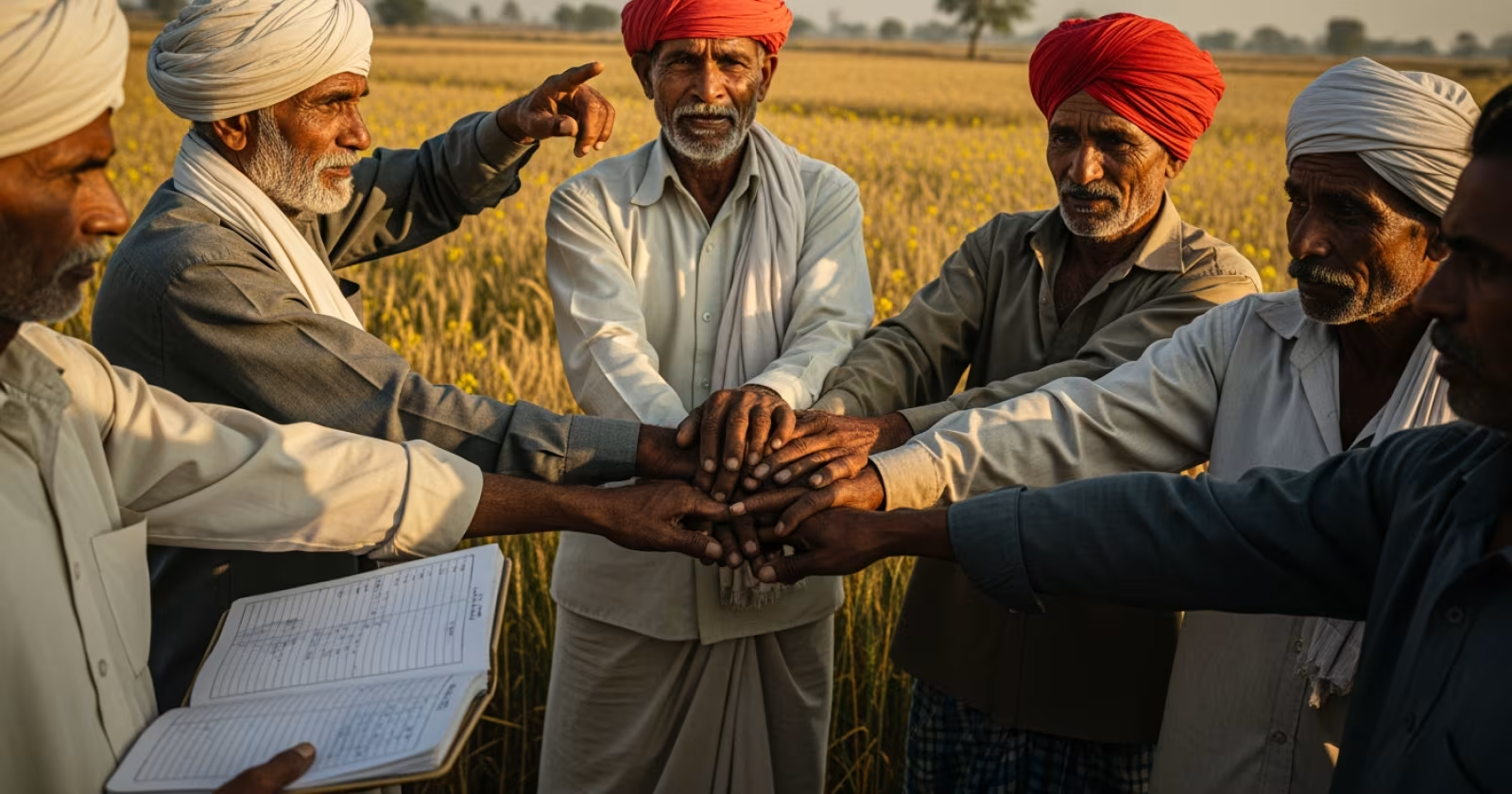
When Byju’s valuation collapsed from $22 billion to near-worthlessness and Paytm’s stock shed over 70% of its market cap within a few years of its IPO, the startup world scrambled for explanations. Meanwhile, a dairy cooperative founded in 1946 by farmers in Anand, Gujarat quietly crossed ₹72,000 crore in annual revenue — and not a single business channel dedicated a primetime segment to it.
I have spent considerable time looking at how India measures economic success, and the pattern is striking: we celebrate the dramatic and ignore the durable. The cooperative model — old, unglamorous, and deeply misunderstood — has outperformed nearly every celebrated startup of the last two decades by the only metric that ultimately matters: survival.
The Quiet Giant That Beat Every Startup at Its Own Game
AMUL — the Anand Milk Union Limited — processes roughly 35 million liters of milk every single day through a network of over 3.6 million farmer-members spread across 18,000 village-level cooperatives. No venture capital. No IPO roadshow. No founder with a TED Talk. The organization’s structure is almost aggressively boring by Silicon Valley standards, and that is precisely why it has survived wars, droughts, inflation spikes, and multiple recessions.
The cooperative model operates on a principle that startup culture often discards: ownership by those who contribute, not those who invest. When a farmer in Mehsana district delivers milk to an AMUL collection center, she is not a vendor — she is a partial owner. Profits are distributed back to members, not extracted upward to a handful of shareholders sitting in Mumbai or Bengaluru.
India now has approximately 8.5 lakh registered cooperatives employing over 280 million people — a figure that dwarfs the combined workforce of every Indian unicorn startup. The number is not well-known because cooperatives rarely generate the press that comes with a funding round or a flashy product launch.
Where Unicorns Fell, These Organizations Held Ground
Between 2022 and 2026, India’s unicorn ecosystem shed significant value. Companies like Oyo, Ola, and PharmEasy faced brutal write-downs, mass layoffs, and in some cases regulatory crackdowns. The pattern repeated across edtech, fintech, and quick commerce — each burning cash at rates that eventually proved unsustainable.
Cooperatives faced the same macro pressures but did not collapse. IFFCO, the Indian Farmers Fertiliser Cooperative and the world’s largest fertilizer cooperative by membership, supplied over 120 lakh metric tonnes of fertilizer during the 2022–23 agricultural cycle even as global supply chains buckled under the Russia-Ukraine conflict. It managed this because it operates on member need, not margin optimization.
Lijjat Papad — formally the Shri Mahila Griha Udyog Lijjat Papad — is another case that deserves far more attention. Founded in 1959 by seven women in a Mumbai chawl with a borrowed sum of just ₹80, it now has over 45,000 women members and annual revenues exceeding ₹1,600 crore. There is no CEO who can be fired. There is no board that can vote to shift production overseas. The organization belongs entirely to the women who roll the papads.
The Constitutional Moment That Changed Everything
In 2021, the Indian government created a standalone Ministry of Cooperation — the first time any democratic country gave cooperatives their own cabinet-level representation. The ministry began pushing for reforms to the Multi-State Cooperative Societies Act and launched new national-level cooperatives in seeds, organic products, and agricultural exports.
One of those initiatives — the National Cooperative Organics Limited (NCOL) — launched in 2023 specifically to connect small organic farmers directly to domestic and international markets, cutting out intermediaries who had long siphoned their earnings. This was not symbolic policy. It was structural rewiring of how rural India accesses commerce.
The digitization drive accompanying these reforms targeted bringing over one lakh cooperative societies online — giving them access to real-time pricing, direct procurement channels, and formal banking relationships that had historically been out of reach. The 97th Constitutional Amendment had already embedded cooperative promotion into Article 43-B of the Constitution; the ministry was finally giving it teeth.
Built to Last, Not Built to Scale Fast
The strongest argument against cooperatives has always been their limited capacity for rapid scaling. Critics point out that decision-making by committee slows growth, and that democratic structures resist the bold, centralized bets that produce companies like Zomato. That criticism has merit. But it misses the actual question being asked.
Verghese Kurien, the architect of AMUL’s model, argued that the cooperative’s job was not to grow fast — it was to grow fairly and to last. He built what became known as the White Revolution, turning India from a milk-deficit country into the world’s largest milk producer without a single rupee of external equity capital. His framework was later replicated in oilseeds, salt, and agricultural commodities through organizations like NAFED and NCCF.
IFFCO‘s recent development of nano-urea and nano-DAP fertilizers — products that received global patent approvals and compete directly with multinationals at a fraction of the price — shows that the cooperative sector is not clinging to relevance. It never needed rescuing in the first place. Its revenues have crossed ₹80,000 crore in recent years while delivering affordable inputs to millions of smallholder farmers who would otherwise be locked out of global agricultural technology.
| Organization | Type | Annual Revenue (approx.) | Members / Workforce | Founded |
|---|---|---|---|---|
| AMUL | Cooperative | ₹72,000 crore | 3.6 million farmers | 1946 |
| IFFCO | Cooperative | ₹80,000+ crore | 35,000 member co-ops | 1967 |
| Lijjat Papad | Cooperative | ₹1,600 crore | 45,000 women members | 1959 |
| Byju’s | Unicorn Startup | ~₹5,000 crore (peak) | ~50,000 (pre-layoffs) | 2011 |
| Paytm | Unicorn Startup | ~₹9,000 crore | ~30,000 | 2010 |
The data does not argue that cooperatives are superior in every dimension. Startups innovate quickly, attract global talent, and enter markets at speeds cooperatives rarely match. But the startups in that table have collectively laid off tens of thousands of workers, seen valuations crater, and faced existential crises — all within a single decade. The cooperatives have operated continuously for between 60 and 80 years.
If India’s economic conversation is going to mature, it needs to make room for organizations that measure success not in valuation multiples but in decades of uninterrupted service to millions of members. I would encourage anyone who cares about sustainable business — whether as a journalist, a policymaker, or simply a citizen paying attention — to visit the nearest cooperative society and ask how it actually works. The answer will be more interesting, and more reassuring, than almost anything a startup pitch deck has ever promised.