
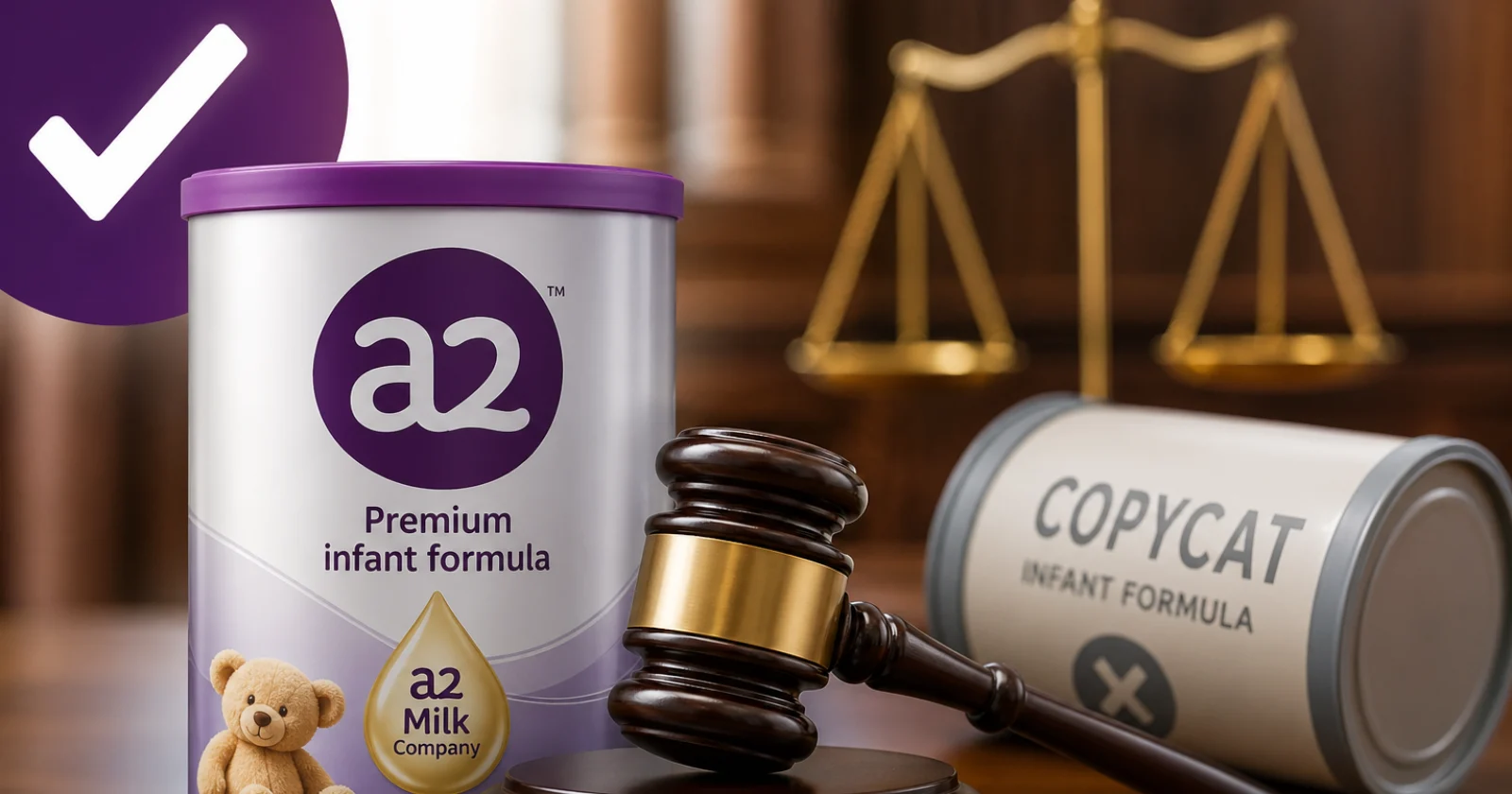
Winning a trademark case is one thing. Winning it against a rival that built its entire brand identity around your most protected asset is another thing entirely. The Federal Court of Australia has ruled in favour of The A2 Milk Company in a trademark infringement case that cuts to the heart of how brand equity is defended — and exploited — in the competitive infant formula category.
The court found that Care A2 Plus, an infant and toddler formula producer operating in Australia, had infringed A2 Milk’s registered trademarks through its use of ‘Care A2+’ branding. The ruling is a significant win for A2 Milk, though final orders on damages and costs are still to be determined after both parties make further submissions.
What Is Trademark Infringement in FMCG and Why It Matters
In fast-moving consumer goods, brand recognition is a commercial asset with real dollar value. Consumers make split-second decisions at shelf, and in categories like infant formula — where trust and perceived provenance carry enormous weight — a brand name does more than identify a product. It signals safety, heritage, and quality.
The A2 Milk Company holds several registered trademarks in Australia, including ‘A2 Milk’ and ‘A2’, covering milk and infant formula products. These marks are not incidental. They underpin a premium positioning that A2 Milk has built over more than two decades, and they are the foundation of its pricing power in both domestic and export markets.
When a competitor enters the same category using branding that closely mirrors those marks, the commercial damage is not hypothetical. It erodes brand distinctiveness, confuses shoppers, and can redirect purchase decisions away from the original brand without the consumer ever realising it.
A2 Milk’s Federal Court Win Against Care A2 Plus
A2 Milk first filed the lawsuit in 2023, alleging that Care A2 Plus had infringed its trademarks in breach of the Australian Consumer Law. The New Zealand-based dairy company argued that Care A2 Plus knowingly continued using similar ‘A2/A2+’ branding even after receiving demands to stop, and that the litigation tactics employed by the defendant had driven up costs for the plaintiff.
Care A2 Plus contested the claim, arguing its packaging was sufficiently distinct. The court disagreed. In its ruling, the Federal Court found that the prominent use of ‘A2/A2+’ branding on Care A2 Plus products would likely signal a connection to A2 Milk in the mind of a reasonable consumer. The court’s reasoning was direct: a shopper encountering Care A2’s products for the first time would likely assume they were part of A2 Milk’s range or endorsed by the company.
The court ruled in A2 Milk’s favour during the hearing but has required both parties to make further submissions before issuing final orders on relief, including damages and costs. A2 Milk confirmed it is seeking either damages or an account of profits from Care A2 Plus.
How the Court Assessed Consumer Confusion at Shelf
The legal test applied here is commercially instructive for any brand manager operating in a category with strong trademark assets. Australian courts assess trademark infringement partly through the lens of the “ordinary consumer” — not an expert, not someone scrutinising fine print, but a typical shopper making a normal purchase decision.
In infant formula, that consumer is often a new parent navigating a shelf with dozens of SKUs, many of which use similar colour palettes, nutritional language, and format conventions. The court’s finding that a reasonable consumer would assume a connection between Care A2 Plus and A2 Milk reflects how easily brand signals can be appropriated in a visually crowded category.
| Factor | A2 Milk Position | Care A2 Plus Position |
|---|---|---|
| Trademark registration | Registered ‘A2 Milk’ and ‘A2’ in Australia | No equivalent registered marks |
| Branding used | ‘A2 Milk’ across milk and infant formula | ‘Care A2+’ on infant and toddler formula |
| Court finding on consumer confusion | Likely to assume connection or endorsement | Argued packaging was distinct — rejected |
| Relief sought | Damages or account of profits | Pending further submissions |
| Case filed | 2023 | Defended throughout proceedings |
What This Ruling Does Not Resolve
The court’s liability finding is confirmed, but the financial outcome remains open. Final orders on damages and costs have not been issued, and the quantum of any award will depend on submissions still to come. Until those orders are made, the full commercial consequence for Care A2 Plus is unknown.
The ruling also applies specifically to Australian trademark law and the Australian Consumer Law. It does not automatically affect how Care A2 Plus or similar operators may be positioned in other markets. For A2 Milk’s international business — particularly its China infant formula operations — separate legal frameworks apply, and this decision carries no direct jurisdictional weight beyond Australia.
Brands watching this case for precedent should note that the outcome turned on the specific marks registered and the specific branding used. It is not a blanket ruling against any use of ‘A2’ terminology in the category.
Suppliers and brand owners in adjacent dairy and nutrition categories stand to benefit most from the clarity this ruling provides. For A2 Milk specifically, the win reinforces the enforceability of its core trademark assets at a time when the company is actively deepening its China ties and expanding its English-label formula sales. A stronger domestic IP position supports that international growth story.
Trademark Enforcement as a Competitive Strategy in Premium FMCG
This case sits within a broader pattern of premium FMCG brands taking a harder line on trademark enforcement. As private label grows and category crowding intensifies — particularly in health, nutrition, and infant care — the brands that have invested in building genuine consumer trust are increasingly willing to defend that investment through litigation rather than tolerance.
For A2 Milk, the ‘A2’ mark is not just a label. It represents a specific protein claim, a supply chain commitment, and a consumer promise that took years and significant marketing spend to establish. Allowing a competitor to free-ride on that equity — even partially — carries a cost that extends well beyond lost sales on any individual SKU.
If you manage a brand with registered trademarks in Australia, this ruling is worth reviewing with your legal team. The court’s reasoning on consumer confusion at shelf is a useful benchmark for assessing your own exposure — whether you are the one defending a mark or the one that may be encroaching on someone else’s.