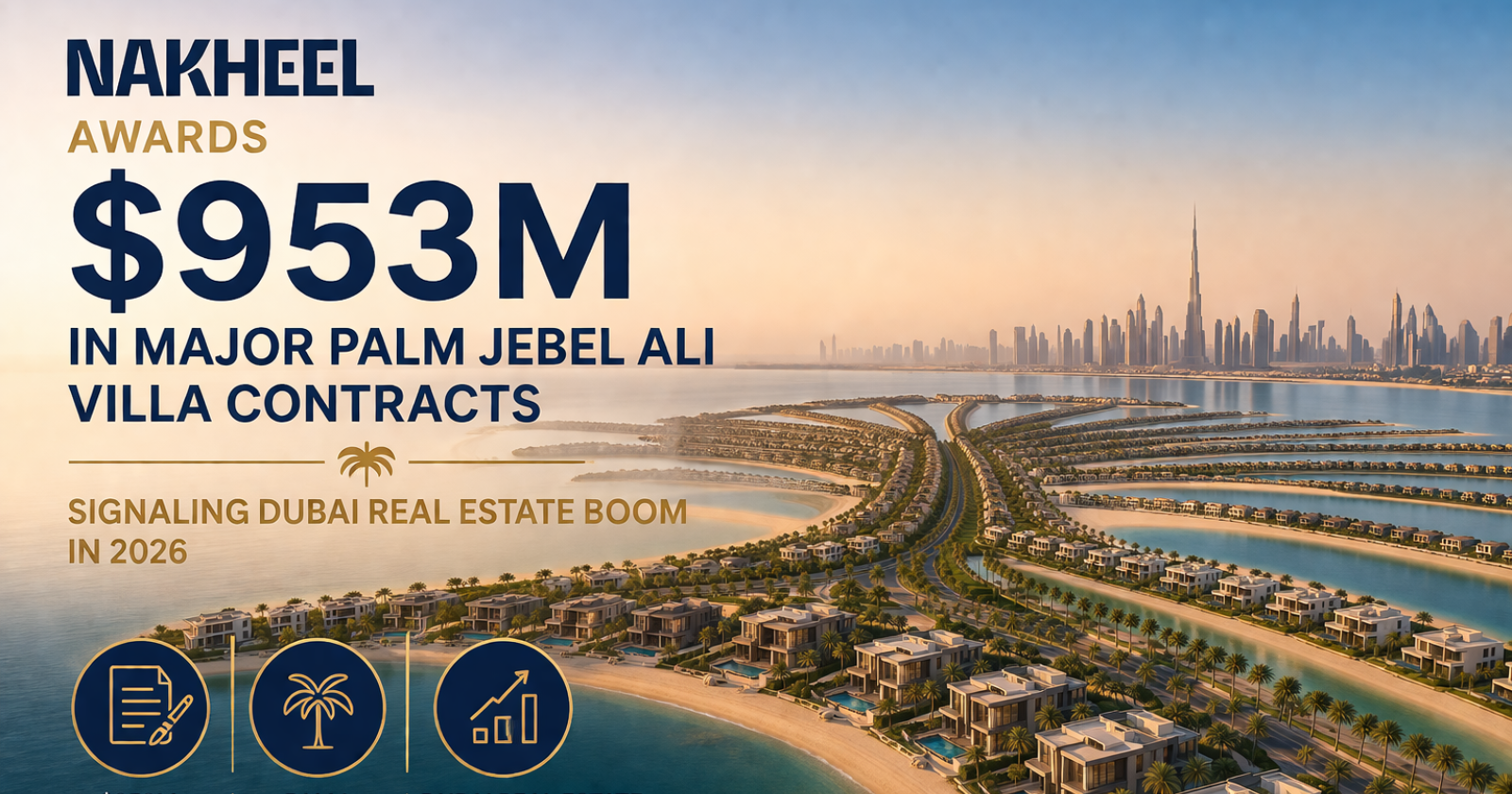
Nearly a billion dollars in construction contracts for a project first announced over two decades ago tells you something about the pace Dubai is now setting for its coastline. Nakheel’s latest move on Palm Jebel Ali turns what was once a stalled megaproject into one of the most capital-intensive residential builds currently underway in the Gulf.
The government-owned developer, operating under Dubai Holding’s real estate division, has signed agreements worth AED 3.5 billion ($953 million) with two contractors to build 544 villas across multiple fronds of Palm Jebel Ali. Construction begins in the second quarter of 2026, with handover targeted for late 2028.
What Is Palm Jebel Ali and Why It Matters for MENA
Palm Jebel Ali was originally unveiled in 2002 as the larger sibling to Palm Jumeirah, Dubai’s iconic man-made island. For years, the project sat dormant, a casualty of the 2008 financial crisis and shifting development priorities. Its revival signals a broader confidence in Dubai’s residential market and the emirate’s willingness to commit sovereign-backed capital to long-cycle real estate.
For the MENA region, Palm Jebel Ali represents more than waterfront luxury. It is a test of whether Dubai can replicate the commercial success of Palm Jumeirah at a time when residential demand is running near historic highs. Occupancy rates across Dubai’s residential sector are approaching 99%, according to recent REIT data, which means supply-side pressure is real and growing.
The project also carries geopolitical weight. The announcement followed remarks by Sheikh Mohammed bin Rashid Al Maktoum, UAE Vice President and Prime Minister and Ruler of Dubai, stating that the emirate will fast-track development despite regional tensions linked to the ongoing US-Israeli conflict involving Iran.
Nakheel’s AED 3.5 Billion Palm Jebel Ali Contract Breakdown
I find the structure of these contracts worth examining closely. Nakheel has split the work between two firms: Ginco General Contracting and United Engineering Construction, known as Unec. Ginco takes the larger share, overseeing 354 villas across Fronds A through D. Unec handles 190 villas on Fronds E and F.
The combined value of AED 3.5 billion ($953 million) makes this one of the largest single residential construction awards in Dubai this year. Khalid Al Malik, CEO of Dubai Holding Real Estate, confirmed that the contract awards mark concrete progress in advancing Palm Jebel Ali, with construction now underway across several fronds.
The timeline is tight but not unrealistic. Ground breaks in Q2 2026, and completion is targeted for Q4 2028. That gives contractors roughly 30 months to deliver, which aligns with standard villa construction cycles in the UAE provided supply chains hold steady.
| Detail | Ginco General Contracting | Unec |
|---|---|---|
| Villas Assigned | 354 | 190 |
| Fronds Covered | A, B, C, D | E, F |
| Combined Contract Value | AED 3.5 billion ($953 million) | |
| Construction Start | Q2 2026 | |
| Targeted Completion | Q4 2028 | |
This latest award follows a separate $144 million contract Nakheel signed for infrastructure and utility works on Island B within the Dubai Islands project, indicating a broader capital deployment cycle across the developer’s portfolio.
How the Palm Jebel Ali Build Actually Works
Splitting a 544-villa project between two contractors is a deliberate risk management strategy. By assigning distinct fronds to each firm, Nakheel avoids a single point of failure. If one contractor faces delays, the other fronds can still progress independently. I see this as a lesson learned from earlier megaproject cycles in the region where single-contractor dependency created cascading delays.
The frond-by-frond approach also allows phased handovers. Buyers on Fronds A through D could potentially receive units before those on E and F, giving Nakheel flexibility in managing cash flow and market absorption. Each frond functions almost as a self-contained neighbourhood, with its own access points and utility connections feeding off the central trunk infrastructure.
Dubai Land Department data cited in a January report indicates that Palm Jebel Ali is now expected to reach full completion by 2028. That timeline encompasses not just the villas but the broader island infrastructure, including roads, utilities, and public amenities.
What This Does Not Change
A nearly billion-dollar contract award does not mean Palm Jebel Ali is a finished product. The 544 villas represent one phase of a much larger masterplan. Retail, hospitality, and commercial components have not been detailed publicly, and their timelines remain unclear.
Nakheel has not disclosed villa pricing, payment plans, or whether units will be offered to international buyers on freehold terms. The broader question of how Palm Jebel Ali will differentiate itself from Palm Jumeirah, which commands some of the highest per-square-foot prices in the Middle East, also remains unanswered. Construction cost inflation across the GCC is another variable that could pressure margins or timelines if material prices spike.
Investors watching this space should note that a contract award is not a delivery guarantee. The 2028 target is ambitious, and regional supply chain disruptions remain a non-trivial risk.
The most immediate beneficiaries are the contractors themselves. Ginco and Unec now hold two of the largest residential construction mandates in Dubai, which strengthens their order books and positions them for future Nakheel work. For property investors and end-users, the benefit arrives later, likely in 2028 when units are delivered. Dubai’s broader economy gains from the construction activity itself, with thousands of jobs and significant material procurement flowing through local supply chains over the next two and a half years.
Palm Jebel Ali Fits Dubai’s Bigger Real Estate Ambition
I think this story connects directly to Dubai’s strategy of building supply ahead of demand rather than chasing it. With residential occupancy near 99% and population growth projections pointing upward, the emirate is betting that waterfront luxury inventory will find buyers well before completion. Palm Jebel Ali, alongside the Dubai Islands project, represents a deliberate expansion of the city’s coastline as a financial asset class. If delivery stays on schedule, Dubai will have added a significant volume of premium housing stock at precisely the moment demographic and capital inflow trends suggest it will be absorbed.
For those of us tracking MENA real estate capital flows, the Palm Jebel Ali contracts are worth watching not for the headline number but for what the delivery timeline and absorption rates will reveal about Dubai’s next growth cycle. If you are an investor or developer evaluating exposure to Dubai’s residential market, now is the time to study the frond-by-frond rollout closely and position accordingly.