
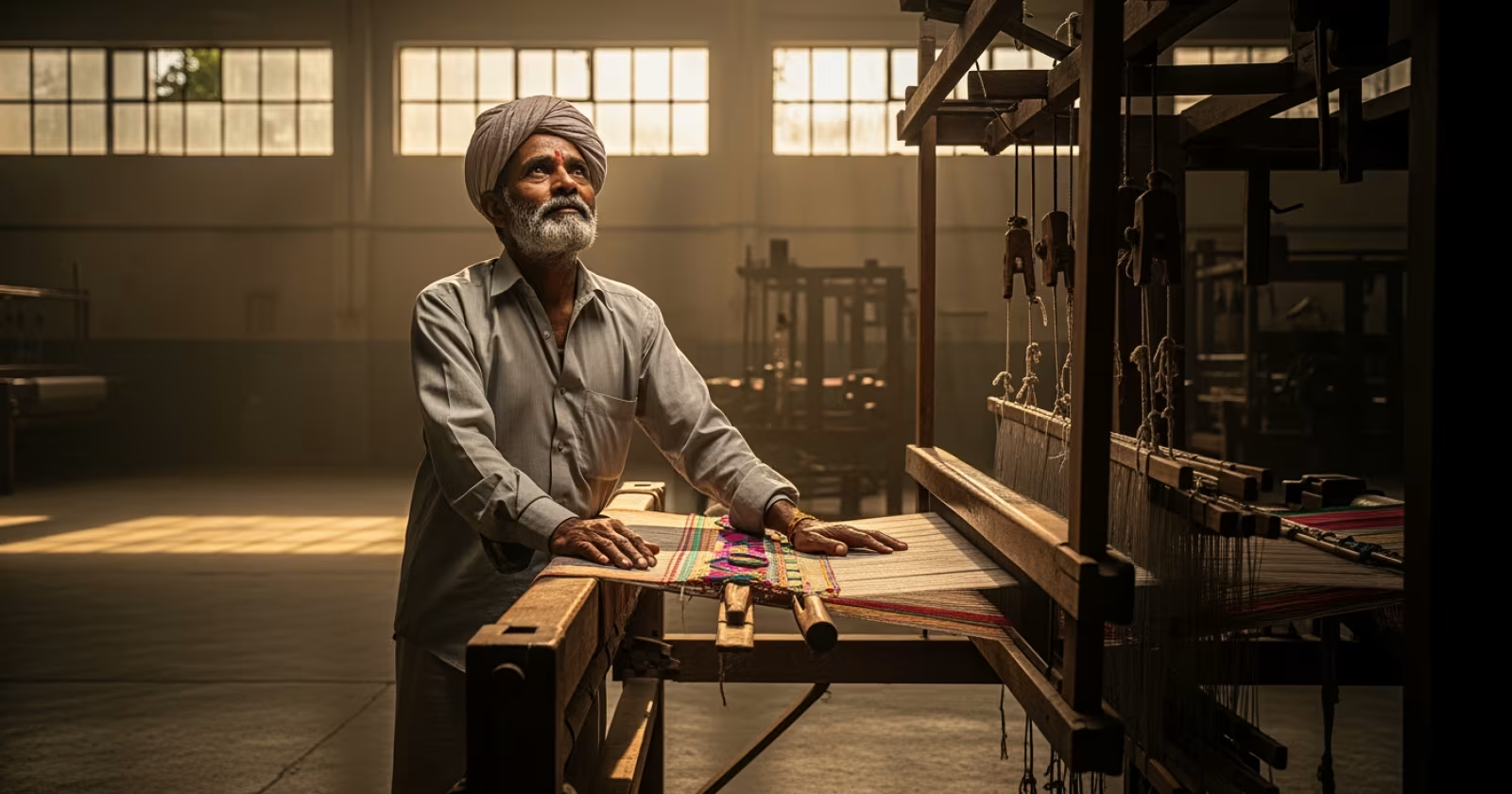
A master weaver in Varanasi can spend three months producing a single Banarasi silk sari worth ₹40,000 in a Delhi boutique — and walk away with less than ₹4,000 of that. The gap between what skilled hands create and what they earn has defined India’s handloom economy for generations — until a quiet ownership revolution began shifting that math entirely.
The Middlemen Who Built an Empire on Someone Else’s Thread
India‘s handloom sector employs roughly 3.5 million weavers, making it the second-largest rural employer after agriculture, according to the Ministry of Textiles, Government of India. For most of its modern history, that workforce operated inside a system engineered to keep them dependent. Yarn merchants advanced raw materials on credit at steep interest rates, while middlemen — locally called mahajans — collected finished cloth at fixed prices and sold it at multiples in urban and export markets.
A Chanderi silk weaver in Madhya Pradesh earning ₹200 a day in 2010 had no direct access to buyers, no capital to stock raw materials, and no legal recourse when mahajans graded work below its actual quality. The debt cycle was so entrenched that in several clusters, weavers inherited their financial obligations across generations — a condition formally documented by the Weavers Service Centres that the Government of India operates across 25 cities nationwide.
By the late 1990s, economists began calculating what the full value chain actually looked like in practice. A dhurrie rug from Rajasthan sold for ₹3,500 in a Mumbai export showroom while the weaver received ₹280 — nearly 92 percent of the final retail price absorbed by traders, exporters, and retailers combined. The weavers were the most essential and least compensated link in an extremely profitable chain.
How Pochampally Changed the Equation
The village of Pochampally in Telangana’s Nalgonda district became the clearest argument for weaver ownership in modern India. Famous for its double Ikat technique — a dyeing process so technically demanding it received a Geographical Indication tag in 2004 — Pochampally’s weavers had long supplied fabric sold in international markets while most families struggled to cover basic household expenses. Then the cooperative structure changed the terms of that relationship.
The Pochampally Handloom Weavers’ Cooperative Society, one of more than 400 registered cooperatives in the Nalgonda cluster, reorganized how income flowed through the community. Members pooled resources to purchase yarn directly from mills, cutting out the merchant markup entirely, and collectively marketed fabric under the Pochampally Ikat brand — a name that now commands recognition in London and Tokyo. They accessed subsidized raw materials through government schemes and retained a far larger share of every rupee the fabric eventually earned.
The Self Employed Women’s Association (SEWA), headquartered in Ahmedabad, demonstrated a parallel model across Gujarat’s textile sector. SEWA organized women weavers and embroiderers into producer collectives that negotiated directly with buyers, bypassing the layered intermediary chain entirely. By 2020, SEWA’s artisan members earned an average 40 percent more than comparable workers outside the collective — not because they worked harder, but because they captured more of the value they had always created.
The Numbers Behind the Revolution
What changed in cooperative-owned clusters was not the craft itself — it was the structure of who captured the profit at each stage of the chain. Weavers moved from wage receivers to margin holders, and that distinction produced concrete, documented outcomes across India’s major handloom geographies. The following data reflects income and structural changes recorded across several key clusters.
| Weaving Cluster | State | Cooperative Model | Reported Income Change |
|---|---|---|---|
| Pochampally Ikat | Telangana | Weavers’ Cooperative Society | Up to 3x increase in net household income |
| Chanderi Silk | Madhya Pradesh | NHDC-linked producer groups | 35–40% improvement in take-home earnings |
| Kutch Embroidery | Gujarat | SEWA collective marketing | 40% above non-member average income |
| Banarasi Silk | Uttar Pradesh | Weavers Service Centre support | 25% wage floor improvement |
| Kanjivaram Silk | Tamil Nadu | State cooperative retail model | Stable income through direct retail channels |
The National Handloom Development Corporation (NHDC), a Government of India enterprise established in 1983, became central to this structural shift by supplying yarn at subsidized rates directly to registered cooperative societies. When cooperatives controlled raw material procurement, the margin that previously flowed to traders remained inside the weaving community instead. That retained capital created something the old system had structurally prevented: the ability to save, reinvest, and borrow at rates far below what the informal credit market charged.
A Model That India’s Craft Economy Cannot Afford to Ignore
What Pochampally and SEWA demonstrated was not charity, nor government subsidy filling a market gap — it was the correction of a structural imbalance that had been treated as natural simply because it was old. India holds roughly 40 registered Geographical Indication tags for handloom textiles, from Pochampally Ikat to Muga silk from Assam’s Brahmaputra valley. Each of those tags represents a living craft tradition sustained by specific communities, and whether those communities prosper or merely survive depends almost entirely on who controls the production chain.
The cooperative model is not without serious friction. Mismanagement, political capture of societies, and chronic under-investment in marketing infrastructure have eroded several clusters — including portions of the Chanderi cooperative network, where irregular payment cycles pushed younger weavers back toward individual contractor arrangements with the same middlemen their parents had tried to escape. Ownership alone does not guarantee prosperity; governance determines whether that ownership is meaningful or ceremonial.
But the trajectory in well-functioning cooperatives is unmistakable and consistent across decades of evidence. When weavers collectively own the production chain, control pricing, and reach buyers without an intermediary layer absorbing the margin, the fundamental economics of the craft shift decisively in their favor. The factory, metaphorically and sometimes literally, belongs to the people who built it with their hands every single morning. India has run this experiment across dozens of districts and hundreds of thousands of looms. The results are in, and they are not ambiguous.
I’ve spent years tracking India’s craft economy, and the evidence from functioning cooperatives keeps pointing to the same conclusion: ownership structure is the single most powerful variable in weaver prosperity. Seek out cooperatively produced handloom fabric, look for the Handloom Mark, and pay attention to who actually controls the supply chain — not just the beauty of the cloth. That distinction is where the future of these traditions gets decided.