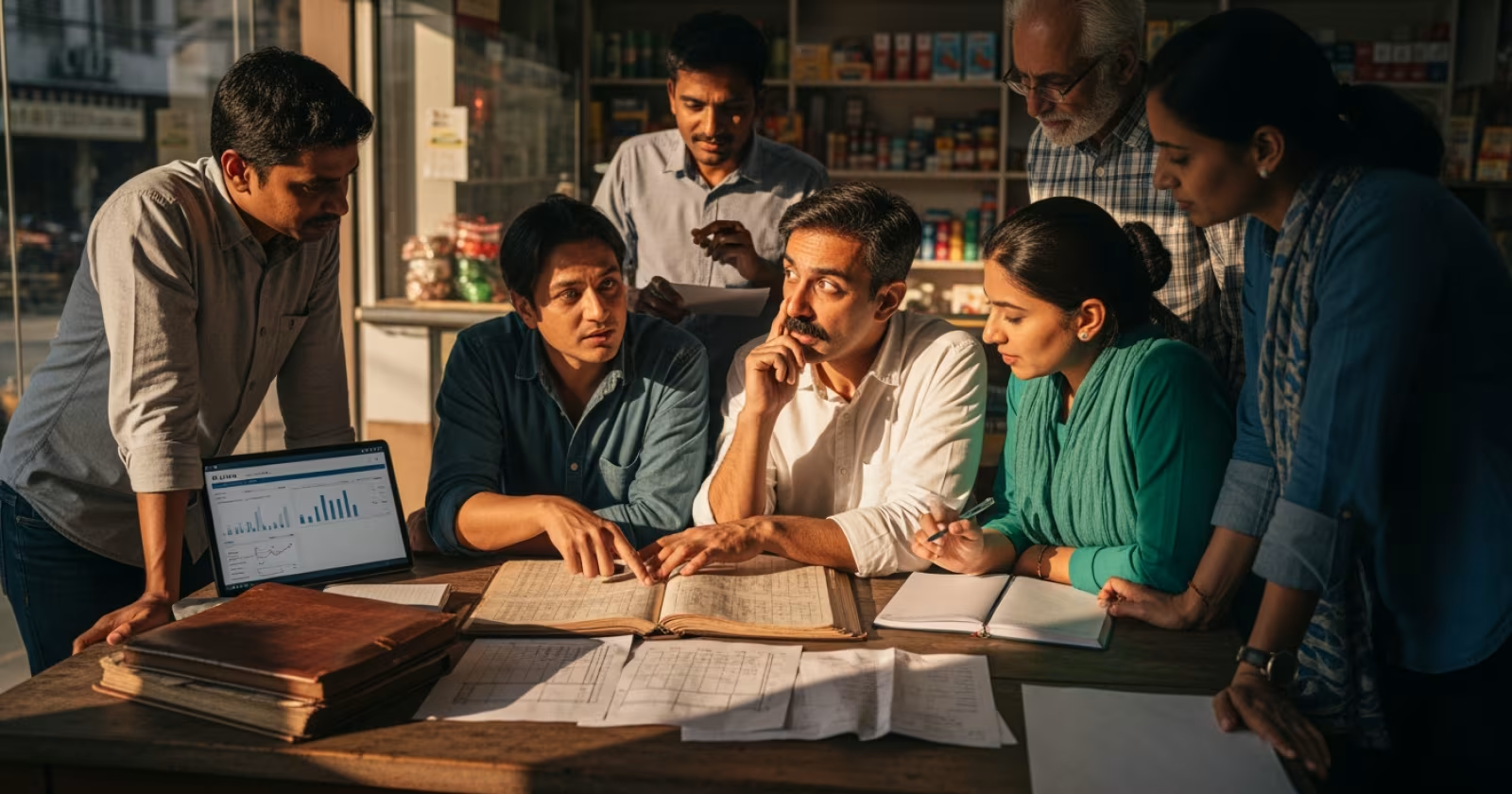
While Blinkit and Zepto were burning through hundreds of crores in venture capital to deliver groceries in 10 minutes, a business model born in a British mill town in 1844 was quietly outpacing both of them in the Indian heartland. Nobody in a Mumbai boardroom saw it coming — but the numbers in 2026 are impossible to ignore.
I started tracking this shift when Kendriya Bhandar outlets in Delhi began stocking the same product categories as BigBasket — at prices nearly 18 percent lower — and queues started forming outside them on weekday mornings. These government-backed cooperative stores, which most urban consumers had written off as relics of a socialist era, were suddenly relevant again. The cooperative model, formally codified in India through the Cooperative Credit Societies Act of 1904, had just turned 122 years old. And it had quietly returned to center stage.
The Origin Story Most Business Schools Skip
The cooperative model traces its formal roots to the Rochdale Society of Equitable Pioneers, a group of 28 weavers in Lancashire, England, who pooled resources in 1844 to buy food at fair prices. The idea was structurally simple: members owned the enterprise, shared its surpluses, and bought collectively to eliminate exploitative middlemen. It spread across Europe within decades, then crossed into colonial India — where the British administration codified it through the 1904 act, making it one of the oldest structured business frameworks still active on Indian soil.
In India, the model gained real muscle through the dairy sector. Verghese Kurien and Tribhuvandas Patel built AMUL in Anand, Gujarat, starting in 1946 — teaching millions of rural farmers to collectively negotiate, process, and brand their own milk. By 2026, AMUL’s annual revenues have crossed ₹80,000 crore, making it India’s largest food brand by turnover. What Kurien understood, and what Silicon Valley’s retail disruptors repeatedly forget, is that the cooperative’s fundamental edge is not technology. It is ownership.
Why 2026 Became the Tipping Point
The Indian government created a standalone Ministry of Cooperation in July 2021 — the first time in independent India’s history that cooperatives commanded their own cabinet-level portfolio. By 2026, the downstream effects of that structural decision have become visible on high streets and village mandis alike. The National Cooperative Consumer Federation of India (NCCF) has expanded to over 4,500 retail outlets across 14 states, and the “Sahakar se Samridhi” initiative has directed substantial capital into cooperative infrastructure at the district level.
The timing aligned with a widespread consumer fatigue toward quick-commerce platforms. After years of convenience-at-any-cost pricing, Indian households — particularly in Tier 2 and Tier 3 cities — began recalibrating their spending decisions. Cooperative retail does not offer 10-minute delivery. What it offers is trust, member ownership stakes, and prices that private retail structurally cannot match, because there is no profit margin being extracted for a foreign venture fund waiting on a return. Foot traffic at cooperative outlets in Jaipur, Bhopal, and Coimbatore reportedly rose between 22 and 31 percent from 2024 to 2026, according to figures from the Ministry of Cooperation’s annual operational review.
How AMUL’s Retail Push Changed the Rules
AMUL’s pivot toward direct retail has been the most closely watched story in Indian fast-moving consumer goods this decade. The cooperative launched over 10,000 branded parlors by mid-2026, selling not just dairy but packaged staples, ready-to-eat meals, and fresh produce. Its logistics network — built on four decades of cold-chain investment — now rivals any private quick-commerce player in refrigerated delivery capacity. What particularly startled analysts was AMUL’s margin retention: because the supply chain is owned by the cooperative itself, surpluses stay within the producer-member community rather than leaking to external shareholders.
That success has inspired a new generation of sector-specific cooperatives. Fishermen’s cooperatives in Kerala have launched branded seafood retail under the Matsyafed umbrella, cutting out four layers of middlemen overnight. Organic farming cooperatives in Sikkim and Uttarakhand have listed products directly to urban consumers through the Open Network for Digital Commerce (ONDC), bypassing conventional distributor chains entirely. A cooperative manager I spoke with in Nashik described the shift plainly: “We spent 60 years selling to someone else’s brand. Now we are the retailer.”
| Cooperative Body | Sector | Scale (2026) | Key Structural Advantage |
|---|---|---|---|
| AMUL, Gujarat | Dairy & FMCG | 10,000+ retail parlors | End-to-end supply chain ownership |
| NCCF (National) | General Retail | 4,500+ outlets, 14 states | Government-backed pricing power |
| Matsyafed, Kerala | Seafood Retail | 350+ branded outlets | Direct fisher-to-consumer pricing |
| Organic Cooperatives, Sikkim | Organic Produce | Active on ONDC platform | Zero-pesticide certified sourcing |
The Structural Advantage Private Retail Cannot Replicate
Private retail chains and quick-commerce platforms operate on a fundamental tension: they must satisfy investors before they can satisfy customers. Cooperatives face no such conflict. Every rupee of surplus generated is either reinvested into operations or returned to members — farmers, artisans, fishermen, and consumers who are themselves partial owners of the enterprise. This alignment is not a philosophy or a marketing message. It is a financial architecture that changes how pricing, quality control, and reinvestment decisions get made at every level of the supply chain.
The National Cooperative Union of India estimates that cooperative enterprises currently touch the economic lives of over 290 million Indians. That number is growing — not because of advertising budgets or influencer campaigns, but because the model consistently delivers tangible financial returns to communities that private retail never prioritized. AMUL’s story, now being replicated across fisheries, cotton, handlooms, and organic produce, makes a compelling case that the oldest modern business framework may also be the most structurally durable of all.
Tracking this shift closely matters, because the cooperative’s return is neither a government scheme nor a nostalgic experiment. It is a structural correction in how Indian retail has allocated value for three decades. Anyone serious about consumer India will want to follow this story deep into 2027 — and perhaps revisit every assumption about what disruption in retail actually requires to last.