
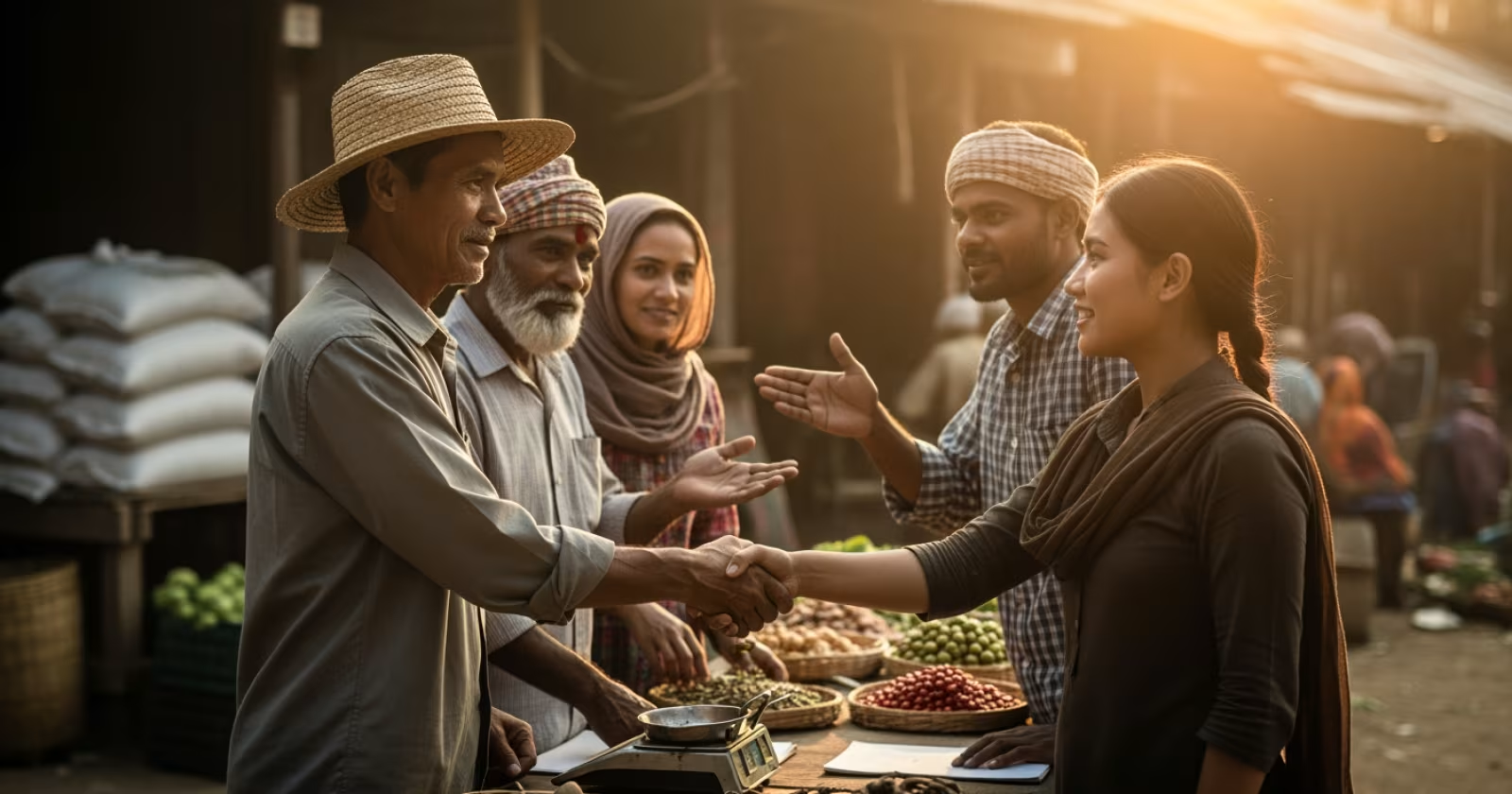
In the summer of 2023, soybean farmers in Harda district, Madhya Pradesh, watched helplessly as local traders offered them ₹3,800 per quintal — roughly 30% below the government’s minimum support price. By the following rabi season, those same farmers were selling directly through their newly registered cooperative at ₹5,200 per quintal, pocketing an additional ₹14,000-₹18,000 per acre. The middlemen who had controlled Harda’s mandi yards for decades suddenly found themselves irrelevant. I’ve tracked cooperative movements across central India for years, and what happened in Harda isn’t an isolated miracle. It’s a pattern — one that’s accelerating faster than most policy analysts expected.
Why Cutting Out Middlemen Matters at Scale
India’s agricultural supply chain has long been defined by a brutal arithmetic. Farmers receive, on average, only 25-30% of the final consumer price of their produce. The rest evaporates across layers of aggregators, commission agents (arhatiyas), transporters, and wholesale dealers. The Ministry of Cooperation, established in 2021 under Amit Shah, has made dismantling this chain a stated priority — channelling produce through cooperative networks instead.
The numbers are staggering. India has over 1.02 lakh Primary Agricultural Credit Societies (PACS) spread across nearly every block. Yet until recently, most PACS functioned as little more than credit dispensaries. The government’s plan to convert them into multi-service centres — handling procurement, storage, and even retail — is what’s turning villages like those in Harda into test cases for a much larger experiment.
How the Cooperative Model Was Born in Harda
The story in Harda didn’t begin with a government scheme. It began with frustration. In 2022, a group of approximately 40 soybean and wheat farmers pooled ₹2,000 each to register a cooperative society under the Madhya Pradesh Cooperative Societies Act. Their initial goal was modest: collectively negotiate transport costs to the nearest mandi in Bhopal, cutting out the local trader who charged a 6% commission on every transaction.
Within six months, the cooperative — with guidance from a young agricultural graduate posted under the state’s rural extension programme — realised they could do more. They applied for and received a ₹12 lakh warehouse loan through NABARD’s Warehouse Infrastructure Fund. A simple 200-tonne godown, built on panchayat land, meant they no longer had to sell at harvest-time lows. They could store, wait, and sell when prices climbed. This single infrastructure decision changed the economics entirely.
By early 2024, membership had grown to 185 farmers. The cooperative registered with NAFED as a procurement agency for government purchases, giving members direct access to MSP operations without any intermediary. The model wasn’t new — Amul had proven it decades ago with milk — but applying it to dryland oilseed farming in a semi-arid district was genuinely novel.
The Mechanics: How Farmers Actually Benefit
I find that most cooperative stories gloss over the operational details, which is precisely where the real value lies. Here’s how the Harda model works in practice.
| Parameter | Before Cooperative (2022) | After Cooperative (2024-2026) |
|---|---|---|
| Average sale price (soybean/quintal) | ₹3,600–₹4,000 | ₹4,800–₹5,400 |
| Commission to middlemen | 5–7% | 0% (1.5% cooperative fee) |
| Transport cost per quintal | ₹180 (individual) | ₹95 (collective) |
| Access to MSP procurement | Rare (traders blocked access) | Direct via NAFED registration |
| Post-harvest storage | None (distress selling) | 200-tonne godown on-site |
| Credit access | Moneylender at 24–36% p.a. | PACS linkage at 7% p.a. |
Members pay a one-time ₹2,000 share and an annual ₹500 membership fee. The cooperative retains 1.5% of every sale as operating margin. Surplus — after paying for the godown loan, a full-time manager’s salary, and transport — is distributed as a dividend. In 2026, members received approximately ₹1,100 each as year-end surplus, modest but symbolically powerful.
The cooperative also negotiated bulk input purchases. Fertiliser and certified seeds bought collectively cost 12-15% less than what individual farmers paid at local dealers. This upstream saving, often overlooked, adds another ₹2,000-₹3,000 per acre to the effective income gain.
What Threatens to Break the Model
I’d be dishonest if I painted this as a frictionless success story. The Harda cooperative faces three specific pressures that mirror challenges across India’s cooperative landscape.
First, political capture. As the cooperative’s influence grew, local political figures attempted to install allies on the managing committee during the 2026 elections. This is the single most common disease in Indian cooperatives — elected boards that serve political networks rather than member interests. The NCDC has flagged governance reform as critical, but enforcement remains weak at the state level.
Second, climate volatility. Harda received 40% below-normal rainfall in the 2024 kharif season. Soybean yields dropped sharply, and the godown sat half-empty. A cooperative that depends on volume throughput for its revenue model is inherently vulnerable to production shocks. Crop insurance penetration among members remains below 35%.
Third, digital infrastructure gaps. The government’s push to digitise PACS through the national cooperative database requires reliable internet connectivity and basic digital literacy. In Harda’s interior villages, neither is guaranteed. Without digital record-keeping, the cooperative struggles to access formal credit lines that require audited transaction histories.
A Parallel From Maharashtra Shows What’s Possible
Compare Harda with Washim district in Maharashtra, where a soybean cooperative established in 2018 has scaled to over 1,200 members across 14 villages. The Washim cooperative went a step further — it invested in a small oil extraction unit, selling branded soybean oil directly to urban retailers through an e-commerce tie-up. The value addition pushed farmer returns to nearly ₹7,000 per quintal equivalent, almost double the raw commodity price.
The lesson is clear: cooperatives that stay in raw commodity trading capture only part of the value chain. Those that move into processing and branding capture dramatically more. The NCDC has a dedicated fund for cooperative agro-processing, disbursing approximately ₹2,400 crore in 2026-26, but uptake remains concentrated in states like Maharashtra, Gujarat, and Kerala. Madhya Pradesh cooperatives have been slower to apply.
What the Next Five Years Look Like
The Ministry of Cooperation’s target of computerising and converting all 1.02 lakh PACS into multi-service centres by 2027 is ambitious but directionally correct. If even 30% of these conversions succeed operationally — not just on paper — it would represent the largest disintermediation event in Indian agriculture since the Green Revolution’s institutional reforms.
Technology will matter. NABARD is piloting blockchain-based commodity tracking in select cooperatives, which could eventually allow members to prove provenance and access premium markets. Drone-based crop assessment, already being tested in Rajasthan and Telangana, could make cooperative-level crop insurance viable and affordable.
But the fundamental variable remains governance. Every successful cooperative I’ve studied shares one trait: a managing committee that is genuinely accountable to its members rather than to an external political patron. Without enforceable governance standards — term limits, mandatory audits, transparent elections — the technology layer is irrelevant.
Back to Harda
When I last checked on the Harda cooperative in early 2026, membership had crossed 220. They were in discussions with a Bhopal-based food processing company to supply cleaned, graded soybean directly — a contract that would guarantee a floor price regardless of mandi fluctuations. The godown had been expanded to 350 tonnes with a second NABARD tranche.
The middlemen haven’t disappeared from Harda’s weekly market. They still operate, serving farmers who haven’t joined the cooperative or who need instant cash without waiting for cooperative payment cycles. But their pricing power has collapsed. When farmers have an alternative, the market corrects itself. That, ultimately, is the cooperative argument in its simplest form — not ideology, not charity, just leverage.
If you’re involved in a farmer producer organisation or a village-level cooperative anywhere in India, I’d encourage you to study what’s working in districts like Harda and Washim. The operational blueprints exist. The funding channels through NCDC and NABARD are open. The hardest part isn’t money or technology — it’s trusting your neighbours enough to build something together. Start there.