
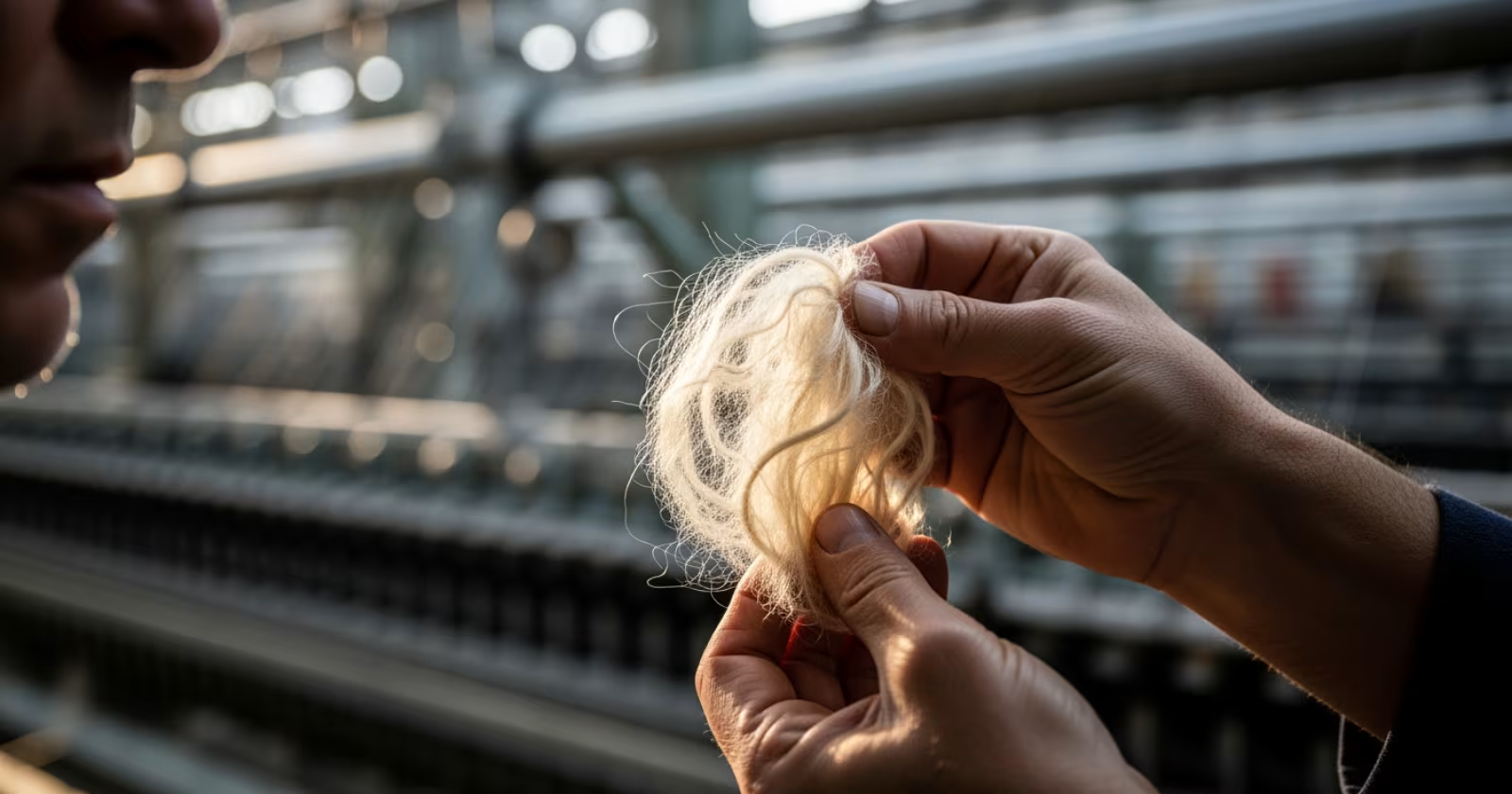
Wood-based fibre technology has been inching toward commercial scale for years. Spinnova’s decision to begin trial runs at the Woodspin demo factory in Jyväskylä, Finland signals that the gap between pilot promise and production reality is now being tested under genuine operating conditions.
I’ve been tracking this company’s scaling trajectory closely, and the April 9, 2026 announcement carries more technical weight than a standard progress update. The trial runs are not exploratory — most of the technological solutions being evaluated have already been validated at a smaller pilot scale. What this phase does is confirm whether those solutions hold up at the next level of production intensity.
For brand sourcing teams and fibre buyers who have been evaluating SPINNOVA® fibre as a sustainable alternative to conventional cotton or viscose, that distinction matters considerably.
What Is SPINNOVA® Fibre and Why Scale-Up Matters for Textile Manufacturing
SPINNOVA® fibre is produced from microfibrillated cellulose (MFC) derived from wood. Unlike lyocell or viscose, the production process avoids chemical dissolution — the fibre is formed through a mechanical process that Spinnova states eliminates harmful solvents from the manufacturing chain.
That positions it differently from most cellulosic alternatives currently available to mills. The absence of chemical dissolution steps is a meaningful production advantage on paper, but it also means the mechanical process must be optimised rigorously before it can run at industrial throughput without quality compromise.
That is precisely the challenge the Woodspin demo factory is designed to address. Scaling from pilot to demo to industrial is where most novel fibre technologies either prove themselves or stall.
Spinnova Begins Trial Runs as SPINNOVA® Fibre Production Targets Industrial Scale
Spinnova confirmed on April 9, 2026 that trial runs are now beginning at the Woodspin demo factory in Jyväskylä, with production efficiency as the primary focus. The company stated that most technological solutions being evaluated during these trials have already demonstrated success at a smaller pilot scale.
CEO Janne Poranen described the trial runs as a “key phase in delivering SPINNOVA® fibre to customers and scaling our technology to an industrial level.” The company’s stated goal is to restart production on a larger scale during 2026, based on results achieved through these trials.
This follows Spinnova’s acquisition of full ownership of the demo factories of Woodspin Oy and Suzano Finland Oy — now operating as Spinnova Refining Oy — completed in October 2026. Together, these two facilities provide the integrated infrastructure for both preparing the MFC raw material and producing SPINNOVA® fibre.
| Entity | Role in Production Chain | Ownership Status |
|---|---|---|
| Woodspin Oy (demo factory) | SPINNOVA® fibre production | Fully owned by Spinnova since Oct 2026 |
| Spinnova Refining Oy (formerly Suzano Finland Oy) | MFC raw material preparation | Fully owned by Spinnova since Oct 2026 |
| Pilot facility | Technology validation at smaller scale | Existing Spinnova operation |
How the Demo Factory Trial Runs Approach Production Efficiency
The trial run phase is designed to validate, not discover. Spinnova’s language is deliberate: the technologies being tested are not new concepts but proven pilot-scale solutions being applied at the demo factory’s higher throughput environment.
In cellulosic fibre production, the jump from pilot to demo scale frequently exposes process instabilities that small-scale equipment masks. Flow dynamics, drying consistency, and fibre quality uniformity behave differently when production volumes increase. The mechanical MFC processing underpinning SPINNOVA® fibre is no exception to this scaling challenge.
I read CEO Poranen’s step-by-step ramp-up framing as a deliberately controlled approach rather than an accelerated push — and in technically complex fibre manufacturing, that measured strategy typically produces better long-term results than aggressive scaling timelines.
What These Trials Do Not Yet Confirm for Mill and Brand Partners
The announcement confirms trial run commencement and a production restart target within 2026. It does not confirm production volumes, fibre yield rates, or specific quality specifications that mill buyers would require before committing to sourcing agreements.
Certifications applicable to SPINNOVA® fibre at commercial scale were not referenced in this announcement. Brand partners evaluating the fibre for sustainable collections should treat the 2026 production restart as a development milestone, not a confirmed commercial supply date.
The timeline from trial run results to actual larger-scale production restart introduces further variability. If trial data requires additional process adjustments, the restart window could shift.
Brands with active sourcing pipelines dependent on this fibre should maintain contingency planning with alternative cellulosic suppliers while the demo factory ramp-up proceeds.
Who Stands to Benefit When SPINNOVA® Fibre Reaches Commercial Scale
Apparel brands with confirmed sustainability sourcing commitments are the most direct beneficiaries once SPINNOVA® fibre production stabilises commercially. Premium and mid-market brands seeking wood-based, solvent-free cellulosic alternatives to viscose or conventional cotton have limited options at commercial scale today. Mills in Scandinavia and Central Europe, where sustainable fibre sourcing is increasingly a customer requirement rather than a preference, are logically positioned as early partners.
Consolidated Ownership and the Shift Toward Vertically Controlled Sustainable Fibre Supply
Spinnova’s acquisition of full ownership across both demo factory entities was a strategically important move that the current trial phase now makes more operationally legible. Controlling both the MFC preparation step and SPINNOVA® fibre production under a single ownership structure removes a coordination layer that can slow decision-making at critical scaling moments.
I see this as part of a broader pattern in novel sustainable fibre development: companies that retain full process control at the manufacturing level have a cleaner path to quality consistency and cost optimisation than those operating through multi-party production arrangements.
The trial run results — expected to guide the larger-scale production restart within 2026 — will be the most technically meaningful data Spinnova has generated in its commercial development arc to date.
If you are evaluating sustainable cellulosic fibres for 2026 sourcing decisions, I’d recommend requesting a direct technical briefing from Spinnova as trial data becomes available — the production efficiency improvements being validated now will define the fibre specifications that mills and brands will be working with at commercial scale.