
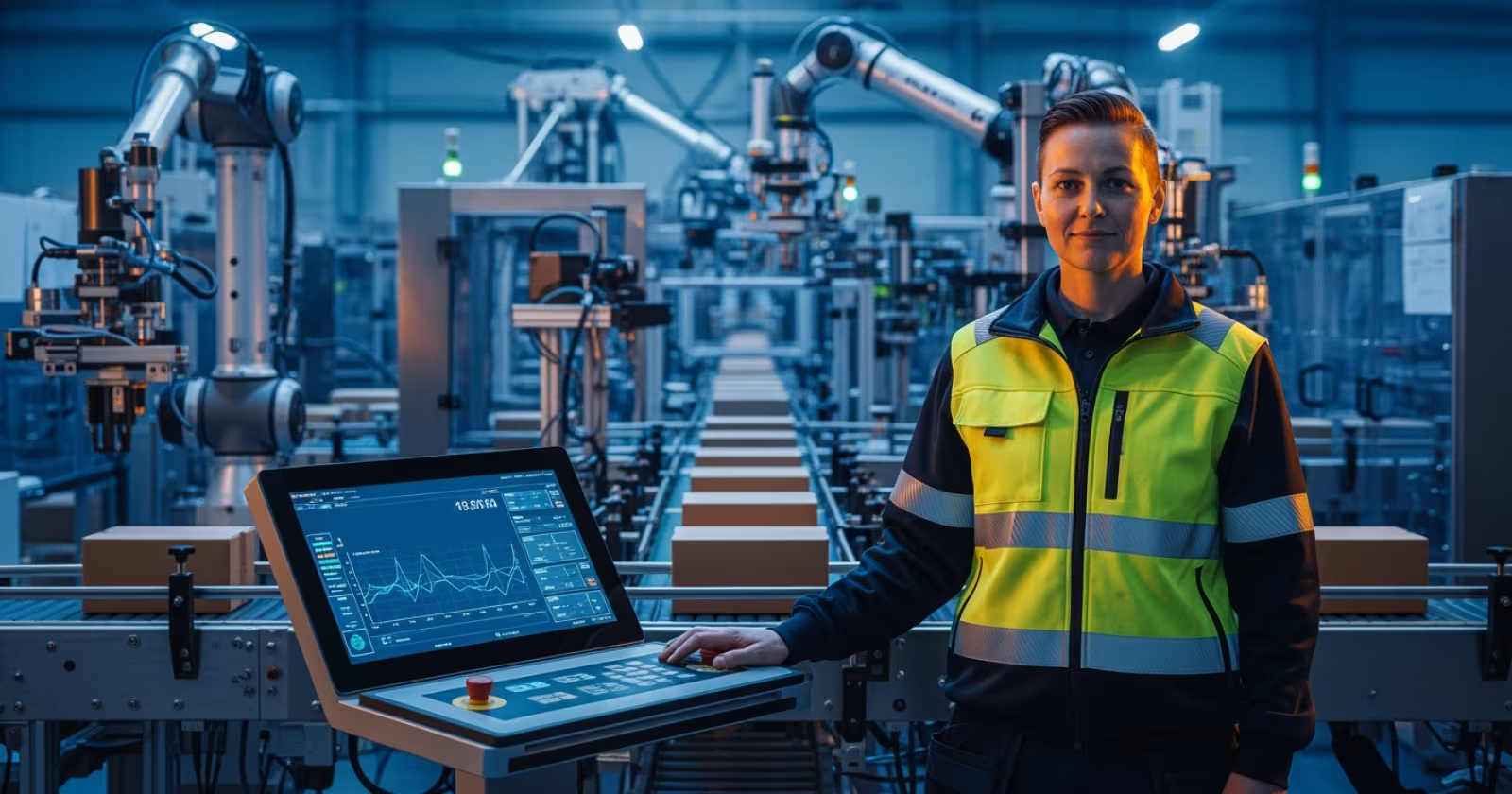
For Australian FMCG manufacturers, the gap between those who have already automated and those still running labour-heavy production lines is widening faster than most operations managers want to admit. Rising input costs, constrained margins, and a domestic retail environment that rewards volume efficiency over manual process have pushed automation from capital project to competitive necessity.
I’ve been tracking this shift closely, and what strikes me most is how the ROI conversation has changed. The question is no longer whether automation pays for itself — the evidence across throughput, quality, safety, and labour reallocation is clear enough. The real question is how to sequence the investment to capture returns as early as possible in the capital cycle.
Why Australian FMCG Manufacturers Can No Longer Defer Automation
Australia’s food and grocery manufacturing sector is under structural pressure on multiple fronts simultaneously. Retail buyers at Coles, Woolworths, and Aldi are applying consistent cost-per-unit discipline. Labour availability and wage costs have tightened considerably. And quality expectations for both domestic shelf placement and export markets — particularly into Asia — have lifted well beyond what inconsistent manual production can reliably meet.
Manual production lines carry hidden costs that are easy to undercount in a capital proposal. Inconsistent output quality, high rework rates, workplace injury exposure, and the compounding drag of human error at scale all accumulate quietly. In high-volume FMCG environments, a single quality failure affecting a major grocery listing can cost more than a full year of automation capital repayments.
RML Machinery’s position — developed across New Zealand and Australian manufacturing environments — is that production automation is not a single technology decision. It is a disciplined process of identifying the highest-return interventions and building from there. That framing matters because it makes automation accessible to mid-tier manufacturers who cannot fund a full-facility overhaul within one capital cycle.
Where Automation Delivers the Fastest Returns for Food and Goods Producers
Not all automation investments carry the same payback profile, and treating them as interchangeable is one of the more expensive mistakes I see in capital planning. Three areas consistently deliver measurable, near-term returns for FMCG producers based on RML’s operational focus.
End-of-line solutions — covering packaging, palletising, and dispatch preparation — are often the fastest to generate ROI because they sit at the highest-labour, lowest-value-add point of most production facilities. Robotic systems applied to picking, filling, and labelling deliver consistency gains that translate directly into lower waste rates and fewer customer rejections. Customised machinery, designed around a facility’s specific product formats and line configuration, captures the efficiency gains that off-the-shelf solutions routinely miss.
| Automation Area | Primary ROI Driver | Typical FMCG Application |
|---|---|---|
| End-of-line solutions | Labour cost reduction, throughput increase | Packaging, palletising, wrapping, dispatch |
| Robotic systems | Consistency, waste reduction, safety improvement | Pick and place, filling, labelling |
| Customised machinery | Line integration, format flexibility | Unique product lines, high-SKU operations |
What the Investment Side of the Equation Actually Covers
One of the most common misframings I encounter in automation decisions is treating the equipment purchase price as the total cost. It isn’t, and modelling it that way leads directly to ROI shortfalls that get blamed on the technology rather than the budgeting. A complete investment assessment needs to account for installation, systems integration, operator training, and the change management required to shift a production workforce into new working patterns.
Those are real costs and they deserve honest modelling. But they are also largely one-time costs set against ongoing annual savings in labour, waste, and quality rework — savings that compound over the life of the machinery. RML’s emphasis on systems that integrate into existing operations with minimal downtime during installation addresses one of the most underweighted line items in any automation proposal: lost production time during the cutover period.
For any producer running five-day or seven-day production schedules, installation downtime is a direct, calculable cost. It belongs in the ROI model from day one, not as a footnote.
What Automation Does Not Fix on Its Own
I want to be direct about the limits here, because enthusiasm around automation can outrun operational reality. Automation does not solve poor process design — it accelerates it. A badly structured production flow becomes a faster, more expensive badly structured production flow when robotics are installed on top of it without a process review first.
Automation also shifts the labour requirement rather than eliminating it. Headcount moves from repetitive manual tasks toward higher-skill roles in machine operation, programming, and maintenance. Manufacturers need to plan for that capability transition deliberately. Payback periods also vary by project — any supplier quoting a fixed timeline before conducting a proper site assessment is working from assumptions, not data.
Who Gains Most and On What Timeline
Mid-tier FMCG manufacturers — those producing at meaningful volume but not yet at multinational scale — arguably stand to gain the most from a specialist automation partner. Large manufacturers carry in-house engineering capability. Small producers often lack the volume to justify the capital. The manufacturers in the middle are precisely where a well-structured automation project can shift the unit economics materially, and where RML’s turnkey and customised approach is most directly applicable.
Automation’s Place in the Structural Shift Reshaping Australian FMCG Production
The case for automation in Australian FMCG manufacturing is only strengthening at the structural level. Retail consolidation has reduced the number of major buyers and increased their leverage over cost-per-unit. Export growth into Asian markets requires the consistency and volume reliability that manual lines cannot sustainably deliver at competitive price points. And the domestic labour market has made the old model of absorbing volume growth through headcount increasingly difficult to sustain year on year.
Automation is not a hedge against those pressures — it is the practical operational response to them. Manufacturers who treat it as a future consideration rather than a current priority are already competing at a cost disadvantage that compounds with every quarter they wait.
If you are evaluating where automation delivers the fastest payback for your facility, I’d encourage starting with a structured assessment of your end-of-line operations and robotic potential — and then engaging RML Machinery directly to work through what a practical, site-specific solution looks like for your production environment and growth targets. The manufacturers moving fastest on this right now are not the largest ones. They are the ones who stopped waiting for certainty and started with a scoped, sequenced plan.