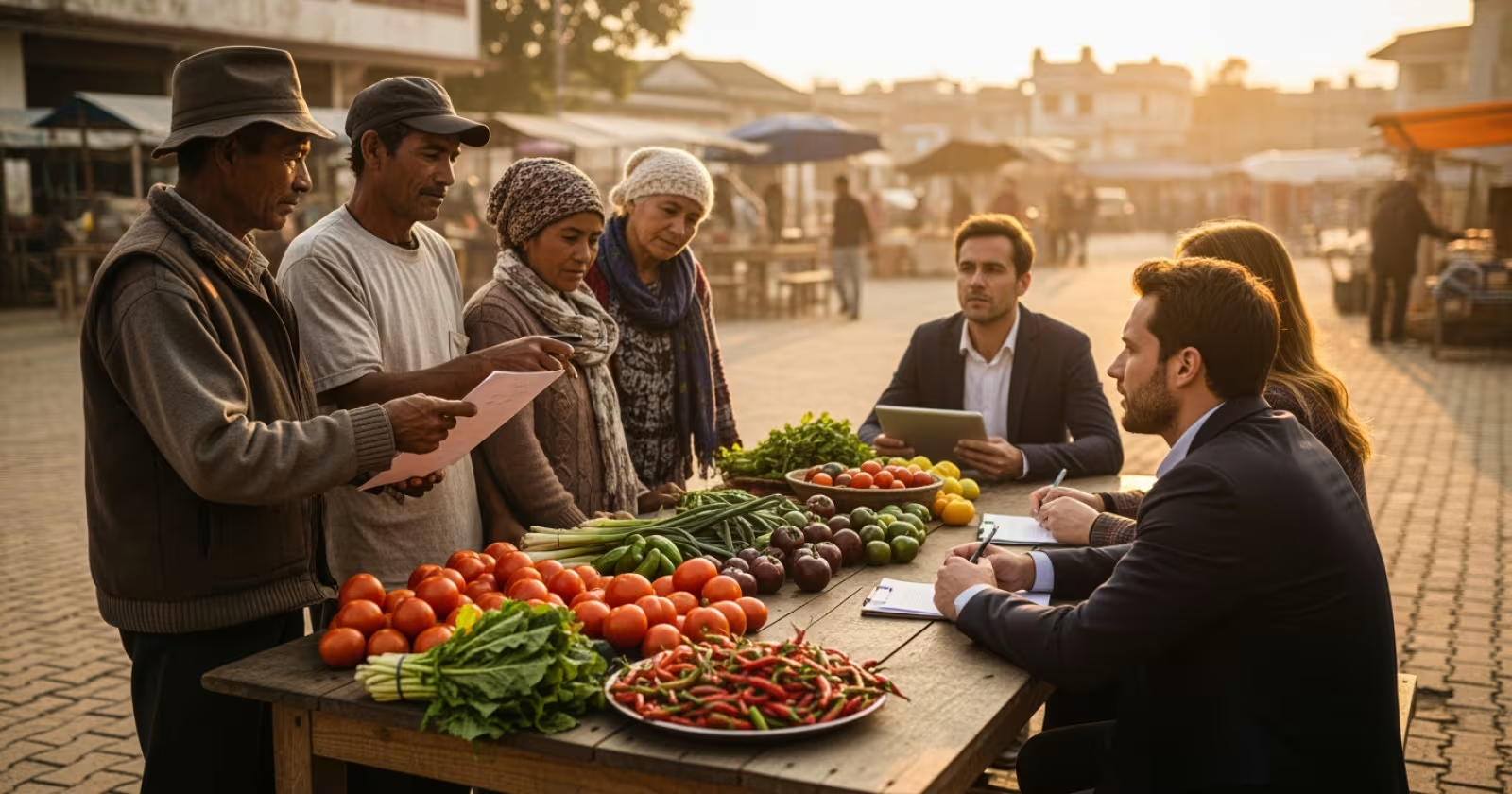
The lakadong turmeric grown in Meghalaya’s Jaintia Hills contains up to 7.5 percent curcumin — nearly three times the concentration found in most commercial varieties and a figure that makes it the most chemically potent turmeric on earth. For three decades, that extraordinary quality translated into almost nothing for the farmers who grew it, because corporate traders from Guwahati, Delhi, and Kolkata arrived each harvest season, named a price no one in a remote hill village could dispute, and drove away with truckloads of what international buyers would later pay fortunes to secure.
That arrangement has fractured — not through legislation or protest, but through a precise and patient reorganization of how smallholder farmers in Meghalaya grow, certify, and sell what their land produces. I followed this story across multiple reporting threads from the region, and what surprised me most was not the scale of the change but the near-total silence in which it happened.
The Architecture of Dependence That Ran for Decades
For most of the last century, agricultural trade in Northeast India was structured to exhaust the grower before they could accumulate anything. Farmers spread across remote villages in West Khasi Hills, Ri Bhoi district, and the Garo Hills had no cold storage, no reliable road links to urban markets, and no legal knowledge to challenge price manipulation when it arrived smiling at the farmgate. Corporate buyers — and local commission agents working for large spice conglomerates — exploited that geographic and informational isolation with precision, setting purchase prices just barely above production cost.
A 2022 assessment by NABARD on Northeast India’s agricultural economy estimated that farmers in Meghalaya received only 18 to 22 percent of the final retail price of their produce, with the remaining value absorbed across layers of intermediaries. That figure held steady for over two decades. Post-harvest losses ran as high as 30 percent in some highland districts simply because no infrastructure existed to slow spoilage between harvest and sale, which further compressed the margin farmers had to work with.
When a Legal Certificate Became the Sharpest Tool in the Shed
The first serious crack appeared when Lakadong turmeric received a Geographical Indication (GI) tag from India’s Intellectual Property Office. A GI tag operates like a protected trademark bound to geography — the same mechanism that prevents any wine outside the Champagne region of France from legally using that name. Once Lakadong turmeric held that protected status, farmers gained legal standing to market their product under a name no corporate trader could replicate or dilute, and that immediately created price differentiation in export markets that middlemen had quietly controlled for years.
Farmer collectives organized under the North East Rural Livelihoods Project and supported by the Meghalaya Basin Development Authority began using GI certification to approach international buyers directly. The Agricultural and Processed Food Products Export Development Authority (APEDA) facilitated introductions to organic spice importers in Germany, Japan, and the United States — buyers who were already paying premium prices and actively seeking verified, high-curcumin turmeric. By early 2026, certified Lakadong turmeric was fetching ₹350 to ₹420 per kilogram in direct export transactions, compared to ₹90 to ₹110 per kilogram from domestic traders just four years earlier.
Women, Cold Chains, and the Infrastructure That Made the Numbers Real
The price shift did not happen on the strength of the GI tag alone — it required simultaneous construction of Farmer Producer Organizations (FPOs) at the village level, many of them led entirely by women. Meghalaya’s matrilineal social structure, practiced by the Khasi and Jaintia communities, channels property rights and clan identity through the maternal line. That cultural tradition translated, in practical economic terms, into women taking the lead when Self-Help Groups began converting into formally registered FPOs with collective bargaining authority and the legal standing to sign procurement contracts.
The state government’s Integrated Basin Development and Livelihoods Programme funded cold storage units across Ri Bhoi, East Jaintia Hills, and West Khasi Hills districts between 2023 and 2024, cutting post-harvest losses that had previously erased up to 30 percent of a season’s income before it could ever be realized. Digital payment infrastructure, rolled out alongside rural financial literacy programs, allowed farmers to receive direct payments from urban retailers and export agents — bypassing the cash-handling chains that had always tilted negotiations toward intermediaries. No single one of these changes was dramatic in isolation, but together they removed three of the four structural barriers that had kept farmers trapped.
The contrast between the old and new model, measured across six critical factors, makes the shift concrete:
| Factor | Old Corporate-Middleman Model | New Farmer Collective Model (2026) |
|---|---|---|
| Price received per kg (Lakadong turmeric) | ₹90–₹110 | ₹350–₹420 |
| Farmer share of final retail price | 18–22% | Estimated 55–65% |
| Post-harvest loss rate | 25–30% | Under 8% with cold chain access |
| Market reach | Domestic traders, local mandis | Direct export to Germany, Japan, USA |
| Legal protection for produce identity | None | GI tag and FPO registration |
| Payment method | Cash, often delayed or disputed | Direct digital transfer on delivery |
Results That Have Begun Rewriting the Regional Playbook
Across Meghalaya’s highland farming communities, the outcomes have grown measurable enough to draw national attention. In Ri Bhoi district alone, FPO membership climbed from fewer than 400 households in 2022 to over 3,200 households by January 2026, according to state agriculture department figures. Average household agricultural income in participating villages rose by 47 percent over that three-year span — a number that would have read as fantasy at the start of the decade when corporate buyers set the only terms that mattered.
Corporate buyers have not disappeared from the picture; they have adapted. Several large spice companies now negotiate procurement contracts directly with FPOs rather than routing purchases through agent networks, which has reduced their own logistics costs while raising the base price paid at the farm. The outcome that few predicted: collective organization by smallholder farmers did not merely improve their margins — it restructured how the entire regional supply chain operates, with established corporations adjusting to rules they no longer write alone.
The story unfolding in Meghalaya’s hills carries implications that reach far beyond turmeric and ginger. It demonstrates that remote smallholder farmers can shift entrenched market power when legal tools, institutional infrastructure, and collective discipline converge at the right moment. The blueprint is now visible, and farming communities across Assam, Manipur, and Nagaland are studying it closely — because the same crop, with the same land, under the same rains, can produce a completely different economic life depending on who controls the pathway to market.
Tracking organizations like NABARD, APEDA, and the Meghalaya Basin Development Authority through their official channels is the most direct way to stay current as this model expands to other crops and other states. The farmers driving this change built their advantage quietly and methodically — the least the rest of us can do is pay attention now that the results are in.