
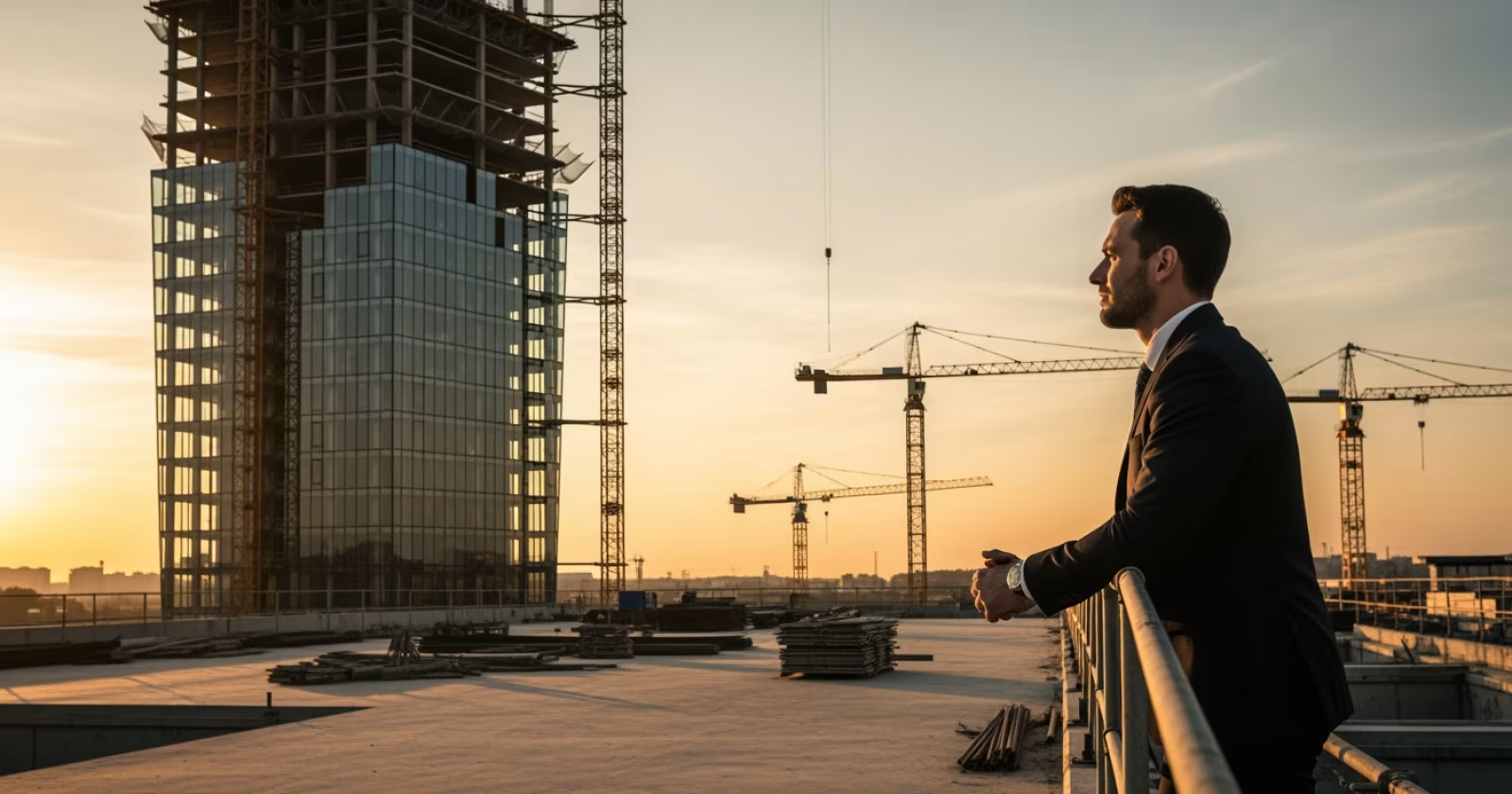
A $1.4 billion bet on commercial real estate along Sheikh Zayed Road tells you more about one billionaire’s reading of Dubai‘s trajectory than any sentiment survey could. Khalaf Al Habtoor is putting that capital to work at a moment when some developers are trimming prices to keep buyers engaged.
The founding chairman of Al Habtoor Group has confirmed plans to develop a new commercial tower within Al Habtoor City, backed by an investment of AED 5 billion. The project sits on Dubai’s most iconic corridor and forms part of a wider expansion pipeline the group is preparing across Dubai and Abu Dhabi.
What Al Habtoor City Represents for Dubai’s Commercial Landscape
Al Habtoor City is already one of the most recognizable mixed-use developments on Sheikh Zayed Road, combining hospitality, residential, and entertainment assets. Adding a dedicated commercial tower to that cluster shifts its positioning toward a more integrated business destination.
Dubai’s commercial real estate market has been navigating a complex period. Regional geopolitical tensions, particularly the recent escalation between the United States and Iran, have tested investor confidence. A two-week ceasefire agreement between Washington and Tehran, alongside Iran’s commitment to reopen the Strait of Hormuz, provided a degree of relief. The UAE Ministry of Defence confirmed that no ballistic missiles, cruise missiles, or drones were detected as having been launched from Iran on Thursday.
Against that backdrop, a commitment of this scale from one of the UAE’s most prominent private-sector figures carries weight. It signals that long-term investors are looking past short-term volatility.
Al Habtoor Group’s AED 5 Billion Commercial Tower on Sheikh Zayed Road
The tower will be located within the existing Al Habtoor City precinct on Sheikh Zayed Road. Beyond the location and the investment figure, the group has not disclosed further details regarding the project’s design, tenant strategy, or construction timeline.
In his statement, Al Habtoor framed the decision as a vote of confidence. “Our decision to proceed with this investment underscores our strong confidence in the UAE, and particularly in Dubai,” he said. The project is part of a broader pipeline of developments the group plans to roll out across both Dubai and Abu Dhabi as part of its expansion strategy.
This is not the group’s only active front. In February, Al Habtoor Group unveiled plans to invest billions in new projects in Syria, targeting economic recovery in the war-affected nation. The group has also stated its intention to initiate legal proceedings against the Lebanese government, extending a prolonged dispute with a country where it remains one of the largest foreign investors.
| Al Habtoor Group — Active Investment Fronts | Details |
|---|---|
| Dubai Commercial Tower | AED 5 billion ($1.4 billion), Sheikh Zayed Road |
| Abu Dhabi Expansion | Part of broader pipeline, details undisclosed |
| Syria Projects | Billions in planned investment for economic recovery |
| Lebanon Legal Action | Proceedings against Lebanese government |
| Habtoor Hospitality IPO | Plans disclosed in 2026 for listing on Dubai Financial Market |
How Dubai’s Commercial Market Is Absorbing Geopolitical Pressure
The timing of this announcement is instructive. A report by AGBI indicated that Dubai developers had begun introducing discounts and more flexible payment plans to attract investors to off-plan properties. Within the first two weeks of the regional conflict, some property firms reduced prices by up to 10 percent to stimulate demand.
That dynamic creates a two-track market. On one side, smaller developers are adjusting prices to maintain sales velocity. On the other, established conglomerates like Al Habtoor Group are deploying capital into large-scale projects that take years to deliver, suggesting they view the current softness as temporary rather than structural.
The UAE’s air defence record during the escalation period offers some context for that confidence. The Ministry of Defence reported that the country’s systems intercepted 537 ballistic missiles, 26 cruise missiles, and 2,256 drones since the escalation began. That operational track record underpins the security argument that Dubai continues to make to international investors and tenants.
What This Commitment Does Not Resolve
A single tower, even at $1.4 billion, does not settle the broader questions facing Dubai’s commercial property segment. Office vacancy rates, tenant quality, and rental yield compression remain live concerns in several sub-markets along Sheikh Zayed Road.
The absence of a construction timeline is notable. Without a delivery date, it is difficult to assess how this project will interact with supply already in the pipeline. The group has also not confirmed whether the tower targets multinational tenants, regional corporates, or a mixed occupancy model. Those details will determine whether this project adds depth to the market or simply adds inventory.
The geopolitical ceasefire, meanwhile, remains fragile. A two-week window does not constitute a durable settlement, and any renewed escalation could shift sentiment quickly.
The most immediate beneficiaries are likely the contractors and consultants who will be appointed to design and build the tower, along with the broader Sheikh Zayed Road commercial corridor, which gains a signal of continued institutional investment. For tenants, the benefit depends entirely on delivery timelines and lease terms that have not yet been disclosed. The Al Habtoor Group itself stands to consolidate its position as one of the most diversified private conglomerates in the UAE, with active investments spanning hospitality, real estate, and international markets.
Dubai’s Commercial Real Estate Enters a Capital-Intensive Phase
I see this announcement fitting into a broader pattern across Dubai’s real estate market. The city is moving from a cycle driven by residential speculation to one anchored by large-scale commercial and mixed-use commitments from established family groups and sovereign-linked entities. The Al Habtoor Group’s simultaneous pursuit of a hospitality IPO on the Dubai Financial Market and a billion-dollar commercial tower suggests a strategy that pairs public market capital with private development ambition.
For the MENA region, the signal is clear. Private capital with deep local roots is not retreating from Dubai despite geopolitical noise. If anything, it is accelerating deployment, treating the current environment as a window for securing prime assets before the next cycle of international inflows.
The true test of this $1.4 billion commitment arrives when construction timelines, tenant strategies, and delivery dates move from internal planning to public record.