
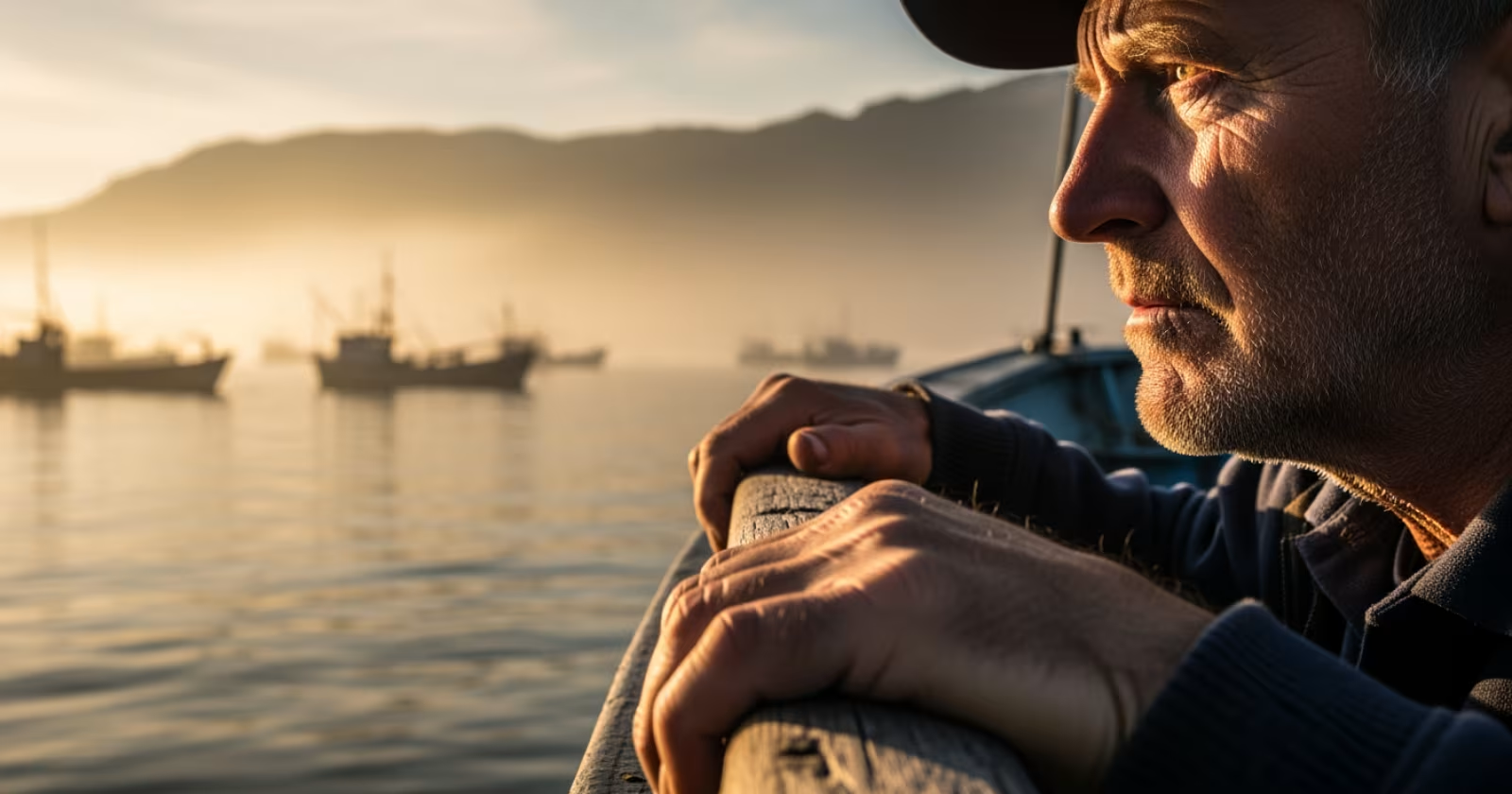
In Veraval’s crowded fish auction yard in Junagadh district, a kilogram of locally caught ribbonfish fetched ₹85 last monsoon season. Three years ago, the same fish commanded ₹140. I spoke to cooperative members along this stretch of Gujarat who told me the culprit isn’t overfishing or a bad season — it’s containers of frozen Chinese fish arriving at Indian ports at prices no local trawler can match.
A Coastline Under Siege From Cheap Imports
The Saurashtra coast stretches over 1,100 kilometres across Gujarat’s western edge, home to approximately 3.5 lakh fishermen families dependent on marine catch. This coastline contributes nearly 70% of Gujarat’s total fish production, and the cooperative model has been the backbone of this economy for decades. Yet between 2022 and 2026, India’s fish imports from China surged past ₹1,200 crore annually, according to Marine Products Export Development Authority data. Much of this is low-cost tilapia, squid, and processed fish meal flooding wholesale markets in Gujarat, Maharashtra, and Kerala.
For fishermen cooperatives along the Saurashtra belt — from Porbandar to Mangrol to Diu — this isn’t an abstract trade policy debate. It’s a direct assault on their price realisation, bargaining power, and survival.
How Saurashtra’s Fishing Cooperatives Were Built
Gujarat’s fishermen cooperatives trace their roots to the 1960s, when the state government encouraged collective ownership of mechanised boats. The idea was simple: individual fishermen couldn’t afford trawlers, diesel, or cold storage. Pooling resources through a cooperative meant shared boats, shared risk, and shared market access.
By the 1980s, the Gujarat State Federation of Fisheries Cooperatives had emerged as a significant force. Societies in Veraval, Mangrol, and Porbandar organised everything from diesel procurement to ice supply to auction-yard operations. NABARD and the National Cooperative Development Corporation (NCDC) channelled credit to these bodies, funding boat engines, nets, and basic cold chain infrastructure.
At their peak, these cooperatives gave Saurashtra’s fishing communities something rare — a degree of market control. Fishermen weren’t selling to lone middlemen at whatever price was offered. The cooperative negotiated collectively, stored catch in shared ice plants, and even began exploring direct export channels to Southeast Asia and the Middle East.
The Chinese Import Problem: Numbers That Hurt
Here’s what I find striking about this crisis. India is the world’s third-largest fish producer. Gujarat alone produces over 8 lakh metric tonnes annually. And yet, cheap Chinese fish — often farm-raised tilapia and processed surimi — undercuts local catch in domestic wholesale markets.
The economics are brutal. Chinese aquaculture operates at massive industrial scale with state subsidies that Indian cooperatives simply cannot compete against. A kilogram of frozen Chinese tilapia lands in Indian ports at approximately ₹60-75, while a Saurashtra cooperative’s fresh catch costs ₹90-120 to bring to the same market after accounting for diesel, labour, ice, and transport.
| Parameter | Saurashtra Cooperative Catch | Chinese Fish Imports |
|---|---|---|
| Average landing cost per kg | ₹90–120 | ₹60–75 |
| Cold chain infrastructure | Limited, ageing plants | Industrial-scale |
| Government subsidy support | PMMSY (partial) | Heavy state subsidies |
| Processing & value addition | Minimal (under 15%) | Extensive (over 60%) |
| Market reach | Regional wholesale mandis | Pan-India via importers |
The gap isn’t just price. It’s processing capacity. Chinese exporters send ready-to-cook fillets, pre-marinated cuts, and packaged fish meal. Most Saurashtra cooperatives still sell whole, iced fish at auction yards — raw, unprocessed, perishable.
What the Cooperatives Are Actually Doing About It
I’ve been tracking three distinct responses from Saurashtra’s fishing cooperatives in 2026 and early 2026, and they reveal both resourcefulness and deep structural gaps.
First, several cooperatives in Veraval and Mangrol have petitioned the Ministry of Commerce to impose anti-dumping duties on specific Chinese fish categories. The National Federation of Fishers Cooperatives (FISHCOPFED) formally raised this demand at the national cooperative congress, arguing that subsidised Chinese aquaculture constitutes unfair trade under WTO norms.
Second, a cluster of cooperatives in Porbandar district has begun investing in fish processing units under the Pradhan Mantri Matsya Sampada Yojana (PMMSY). The scheme offers up to 60% subsidy for cold storage, fish drying yards, and value-addition units. Approximately 12 new cooperative-run processing facilities were sanctioned across Saurashtra in 2026, though only four were operational by early 2026.
Third — and this is the most interesting development — some younger cooperative leaders are pushing for direct-to-consumer channels. A cooperative society near Rajkot has started supplying branded, vacuum-packed fish to urban retailers in Ahmedabad, bypassing the traditional mandi system entirely. Early results show a 25-30% improvement in price realisation compared to auction-yard sales.
Kerala Offers a Contrast Worth Studying
Kerala’s Matsyafed — the state fisheries cooperative federation — faced similar import pressures a decade ago and responded with aggressive branding. Their “Matsyafed” retail outlets now sell processed, cleaned, and packaged fish directly to consumers across the state. Revenue crossed ₹500 crore in the last fiscal year. The federation also runs fish meal plants that convert low-value bycatch into exportable animal feed.
Gujarat’s cooperatives have no equivalent retail infrastructure. The contrast is instructive: cooperatives that invested in processing and branding early have weathered import competition far better than those still dependent on raw-catch auctions. The Ministry of Cooperation, which has been expanding its focus on fisheries cooperatives since 2023, has reportedly studied the Matsyafed model for replication in Gujarat and Maharashtra.
The Road Ahead: Policy, Technology, and Hard Choices
Several policy shifts could reshape this battle by 2030. The PMMSY’s second phase, with an outlay of ₹6,000 crore, prioritises cold chain and processing infrastructure — exactly what Saurashtra needs. NABARD’s new fisheries cooperative credit line, announced in late 2026, offers concessional loans for cooperative-owned processing plants.
Technology adoption is another frontier. GPS-based fish aggregation data, solar-powered ice plants, and e-auction platforms are being piloted across coastal Gujarat. If cooperatives can reduce post-harvest losses — currently estimated at 20-25% of catch — they can close the cost gap with imports significantly.
But let me be honest: none of this works without addressing governance. Several Saurashtra fishing cooperatives suffer from the same disease that afflicts cooperatives across India — elected boards dominated by a few families, poor financial transparency, and political interference in leadership appointments. Younger fishermen I’ve spoken to express deep frustration with cooperative leadership that is slow to modernise.
Back at Veraval’s Auction Yard
The fishermen at Veraval haven’t stopped going to sea. They can’t — most have boat loans to repay, families to feed, and no alternative livelihood. But the mood has shifted from quiet resilience to active anger. Cooperative meetings that once discussed diesel subsidies and net repairs now feature heated debates about trade policy, processing investment, and whether the cooperative model itself needs reinvention.
This is a story that matters far beyond Gujarat’s coast. If India’s fishing cooperatives — representing over 40 lakh families nationally — cannot find an answer to industrial-scale import competition, the cooperative promise of collective strength collapses into collective vulnerability. The Saurashtra coast is where that test is playing out in real time.
If you’re tracking India’s cooperative movement, this is a space to watch closely. Explore more cooperative sector analysis on IICTF, share this piece with anyone working in fisheries policy, and stay connected as we follow this story forward.