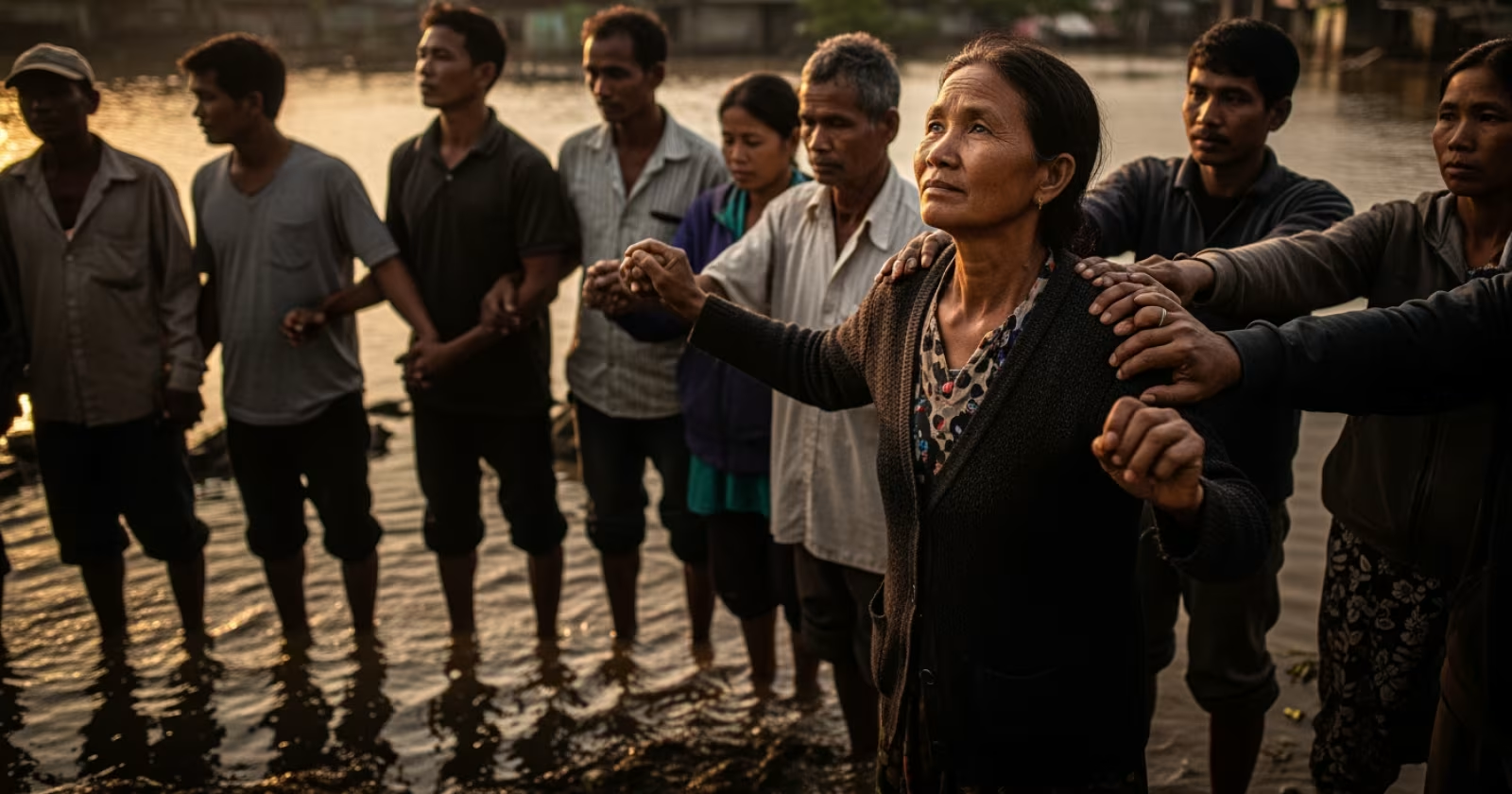
When the floodwaters finally retreated across Kerala in August 2018 — the worst inundation the state had witnessed in 94 years — the damage bill had already crossed ₹31,000 crore, more than 480 people were dead, and over a million had been displaced from fourteen of the state’s fourteen districts. Government helicopters and military boats made the front pages. What did not make the front pages was the quiet machinery that had already begun working before the cameras arrived.
I started looking into this story because the dominant narrative around Kerala’s recovery centered almost entirely on celebrity donation drives, prime ministerial visits, and the Navy’s logistics. The cooperative sector — which had been threading itself into Kerala’s economic fabric since 1914 — barely warranted a paragraph in national coverage. Yet on the ground, in villages across Wayanad, Idukki, and Pathanamthitta, cooperative societies were doing the most consequential rebuilding work the state had seen in generations.
A Network Built Long Before the Water Rose
Kerala’s cooperative movement predates Indian independence by three decades. The first agricultural credit cooperative was registered under British rule in Thiruvalla in 1914, and by the time the 2018 Kerala floods struck, the state had over 15,000 registered cooperative societies — spanning dairy, fisheries, housing, banking, and agriculture. This was not a coincidence of geography. It was the result of decades of deliberate state policy, high literacy rates, and a political culture that trusted collective ownership.
The Kerala State Cooperative Bank anchors a three-tier structure of district cooperative banks and primary agricultural credit societies that together hold accounts for millions of rural households. When mainstream commercial banks were still processing internal disaster protocols, cooperative banks in Kottayam and Pathanamthitta had already begun releasing emergency cash to their members. Some primary societies waived interest on existing agricultural loans within the first two weeks — a decision made at the grassroots level, without waiting for a directive from any ministry.
Kudumbashree and the Women Who Moved First
No cooperative-linked organization moved faster in the immediate aftermath than Kudumbashree, the Kerala government’s poverty eradication and women’s self-help network. With over 4.5 million members organized into nearly 300,000 neighborhood groups across the state, Kudumbashree functioned less like a relief organization and more like a pre-existing emergency network that simply activated. Members in Ernakulam district were running community kitchens and cataloguing household damage within 48 hours of the waters pulling back.
What made this possible was not emergency funding or extraordinary heroism — it was organizational density. Each neighborhood group already knew which households had elderly residents, which families depended entirely on paddy farming, and which small enterprises like fish vending stalls or tailoring units would need immediate credit to restart. That knowledge, accumulated over years of microfinance activity, became a precise tool for prioritizing reconstruction support. I found this detail remarkable: formal government disaster agencies were still building their damage assessment databases weeks after Kudumbashree groups had already completed their own ground-level surveys.
Credit, Cattle, and the Quiet Work of Restoring Farms
The floods destroyed an estimated 50,000 hectares of farmland across Kerala, wiping out paddy, banana, and spice crops that farming families had spent an entire growing season cultivating. Primary Agricultural Credit Societies became the primary lifeline for agricultural recovery in Wayanad and Thrissur. They issued restructured loans at reduced interest rates — some as low as four percent annually — specifically to help farmers restock seeds, fertilizers, and equipment that the floodwaters had carried off.
The Kerala Cooperative Milk Marketing Federation, known as Milma, faced a distinct crisis of its own. Flood damage to dairy farms across Thrissur and Ernakulam had disrupted milk supply chains almost overnight. Rather than waiting for insurance settlements that could take months, Milma’s district unions coordinated cattle replacement loans through their affiliated cooperative societies, getting dairy farmers back to operational capacity within roughly three months. Against Kerala’s normal bureaucratic timelines, that pace was striking.
| Cooperative Type | Primary Post-Flood Role | Key Districts | Estimated Beneficiaries |
|---|---|---|---|
| Primary Agricultural Credit Societies | Emergency credit and loan restructuring for farmers | Wayanad, Thrissur, Pathanamthitta | Over 200,000 farmers |
| Kudumbashree Neighborhood Groups | Damage surveys, community kitchens, microenterprise revival | All 14 districts | 4.5 million members |
| Kerala State Cooperative Bank | Emergency cash disbursement and loan moratoriums | State-wide via district banks | Millions of account holders |
| Milma – Dairy Cooperatives | Cattle replacement loans, supply chain restoration | Thrissur, Ernakulam | Approximately 10,000 dairy farmers |
| Cooperative Housing Societies | Subsidized reconstruction loans for damaged homes | Idukki, Alappuzha, Kottayam | Thousands of displaced families |
What Kerala Proves About Recovery Architecture
The cooperative model that proved so resilient in Kerala is not exclusive to the state — cooperatives exist across India, from Gujarat’s dairy giant Amul to the fisheries collectives of Tamil Nadu. But Kerala’s version carried a distinct structural advantage: decades of investment in organizational depth, financial literacy, and active member participation had created societies capable of acting autonomously under extreme pressure. The International Cooperative Alliance notes that cooperatives globally serve over one billion members, yet in formal disaster response frameworks, they rarely appear in the first tier of acknowledged responders.
What happened across Kerala’s flood-stricken villages after 2018 makes a compelling case for changing that — for integrating cooperative societies into official disaster management architecture rather than treating them as informal auxiliaries that appear after the military and large NGOs have finished. The organizations that rebuilt Kerala’s countryside fastest were not the most visible ones. They were the most embedded, the most trusted, and the most precisely informed about the people they served.
I left this story thinking about a woman named Leela from Kuttanad, mentioned in a Malayalam-language feature published in 2019. She organized eleven neighborhood women into a seed-restocking collective using a cooperative loan of ₹85,000 within six weeks of the floods. By the following harvest season, all eleven families had returned to full cultivation. No government officer had assigned her this task. She simply knew what needed doing and had the organizational framework to act on that knowledge. That, more than any relief fund or policy announcement, is what genuine recovery looks like.
If you are connected to state disaster management, rural banking policy, or cooperative development research, this story deserves far more than a footnote in post-disaster assessments. The institutions that moved fastest in Kerala were the ones that had spent decades being present before any disaster arrived. That is a finding worth acting on well before the next flood season comes.