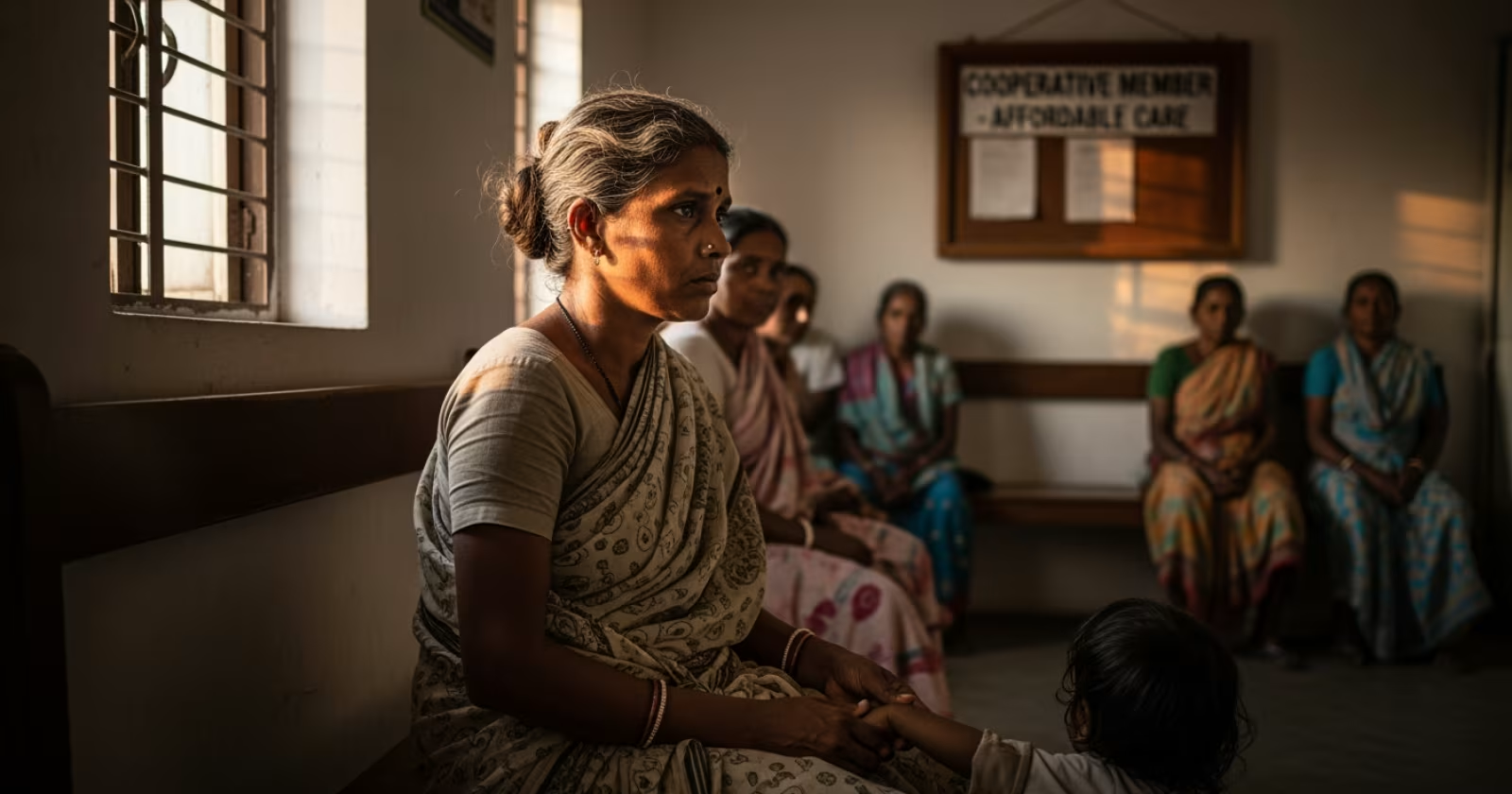
When a seasonal farm worker in Bilaspur, Chhattisgarh needed an appendectomy in 2023, the nearest district government hospital had no surgeon available that week. The private clinic nearby quoted ₹75,000 — roughly five months of his annual income. What saved him was a community-owned health cooperative that performed the same procedure, including post-operative care, for ₹8,000.
That story is not an outlier. Across rural India, a quiet network of cooperative hospitals and health societies has been filling the enormous gap between expensive private healthcare and chronically underfunded public facilities. I’ve followed this movement for two years, and the scale of what has been built — largely without headlines — is genuinely striking.
A Structure Built on Shared Ownership, Not Charity
The cooperative healthcare model works on a principle that feels almost counterintuitive in an era of hospital chains and private equity: the patients are also the owners. Members pay a one-time share capital — often between ₹500 and ₹2,000 — which entitles them to discounted services, annual dividends from surplus revenue, and a vote on how the institution is governed. Profits, when they exist, flow back into the facility rather than to outside shareholders.
The Kozhikode Cooperative Hospital in Kerala, founded in 1948, remains one of the most cited examples of this model at scale. It handles more than 600,000 outpatient visits annually and performs complex surgeries at rates 60 to 65 percent below those at comparable private hospitals in the city. Its pharmacy, stocked through bulk cooperative purchasing, sells generic medicines at prices that routinely undercut even government dispensaries.
Kerala’s experience is not an accident of geography or luck. The state’s long tradition of cooperative institutions — in dairy, fisheries, and banking — gave communities a ready framework to apply to healthcare. The World Health Organization has consistently identified Kerala’s primary care infrastructure as a benchmark worth studying precisely because of how community-managed facilities integrate with the public system.
The Cost Gap That Cooperatives Are Closing
India’s out-of-pocket healthcare expenditure has long been a crisis hiding in plain sight. According to National Health Accounts data from 2021–22, Indian households bear approximately 47 percent of total health expenditure directly from their own pockets — one of the highest ratios among middle-income countries. For rural households, that figure climbs further still, since they lack both geographic access to functioning public hospitals and the financial reserves to absorb emergency costs.
The cooperative model attacks this problem from several directions at once. Pooled procurement allows these hospitals to negotiate far lower drug and equipment prices. Local governance eliminates the administrative overhead that inflates costs inside large hospital chains. And reinvesting surplus into infrastructure rather than distributing profits externally means that capacity grows steadily without the debt-funded construction projects that drive fee structures upward in the private sector.
| Healthcare Setting | Average OPD Cost (₹) | Average Surgery Cost (₹) | Drug Price vs Private Baseline |
|---|---|---|---|
| Private Hospital (Tier 2 City) | 800 – 1,500 | 60,000 – 1,20,000 | 100% (baseline) |
| Government District Hospital | 0 – 50 | 5,000 – 15,000 | 30 – 40% |
| Cooperative Hospital (Rural) | 100 – 300 | 8,000 – 25,000 | 35 – 50% |
What these figures reveal is a middle tier that policy language rarely celebrates: cooperative hospitals charge enough to maintain quality staffing and equipment, but far too little to financially devastate a rural family facing a medical emergency.
SEWA and the Gujarat Blueprint
In Gujarat, the cooperative healthcare movement found a different entry point — through labor organizing. The Self Employed Women’s Association, founded by Ela Bhatt in Ahmedabad in 1972, began as a trade union for informal women workers before identifying healthcare costs as the single greatest economic threat to its members’ stability. By the 1990s, SEWA had built a health cooperative wing to address that threat directly.
SEWA’s model trained community health workers — mostly women from the same villages as the patients — to handle primary and preventive care. These workers reduced the volume of cases requiring hospital referrals, which lowered costs for the cooperative’s secondary care partnerships significantly. By 2024, the network was reaching over 400,000 women and their families across Gujarat, Tamil Nadu, and Madhya Pradesh combined.
What SEWA demonstrated, and what Jan Swasthya Sahyog in Bilaspur independently replicated in Chhattisgarh, is that cooperative healthcare does not require extraordinary funding or government permission to begin. It requires trust, and trust accumulates fastest when the community controls the institution it depends on. The National Health Mission formally began recognizing cooperative and community-based health structures as viable financing partners under its flexible fund mechanisms in 2022 — a significant policy acknowledgment of what the ground-level evidence had already proven.
The Challenges That Still Demand Honest Attention
The cooperative healthcare model carries real friction that its advocates do not always acknowledge loudly enough. Recruiting and retaining qualified specialists — surgeons, radiologists, cardiologists — remains the most persistent structural bottleneck. A rural cooperative hospital cannot match the salaries that urban private chains offer, and specialist shortages mean patients still travel long distances for anything beyond secondary care.
Governance is the second fault line. The democratic structure that gives cooperatives their legitimacy can also slow decision-making to a damaging crawl. Facilities in Maharashtra and Odisha have faced situations where member factions blocked critical capital investments — new diagnostic equipment, expanded emergency wards — because of political disagreements within governing boards. NABARD’s rural cooperative finance division has been piloting governance training programs since 2023 specifically to address this vulnerability before it becomes a breaking point.
Financial sustainability also demands careful discipline. Several smaller cooperatives in Rajasthan and Uttar Pradesh dissolved between 2018 and 2022 after failing to maintain adequate reserve funds for equipment replacement. The cooperatives that survived that period shared one common habit: they set aside a fixed 12 to 15 percent of annual revenue for capital maintenance, regardless of short-term pressure to reduce member fees.
What the Survival of These Institutions Actually Proves
India’s 2026 health policy frameworks openly acknowledge that no government system alone can close the rural healthcare gap within a single decade. The cooperative sector — with more than 200 functioning hospital cooperatives across Kerala, Karnataka, Maharashtra, and Gujarat — represents something that policy documents rarely celebrate: a proven alternative that already exists and already works for millions of people right now.
I find the most compelling evidence not in policy papers but in the membership renewal numbers. When communities voluntarily reinvest their share capital year after year, and when waiting lists form to join a cooperative hospital, that is a signal clearer than any government survey. People are choosing these institutions because ownership creates an accountability that neither private hospitals nor underfunded public facilities can replicate at the same cost.
If the cooperative healthcare story matters to you — as a policymaker, researcher, journalist, or simply someone who believes health systems should answer to patients rather than shareholders — the most useful next step is to find the cooperative health initiatives already operating in underserved districts and amplify what they are doing. The infrastructure is there. What it needs most is visibility, and the sustained attention of people who understand exactly what it represents.