
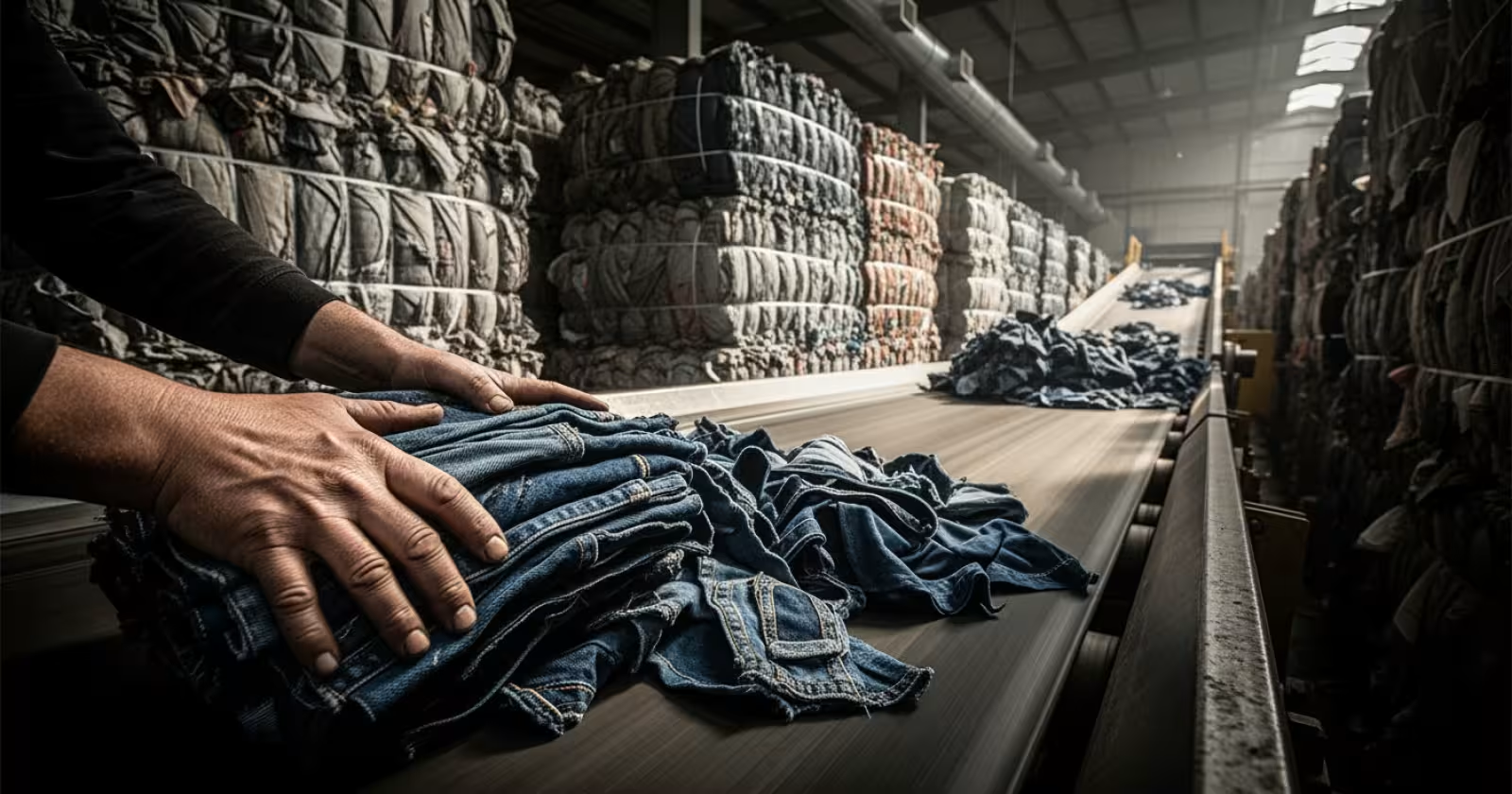
Post-consumer denim has long been one of textile recycling’s harder technical problems. Stretch construction, polycotton blends with varied mechanical histories, and the performance demands of premium fabric specifications have kept circular systems for denim largely at the pilot stage — and this collaboration is a direct answer to that stall.
RE&UP Recycling Technologies, Madewell, and ISKO have produced a textile-to-textile recycled denim capsule built on approximately 20,000 pairs of post-consumer jeans. Announced April 8, 2026, from Eindhoven, The Netherlands, the project represents one of the more technically complete demonstrations of closed-loop denim production to reach commercial launch.
What Textile-to-Textile Denim Recycling Actually Requires From the Production Chain
Most recycled content in denim today comes from mechanical shredding, which degrades fibre length and limits output to lower-grade applications — insulation, padding, or yarn blended at low substitution rates. Textile-to-textile recycling targets a fundamentally different outcome: recovering fibres from worn garments that can re-enter a premium production stream without sacrificing performance specification.
For denim specifically, the challenge compounds quickly. Modern stretch jeans typically combine cotton with elastane or polyester, and blend ratios vary widely across brands and product generations. Any recycling process that requires pre-sorted, uniform inputs collapses when handling real-world take-back volumes at scale.
This is the production gap that makes RE&UP’s feedstock-agnostic claim technically significant — not just commercially convenient.
How RE&UP, Madewell, and ISKO Structured the Closed-Loop Denim Supply Chain
Madewell supplies the post-consumer volume. The brand has operated a denim trade-in programme for over a decade through Cotton’s Blue Jeans Go Green™, collecting and recycling more than two million pairs of jeans across that period. That take-back infrastructure provides a consistent, traceable feedstock stream — which is one of the harder problems in circular textile production, independent of recycling technology.
RE&UP processes those worn garments through its proprietary recycling technology, deconstructing mixed polycotton blends into what the company calls a “raw canvas” of Next-Gen Cotton and Polyester fibres. The process handles diverse blend compositions without requiring manual pre-sorting by fibre type, which is a meaningful operational distinction at commercial volumes.
ISKO receives those fibres and engineers them into fabric. The resulting denim carries Global Recycled Standard (GRS) certification, confirming that the recycled content claim has been verified through chain-of-custody documentation at each production handoff. ISKO’s contribution is not simply weaving — it is delivering the stretch, strength, and aesthetic finish that premium denim buyers require from feedstock that has already completed one garment lifecycle.
The capsule collection launched April 8, 2026 and is available on Madewell.com. Specific production volumes and garment counts for the capsule were not disclosed.
Mechanical Recycling Versus Textile-to-Textile: What the Process Difference Means for Mills
What I find technically significant about RE&UP’s approach is precisely the feedstock handling. Post-consumer jeans from a trade-in programme are not uniform. Garments arrive with different fibre blends, dye loads, finishing chemistries, and varying degrees of mechanical wear. A process requiring clean, pre-sorted inputs fails at the point of volume — which is where most circular textile pilots have stalled before.
| Parameter | Mechanical Recycling | Textile-to-Textile (RE&UP Process) |
|---|---|---|
| Fibre length preservation | Reduced — shredding degrades staple length | Higher — process targets fibre integrity for premium reuse |
| Primary output application | Insulation, filling, low-blend yarn | Premium fabric-grade fibre (Next-Gen Cotton and Polyester) |
| Feedstock flexibility | Often requires pre-sorted single-fibre inputs | Feedstock-agnostic — handles mixed polycotton blends |
| Certification achieved in this project | Varies by processor | GRS (Global Recycled Standard) confirmed |
| Premium market compatibility | Limited — performance constraints apply | Meets stretch, strength, and aesthetic specifications for premium denim |
What This Collaboration Does Not Yet Confirm
The capsule demonstrates one successful pass through a textile-to-textile cycle. What remains unverified is whether the output fibres can cycle again — whether a garment made from RE&UP’s Next-Gen Cotton and Polyester can itself be recovered and reprocessed at equivalent quality in a subsequent loop. Multi-cycle performance is the open question that matters most for brands building long-term circularity commitments.
Specific fibre performance data — denier, tenacity, elongation at break — were not published for the recycled fibres produced in this collaboration. Mills evaluating comparable recycled cotton or polyester feedstock for their own production will need that data before substitution decisions can be made at scale.
ISKO’s GRS certification covers chain-of-custody for recycled content, not recyclability of the finished fabric. End-of-life recovery remains a separate, unconfirmed step in this system as currently described.
Premium denim brands with established take-back programmes gain the most immediately from this model. Madewell’s architecture — collecting post-consumer jeans and routing them through a verified recycling and manufacturing pathway — is replicable for any brand operating at comparable volume with an existing collection infrastructure. ISKO-aligned mills working in the premium segment are the second tier of beneficiaries, with GRS-certified recycled denim now entering production without a documented compromise on technical performance.
Closed-Loop Denim Infrastructure Points Toward a New Baseline for Brand Circularity Claims
What this project outlines is a system architecture, not just a product. Brand take-back streams, advanced recycling technology, and performance fabric manufacturing can now be sequenced into a documented production loop — with certification at each handoff. That changes the conversation for brands and mills examining recycled content commitments under incoming due diligence and disclosure frameworks, where traceable chain-of-custody will matter as much as the recycled content percentage itself.
I expect the next critical question in this space to be repeatability: whether fibres produced through RE&UP’s process maintain quality across multiple recycling iterations, and what that means for garment design specifically optimised for this recovery pathway.
Mills and brands that build verified collection infrastructure now will hold a meaningful position as textile-to-textile recycled denim moves from capsule to core production volume — and the window to establish those supply chain relationships ahead of regulatory pressure is narrowing faster than most sourcing calendars currently reflect.