
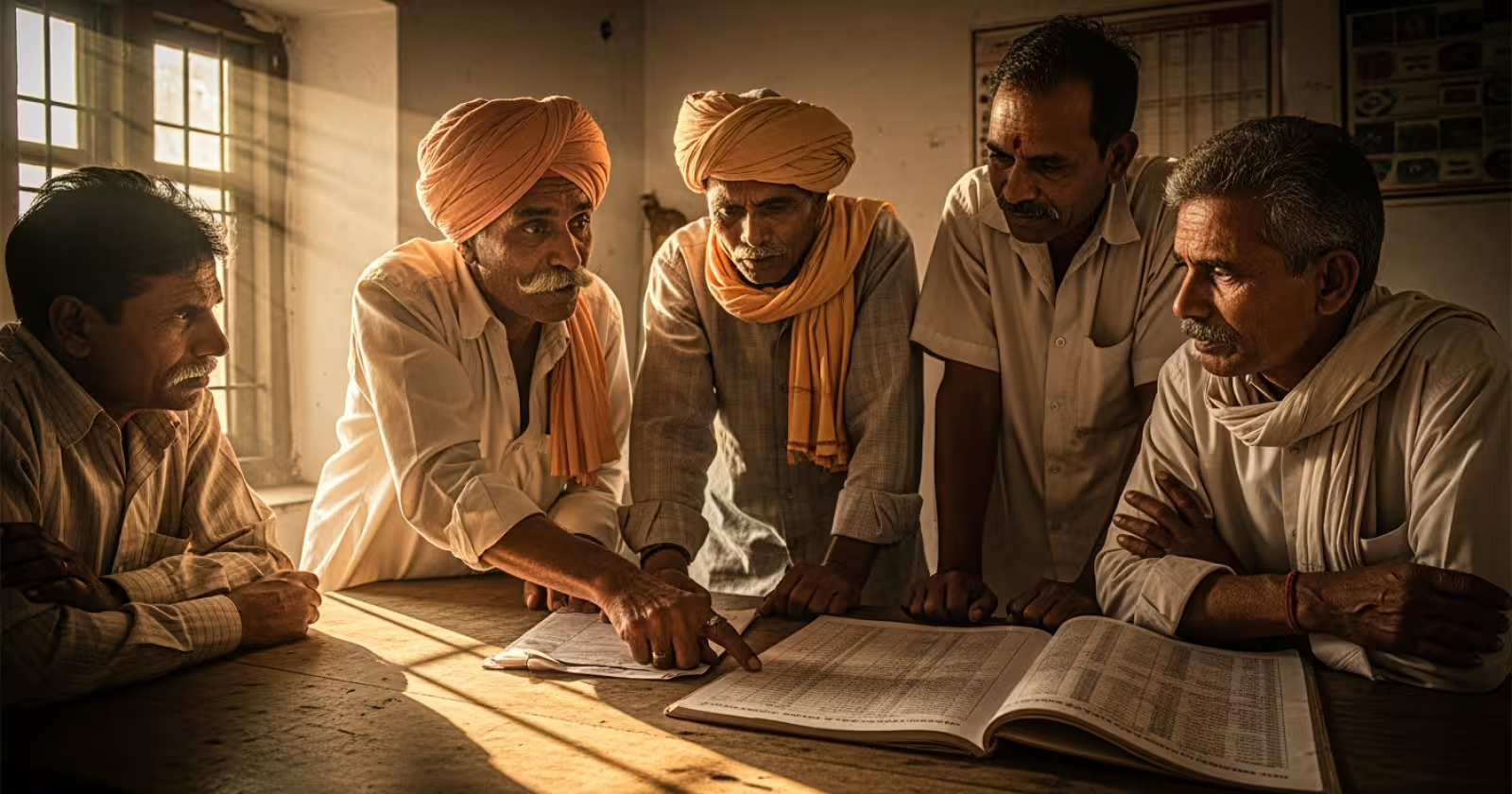
India is home to one of the largest cooperative movements on the planet, with over 8.5 lakh registered cooperative societies touching the lives of roughly 290 million members. Among these, agricultural cooperatives form the backbone of rural economic activity, handling everything from credit distribution and input supply to marketing, processing, and storage of farm produce across every state and union territory.
I have spent years studying how these cooperative structures function at the grassroots, and I can tell you that no single resource compiles a clean, state-wise picture of agricultural cooperatives. That is exactly what I aim to provide here — a detailed, data-backed reference that farmers, researchers, students, and policymakers can use in 2026 and beyond.
Role of Agricultural Cooperatives in Indian Farming
Agricultural cooperatives serve as collective bargaining platforms where small and marginal farmers pool resources to access credit, buy seeds and fertilizers at lower prices, and sell produce without exploitative middlemen. The National Cooperative Development Corporation (NCDC) has been funding and promoting these societies since 1963 under the Ministry of Cooperation, which was established as a separate ministry in 2021 under Amit Shah‘s leadership.
These cooperatives broadly fall into categories such as primary agricultural credit societies (PACS), marketing cooperatives, processing cooperatives, farming cooperatives, and irrigation cooperatives. PACS alone number over 95,000 across India and serve as the last-mile credit delivery system for rural households. They disburse crop loans, distribute fertilizers, and sometimes operate fair price shops under the Public Distribution System.
Marketing cooperatives like NAFED (National Agricultural Cooperative Marketing Federation of India) aggregate produce from state-level federations and handle procurement operations for pulses, oilseeds, and other commodities on behalf of the Government of India. NAFED’s procurement operations regularly exceed ₹30,000 crore annually, stabilizing market prices for farmers nationwide.
State-Wise Distribution of Major Agricultural Cooperatives
The density and effectiveness of agricultural cooperatives vary dramatically from state to state. Maharashtra, Gujarat, Karnataka, and Kerala have historically led the cooperative movement, while states in the northeast and certain Hindi-belt regions have lagged behind. Below is a consolidated reference table listing prominent agricultural cooperative structures by state.
| State | Apex Agricultural Cooperative Body | Key Focus Area | Approx. PACS Count |
|---|---|---|---|
| Gujarat | Gujarat State Cooperative Marketing Federation (GUJCOMASOL) | Dairy, Oilseeds, Cotton | 8,800+ |
| Maharashtra | Maharashtra State Cooperative Marketing Federation | Sugar, Cotton, Credit | 21,000+ |
| Karnataka | Karnataka State Cooperative Marketing Federation | Coffee, Arecanut, Credit | 6,200+ |
| Kerala | Kerala State Cooperative Marketing Federation (MARKETFED) | Spices, Rubber, Coir | 1,600+ |
| Tamil Nadu | Tamil Nadu Cooperative Marketing Federation (TANFED) | Rice, Pulses, Handlooms | 4,500+ |
| Uttar Pradesh | UP Cooperative Federation Ltd | Sugar, Credit, Dairy | 8,900+ |
| Madhya Pradesh | MP State Cooperative Marketing Federation | Soybean, Wheat, Pulses | 4,700+ |
| Rajasthan | Rajasthan State Cooperative Marketing Federation (RAJFED) | Guar, Mustard, Wool | 6,100+ |
| Punjab | MARKFED Punjab | Wheat, Rice, Cotton | 3,800+ |
| West Bengal | BENFED (Bengal Cooperative Marketing Federation) | Rice, Jute, Potato | 5,500+ |
| Andhra Pradesh | AP State Cooperative Marketing Federation | Rice, Chilli, Turmeric | 3,900+ |
| Telangana | Telangana State Cooperative Marketing Federation | Cotton, Rice, Turmeric | 2,800+ |
| Odisha | MARKFED Odisha | Rice, Minor Forest Produce | 3,200+ |
| Bihar | Bihar State Cooperative Marketing Union | Maize, Wheat, Litchi | 8,400+ |
| Haryana | HAFED (Haryana State Cooperative Supply and Marketing Federation) | Wheat, Mustard, Bajra | 2,600+ |
States like Meghalaya, Mizoram, Nagaland, and Arunachal Pradesh have smaller cooperative networks, often numbering fewer than 500 PACS each, but the Ministry of Cooperation has been actively working to revitalize these through the computerization of PACS project launched in 2023. The target is to digitize all PACS by 2027, making them multi-service centres for banking, insurance, and input distribution.
Landmark Cooperative Institutions Operating Across Multiple States
Several agricultural cooperatives transcend state boundaries and operate under the Multi-State Cooperative Societies Act, 2002. The most iconic is IFFCO (Indian Farmers Fertiliser Cooperative Limited), which is the world’s largest fertilizer cooperative by production volume. IFFCO operates plants in Gujarat, Uttar Pradesh, Odisha, and Rajasthan, producing over 80 lakh metric tonnes of fertilizers annually.
KRIBHCO (Krishak Bharati Cooperative Limited) is another multi-state fertilizer cooperative headquartered in Noida. It supplies urea and other nitrogenous fertilizers to cooperative networks in nearly every state. Amul, formally known as the Gujarat Cooperative Milk Marketing Federation, started as a dairy cooperative but has significantly influenced agricultural cooperatives by creating a replicable village-level procurement model that states like Karnataka (Nandini) and Bihar (Sudha) have adopted.
NAFED operates procurement centres in over 20 states and directly engages with state marketing federations. During rabi and kharif seasons, NAFED’s price support scheme purchases help millions of oilseed, pulse, and copra farmers receive the Minimum Support Price (MSP) declared by the Commission for Agricultural Costs and Prices (CACP).
Government Schemes Strengthening Agricultural Cooperatives in 2026
The Union Budget 2026–26 allocated significant funds toward cooperative modernization. The computerization of 63,000 functional PACS is already underway with NABARD acting as the implementing agency. Each PACS is being converted into a multi-purpose centre that can offer warehousing receipts, soil testing, custom hiring of farm equipment, and common service centre functions.
The government has also introduced tax relief measures for new cooperative societies, reducing the surcharge on cooperative income and bringing the effective corporate tax rate for cooperatives down to 22 percent. These measures are designed to encourage formation of new farmer producer organizations (FPOs) and their conversion into cooperatives. The target of forming 10,000 new FPOs by 2027, announced in the 2020–21 budget, remains actively supported through equity grants of up to ₹18 lakh per FPO via SFAC and NABARD.
States like Madhya Pradesh and Odisha have additionally launched state-specific cooperative revitalization programmes in 2026 that include interest subvention on crop loans routed through PACS and capital infusion into district cooperative central banks. This twin approach of central and state funding is expected to double the credit flow through cooperatives within the next three years.
Challenges Facing Agricultural Cooperatives Across States
Despite their enormous reach, agricultural cooperatives face persistent issues. Political interference in cooperative elections remains widespread in states like Maharashtra and Uttar Pradesh, where sugar cooperatives have historically been controlled by political families. Many PACS remain dormant — estimates suggest that nearly 30 percent of registered PACS in Bihar and Jharkhand are non-functional due to accumulated losses and governance failures.
Financial health is another serious concern. Several District Central Cooperative Banks (DCCBs) have failed to meet Reserve Bank of India licensing norms, restricting their ability to lend. States like West Bengal and Assam have multiple unlicensed DCCBs, which directly impacts credit availability at the PACS level. The ongoing PACS digitization programme is partly aimed at improving financial transparency and audit compliance across these institutions.
Awareness among farmers about cooperative membership benefits is also limited in many regions. I have personally observed that young farmers in states like Chhattisgarh and Jharkhand are often unaware of how to register or participate in cooperative decision-making. Bridging this knowledge gap requires targeted outreach campaigns that go beyond just digital infrastructure.
If you are a farmer, researcher, or rural entrepreneur reading this, I strongly encourage you to visit your nearest PACS or district cooperative office and explore what membership can offer. Whether it is subsidized inputs, warehouse access, or collective marketing power, agricultural cooperatives remain one of the most underutilized yet powerful tools available to Indian farmers. Take that first step — the cooperative movement needs active, informed participation now more than ever.