
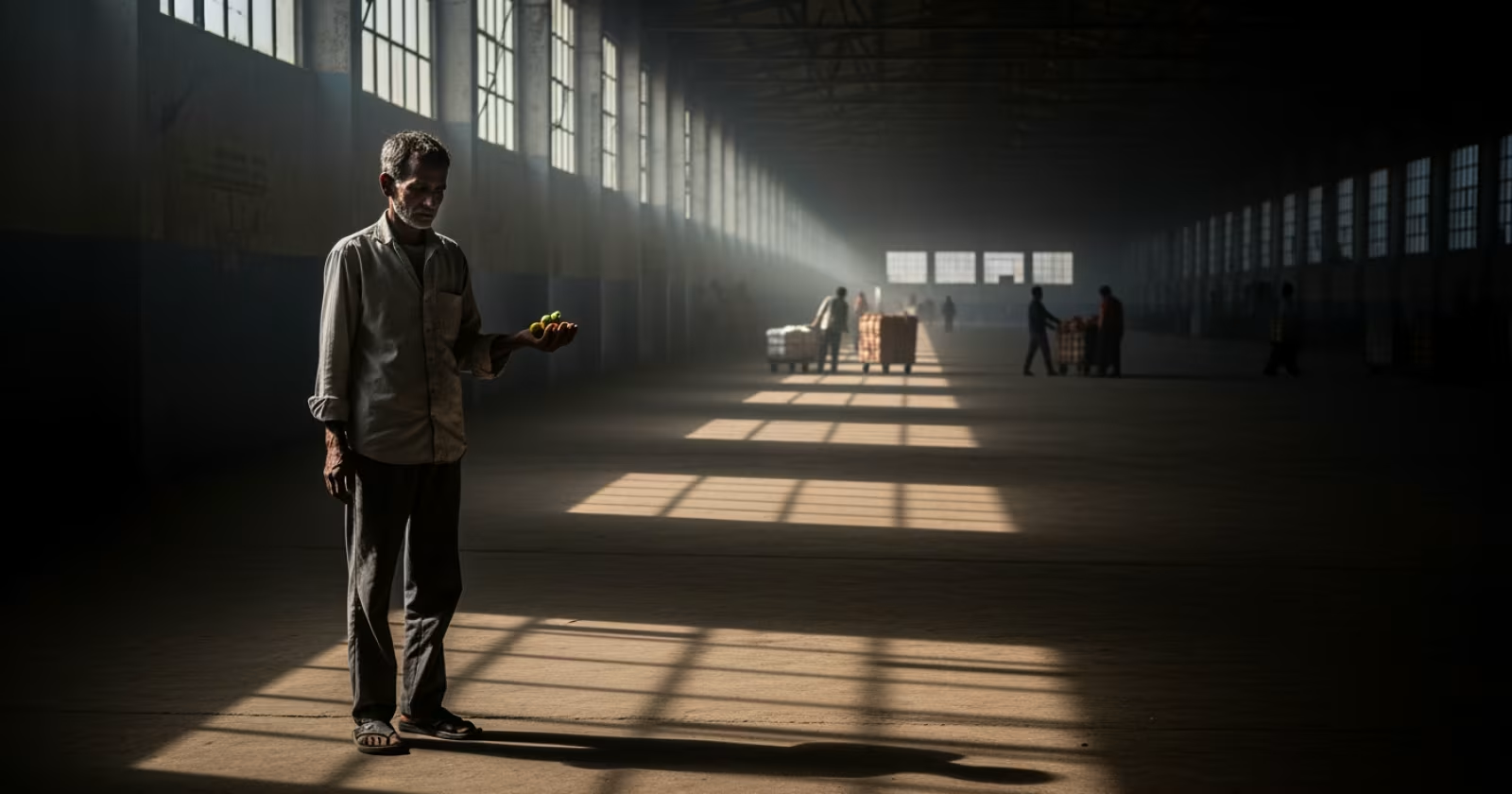
In Nagaur district, a mustard farmer named Hanuman Ram sold his entire winter harvest at the local mandi in early 2026 for roughly ₹4,600 per quintal — about ₹250 below the MSP. He had never heard of RAJFED, the state cooperative body that was, at that very moment, running a price support procurement centre less than 40 kilometres from his village. This is not an isolated story. Across Rajasthan’s arid belt, thousands of smallholders bypass the cooperative safety net simply because nobody told them it existed.
Why RAJFED Matters More Than You Think
I have been tracking India‘s cooperative marketing federations for years, and RAJFED — formally the Rajasthan State Cooperative Marketing Federation Limited — is one of the most paradoxical institutions I have encountered. It handles procurement worth hundreds of crores annually. It is the nodal agency for the Government of India’s Price Support Scheme (PSS) in Rajasthan for crops like mustard, gram, and moong. Yet ask a farmer in Barmer or Churu about it, and you will likely draw a blank stare.
Rajasthan is India’s largest state by area, with approximately 69 lakh operational farm holdings, a majority of them marginal or small. The distances are vast. The information gaps are wider. And RAJFED, headquartered in Jaipur, has struggled for decades to bridge that last mile — not for lack of mandate, but for lack of ground-level visibility and institutional agility.
The Origins: A Federation Born of Desert Economics
RAJFED was established in 1957, barely a decade after Independence, when Rajasthan’s newly unified princely states desperately needed an organised agricultural marketing structure. The idea was straightforward: create a cooperative apex body that would aggregate produce from district-level cooperative marketing societies, secure fair prices, and shield farmers from exploitative middlemen.
In its early decades, RAJFED functioned as a vital link in Rajasthan’s food economy. It procured oilseeds — particularly mustard, which is Rajasthan’s dominant rabi oilseed crop — and pulses like gram and moth. It also dabbled in consumer retailing, fertiliser distribution, and seed supply. By the 1980s, RAJFED had a network of district cooperative marketing unions feeding into its state-level operations. The model mirrored what NAFED was doing nationally, but with a sharper focus on dryland crops suited to Rajasthan’s harsh agro-climatic conditions.
The federation was never designed to be a commercial juggernaut. It was a policy instrument — a cooperative channel through which state and central procurement schemes could reach the ground. That distinction matters, because it explains both RAJFED’s resilience and its chronic weakness.
How RAJFED Operates in 2026
Today, RAJFED’s primary role is executing the central government’s Price Support Scheme in Rajasthan. Under PSS, when market prices for notified crops fall below the Minimum Support Price, agencies like RAJFED and NAFED step in to procure directly from farmers at MSP. For Rajasthan, the key PSS crops include mustard, gram (chana), moong, urad, and groundnut.
Here is a snapshot of RAJFED’s recent procurement activity:
| Crop | Rabi/Kharif Season | Approximate Procurement (Metric Tonnes) | MSP (₹ per Quintal, 2026-26) |
|---|---|---|---|
| Mustard (Rapeseed) | Rabi | 2.5–4 lakh MT (varies yearly) | ₹5,950 |
| Gram (Chana) | Rabi | 1–3 lakh MT | ₹5,650 |
| Moong | Kharif | 50,000–1.5 lakh MT | ₹8,682 |
| Groundnut | Kharif | 30,000–80,000 MT | ₹6,783 |
The federation operates through a network of procurement centres set up at mandi yards and select rural locations during the procurement window. Farmers must register, provide land records and Aadhaar-linked bank details, and deliver produce that meets FAQ (Fair Average Quality) standards. Payments are made directly to bank accounts, typically within 48–72 hours.
Beyond PSS, RAJFED also supplies seeds, undertakes some consumer retail through cooperative stores, and has historically been involved in fertiliser and pesticide distribution. However, procurement remains its bread and butter — and its entire institutional identity revolves around those few months of frantic seasonal buying.
The Visibility Crisis and What Is Broken
Here is the uncomfortable truth. RAJFED’s procurement centres are often too few, too distant, and too late. In a state where a single district like Jaisalmer is larger than Kerala, setting up 20 or 30 centres across the state means many farmers face a 50–80 kilometre journey just to sell at MSP. The transport cost alone eats into the price advantage.
Political interference is another persistent issue. Procurement targets, centre locations, and staffing decisions are heavily influenced by the ruling government’s priorities. When state elections loom, centres multiply. In off-years, they shrink. RAJFED’s managing director is a government appointee, and the federation’s board composition reflects political equations rather than farmer representation.
Storage is a chronic headache. Rajasthan lacks adequate warehousing for the volumes RAJFED procures, leading to spillover into open yards, quality degradation, and eventual losses. The NCDC has sanctioned loans for cooperative storage infrastructure, but utilisation has been sluggish. Meanwhile, private traders with better logistics and instant cash payments continue to dominate the mandi ecosystem. Most farmers, especially those with small lots of 5–10 quintals, simply find it easier to sell to the nearest trader at a discount than navigate RAJFED’s paperwork.
A District-Level Reality Check: Bikaner’s Mustard Story
Bikaner district offers a telling case study. It is one of Rajasthan’s top mustard-producing districts, with vast tracts under rabi oilseed cultivation. During the 2026-26 procurement season, RAJFED operated approximately 8–10 centres in the district. Farmer registrations exceeded 25,000, but actual procurement was limited by slow quality testing, insufficient staffing, and erratic centre operating hours.
Local reports suggested that by mid-March, several centres had stopped accepting produce due to storage constraints — even as thousands of registered farmers waited in queues. Some shifted their produce to private traders at ₹300–500 below MSP. In contrast, Punjab’s cooperative marketing federation runs highly regimented procurement with pre-assigned time slots — a model Rajasthan has studied but not yet adopted. The difference is not just organisational; it is a question of institutional will and funding depth.
What the Next Five Years Could Look Like
The Ministry of Cooperation, established in 2021, has repeatedly signalled that state cooperative marketing federations must be digitised, professionalised, and made financially self-sustaining. Under the national PACS convergence plan, approximately 63,000 Primary Agricultural Credit Societies are being reimagined as multi-service centres — and state federations like RAJFED are expected to serve as aggregation hubs above them.
NABARD has also been pushing digital mandi integration, where farmers can register for MSP procurement via mobile apps, receive centre assignments, and track payments in real time. If Rajasthan implements this at scale, RAJFED’s reach could expand dramatically without proportionate increases in physical infrastructure. There is also growing discussion around allowing RAJFED to enter value-added processing — mustard oil, gram flour — rather than just raw commodity procurement. That shift could transform it from a seasonal government agent into a year-round cooperative enterprise.
Back to Nagaur
Hanuman Ram, the mustard farmer I mentioned at the start, eventually learned about RAJFED from a neighbour who had sold at MSP the previous year. He told local journalists he planned to register for the next season. But he also said something that stuck with me: the system should come looking for the farmer, not the other way around. That single line captures everything about RAJFED’s challenge. The infrastructure exists. The mandate exists. The money exists. What does not exist — yet — is a cooperative culture that actively pulls farmers in rather than passively waiting for them to show up.
If you are a farmer in Rajasthan, or someone working in the cooperative ecosystem, I would urge you to dig into your district’s RAJFED procurement schedule, share it with your network, and hold the system accountable. Cooperatives only work when members know they exist — and demand that they perform.