The problem is not that schemes don’t exist — it’s that most small business owners in India never find out how to actually use them. Crores of rupees sit unused every year because the right information never reaches the right person.
If you run a small business, a shop, a workshop, or a home-based unit — there are real government programs in 2026 that can give you collateral-free loans, subsidies, and skill support. Here is a clear, honest breakdown of what is available and how to access it.
Quick Answer: What Is Available for Small Businesses in 2026?
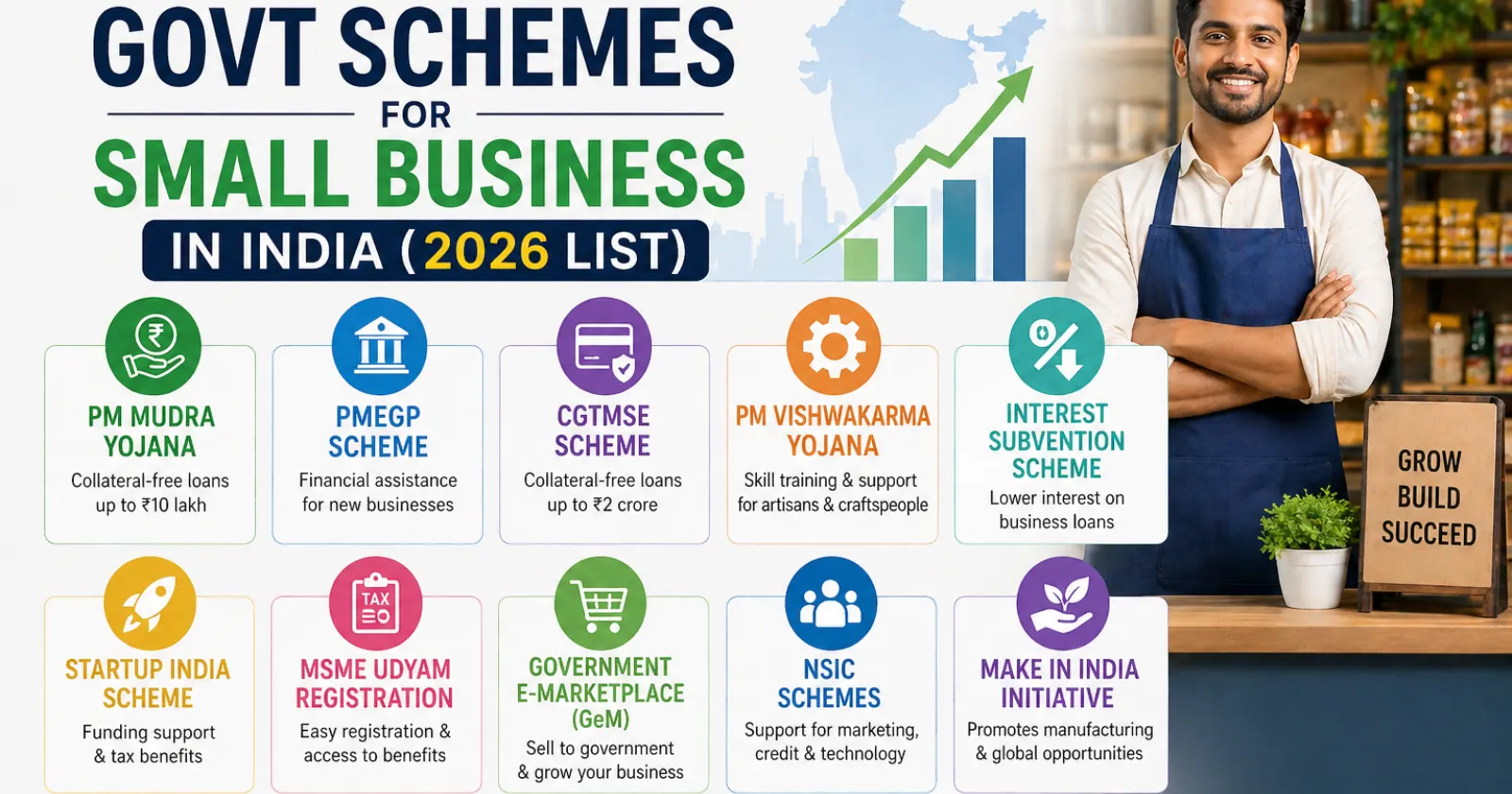
India has multiple central government schemes specifically designed for micro and small enterprises. These are not a single unified program — they are separate schemes run by different ministries and banks. The most important ones include PM Mudra Yojana, PMEGP, Stand-Up India, PM Vishwakarma Yojana, and CGTMSE-backed loans.
Loan amounts range from ₹10,000 under Mudra’s Shishu category to ₹1 crore or more under Stand-Up India. Interest rates depend on the bank and your credit profile, but many schemes offer subsidized or concessional rates.
| Scheme Name | Loan / Benefit Amount | Interest Rate | Who Can Apply | Apply Mode |
|---|---|---|---|---|
| PM Mudra Yojana (PMMY) | Up to ₹10 lakh | Approx. 8.5%–12% (bank-dependent) | Non-farm micro/small businesses | Bank / Online via Udyamimitra |
| PMEGP | Up to ₹50 lakh (manufacturing) | Approx. 11%–14% with subsidy | Individuals 18+, new units only | Online via KVIC portal |
| Stand-Up India | ₹10 lakh to ₹1 crore | Base rate + 3% (approx.) | SC/ST and women entrepreneurs | Bank branch / standupmitra.in |
| PM Vishwakarma Yojana | Up to ₹3 lakh (in two stages) | 5% concessional rate | Traditional artisans and craftspeople | Online via pmvishwakarma.gov.in |
| CGTMSE (via banks) | Up to ₹5 crore (collateral-free) | As per lending bank | MSMEs with Udyam Registration | Through scheduled banks / NBFCs |
PM Mudra Yojana — The Most Accessible Option
PM Mudra Yojana remains the most widely used scheme for small businesses in India. It offers loans under three categories: Shishu (up to ₹50,000), Kishore (₹50,001 to ₹5 lakh), and Tarun (₹5 lakh to ₹10 lakh).
No collateral is required for Mudra loans. You can apply through any public sector bank, private bank, microfinance institution, or online via the Udyamimitra portal. The loan can be used for working capital, equipment purchase, or business expansion.
In many cases, Shishu loans are processed faster. Tarun category loans may require more documentation and take longer depending on the bank branch.
PMEGP — For New Business Setup With Subsidy
The Prime Minister’s Employment Generation Programme (PMEGP) is specifically for people who want to start a new manufacturing or service unit. It is not for existing businesses.
The subsidy under PMEGP ranges from 15% to 35% of the project cost depending on your category (general, SC/ST, women, minorities, ex-servicemen) and location (urban or rural). The remaining amount is a bank loan.
For manufacturing units, the maximum project cost is ₹50 lakh. For service units, it is ₹20 lakh. Applications are submitted online through the KVIC (Khadi and Village Industries Commission) portal.
Stand-Up India — Focused on SC/ST and Women
Stand-Up India is a targeted scheme that ensures at least one SC or ST borrower and one woman borrower per bank branch receives a loan between ₹10 lakh and ₹1 crore for setting up a greenfield enterprise.
This scheme is backed by CGTMSE guarantee, which means the bank has a safety net — making them more willing to lend. You can check your eligibility and apply through standupmitra.in or visit your nearest scheduled commercial bank branch.
PM Vishwakarma Yojana — For Artisans and Craftspeople
Launched in 2023 and continuing strongly in 2026, PM Vishwakarma Yojana covers 18 traditional trades including carpenters, blacksmiths, potters, cobblers, tailors, and weavers. If your work involves a tool and a traditional skill, you likely qualify.
The scheme provides skill training with a daily stipend, a toolkit incentive of ₹15,000, and collateral-free loans — ₹1 lakh in the first stage and up to ₹2 lakh in the second stage — at a concessional interest rate of 5%.
Who Can Apply for These Schemes
- Indian citizens aged 18 years and above
- Micro and small business owners with Udyam Registration
- Women entrepreneurs (priority in most schemes)
- SC/ST applicants (additional benefits under Stand-Up India and PMEGP)
- Traditional artisans and craftspeople (PM Vishwakarma)
- New business applicants (PMEGP — new units only)
- Existing businesses looking to expand (Mudra Kishore/Tarun, CGTMSE)
Documents You Will Typically Need
- Aadhaar card and PAN card
- Udyam Registration certificate
- Bank account details (last 6–12 months statements)
- Business address proof (rent agreement, utility bill)
- Project report or business plan (required for PMEGP and larger loans)
- Caste certificate (if applying under SC/ST category)
- Passport-size photographs
Reality Check — What Actually Happens on the Ground
I want to be honest with you here. These schemes exist and the money is real — but the process is not always smooth. Bank branches in smaller towns often have limited awareness of newer schemes. Some branches may ask for collateral even when the scheme says it is collateral-free.
PMEGP applications can take 3 to 6 months for approval in many cases. Mudra loans above ₹5 lakh often require a credit score check, and rejections happen if your CIBIL score is below 650 approximately. Incomplete project reports are one of the most common reasons for rejection.
If a bank branch is unhelpful, you have the right to escalate to the District Lead Bank or contact the MSME helpline at 1800-11-0007.
A Practical Example
For example, consider a woman in a semi-urban area who runs a small tailoring unit. In many cases, she could register on Udyam, apply under PM Vishwakarma for the ₹1 lakh first-stage loan at 5% interest, complete the free skill training, and use the ₹15,000 toolkit grant to buy a better sewing machine — all within 60 to 90 days if her documents are in order.
This is not a guaranteed outcome, but it is a realistic one when the process is followed correctly.
What You Should Do Next
Start with Udyam Registration at udyamregistration.gov.in — it is free, takes under 10 minutes, and is the foundation for accessing almost every scheme listed here. Once registered, identify which scheme fits your business stage: new setup, existing expansion, or traditional craft. Then visit your nearest bank branch or use the official portals listed above. Do not pay any agent or middleman — all these applications are free of cost. The opportunity is real; the only thing standing between you and it is taking that first step today.