
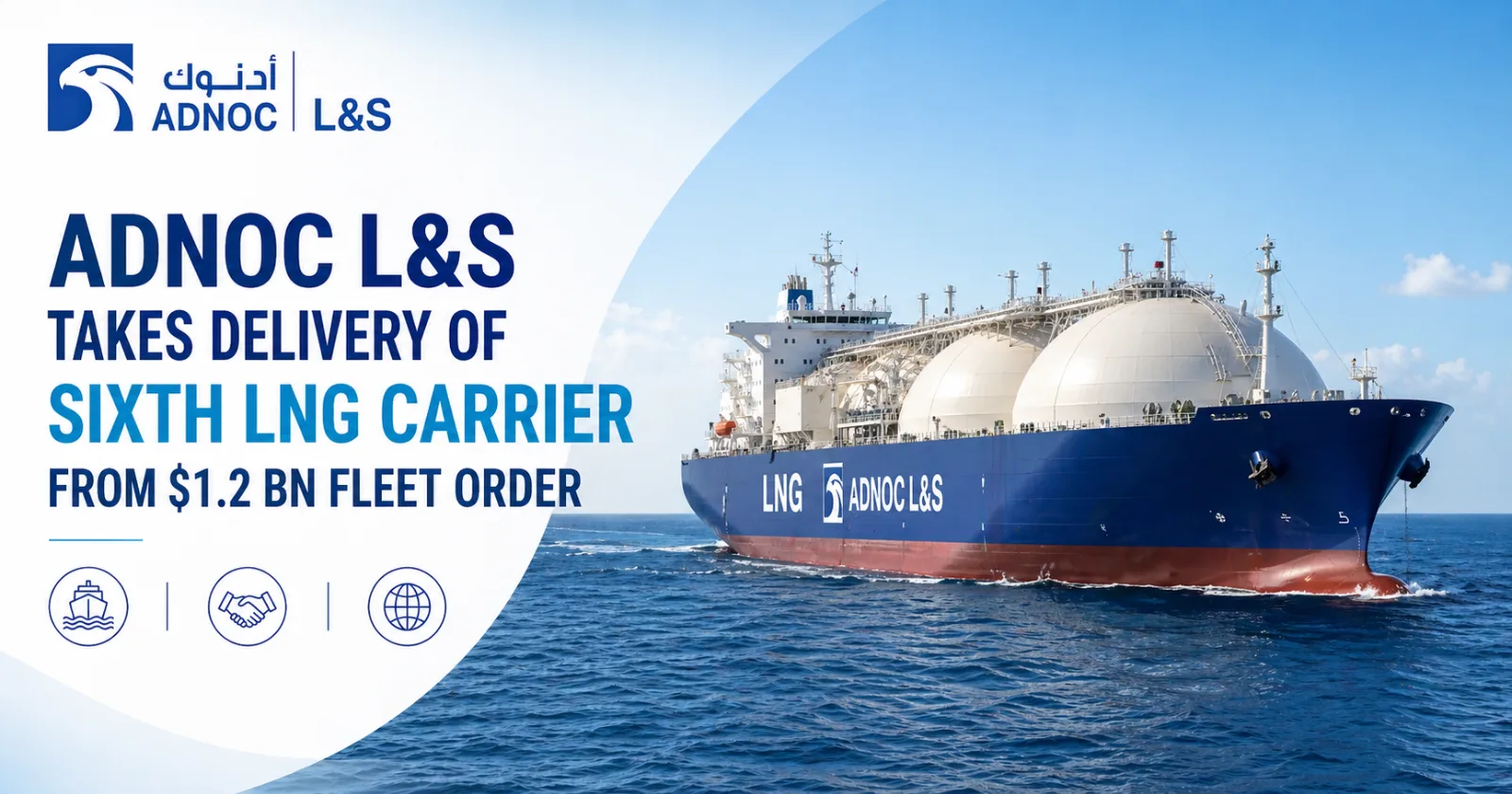
Six vessels into a $1.2 billion shipbuilding programme, and ADNOC Logistics & Services is quietly assembling one of the most commercially locked-in LNG fleets in the region. The latest delivery isn’t just another hull hitting the water — it represents a deliberate bet on long-term contracted revenue at a time when global energy logistics remain under strain.
The company has received its sixth next-generation LNG carrier, named “Al Taweelah,” from Jiangnan Shipyard in Shanghai. The vessel carries a capacity of 175,000 cubic metres, enough to transport around 1.1 terawatt-hours of energy in a single shipment. That volume can cover typical winter gas demand for roughly 100,000 households in Central Europe.
For those of us tracking ADNOC L&S as an investment story, the fleet expansion matters less for the hardware and more for what sits behind it: contracted earnings visibility that few peers in the global shipping space can match right now.
What the ADNOC L&S LNG Fleet Programme Means for MENA Energy Logistics
The UAE has spent the better part of a decade positioning itself not just as an energy producer but as a logistics backbone for global hydrocarbon supply chains. ADNOC L&S sits at the centre of that ambition. Before this fleet programme began in 2022, the company’s LNG shipping capacity was significantly smaller and reliant on older tonnage.
The $1.2 billion order placed with Jiangnan Shipyard was designed to close that gap. Each new carrier brings modern propulsion systems and advanced energy-efficiency technologies that the company says cut methane emissions by up to 50% compared with older-generation vessels. That’s a material improvement at a time when charterers and regulators are both scrutinising shipping emissions more closely.
For the broader MENA energy sector, this fleet build-out signals a shift. The region’s national energy companies are no longer content to sell molecules at the wellhead. They want to control the value chain all the way to the discharge terminal, and ADNOC L&S is the vehicle for that strategy on the maritime side.
ADNOC L&S Sixth LNG Carrier Delivery and Fleet Expansion Details
The “Al Taweelah” was delivered during a ceremony at Jiangnan Shipyard in Shanghai. Captain Abdulkareem Al Masabi, CEO of ADNOC L&S, stated that each new carrier strengthens the company’s ability to reliably deliver energy and essential commodities across international routes, particularly when supply chains are under pressure.
He added that the company continues to expand fleet capacity in close alignment with customer demand, seizing commercial opportunities while securing long-term earnings visibility. For investors, he said, this translates into sustainable value creation and shareholder returns.
Most of the additional LNG capacity has been committed under long-term contracts with both third-party customers and group entities. Around 60% of revenue from ADNOC L&S and its AW Shipping joint venture is secured through long-term agreements. That revenue structure is what gives the stock its defensive quality in a volatile shipping market.
Beyond the current LNG programme, the company’s fleet pipeline is substantial. Vessels under construction include seven Very Large Ethane Carriers and four Very Large Ammonia Carriers under a $1.9 billion AW Shipping order. ADNOC L&S also ordered eight additional LNG carriers worth approximately $2.5 billion from Samsung Heavy Industries and Hanwha Ocean.
| Fleet Programme | Vessel Type | Order Value | Builder | Status |
|---|---|---|---|---|
| 2022 LNG Order | LNG Carriers (175,000 cbm) | $1.2 billion | Jiangnan Shipyard | 6 of programme delivered |
| AW Shipping Order | 7 VLECs + 4 VLACs | $1.9 billion | Various | Under construction |
| 2024 LNG Order | 8 LNG Carriers | ~$2.5 billion | Samsung Heavy / Hanwha Ocean | Under construction |
How the Contracted Revenue Model Works
I find the earnings structure here worth unpacking because it’s central to the investment case. Unlike spot-market-dependent shipping companies that ride freight rate cycles, ADNOC L&S has locked in a significant portion of its fleet revenue under multi-year agreements. The 60% long-term contract figure covers both the parent company’s fleet and the AW Shipping joint venture.
In practical terms, this means that even if LNG spot charter rates decline, a majority of the fleet generates predictable cash flows. The remaining capacity can then be deployed opportunistically when rates spike, as they have repeatedly since 2022 due to European gas supply disruptions and Asian demand growth.
Think of it as a barbell approach: a stable contracted base on one end, and spot market upside on the other. For a company with this much capital deployed in newbuilds, that structure is essential to servicing the investment and returning capital to shareholders.
What This Does Not Change
The delivery of a sixth carrier, while operationally significant, does not alter the fundamental risk profile overnight. The remaining vessels from the 2022 order still need to be delivered on schedule, and shipyard delays remain a persistent industry risk. The $2.5 billion Samsung Heavy and Hanwha Ocean order is still in early construction phases, and those vessels won’t contribute to earnings for some time.
There’s also the question of LNG market dynamics beyond 2027, when a wave of new global liquefaction capacity is expected to come online. More supply could soften charter rates and reduce the premium ADNOC L&S currently captures on its uncommitted tonnage. The company has not disclosed specific contract durations or rate terms, so the precise margin protection remains opaque to outside investors.
The fleet’s emissions improvements, while meaningful, do not yet meet the most aggressive decarbonisation targets being discussed in European regulatory circles. The 50% methane reduction is measured against older vessels, not against zero-emission benchmarks.
The near-term beneficiaries are clear. ADNOC L&S shareholders gain from incremental contracted revenue as each vessel enters service. Third-party LNG buyers, particularly in Europe and Asia, gain access to modern, efficient tonnage at a time when the global LNG carrier orderbook is stretched. The UAE’s broader energy strategy benefits from having a national champion capable of competing with established players like Qatar Energy’s shipping arm and international owners such as Flex LNG and Nakilat.
ADNOC L&S Fleet Growth Signals a Wider MENA Logistics Ambition
Zoom out, and this delivery fits into a pattern I’ve been watching across the Gulf. National energy companies are vertically integrating at speed, moving downstream into shipping, trading, and distribution. ADNOC L&S is arguably the most visible example, but Saudi Arabia’s Bahri and Qatar’s Nakilat are pursuing similar strategies. The combined fleet investment across these three entities now runs into the tens of billions of dollars.
For MENA as a region, controlling energy logistics isn’t just a commercial play. It’s a strategic one. When you own the ships, you control delivery timing, route flexibility, and counterparty relationships. That matters enormously in a world where energy security has returned to the top of every government‘s agenda.
If you’re positioned in MENA energy equities or considering exposure to the region’s logistics infrastructure, the ADNOC L&S fleet programme deserves close attention. The contracted revenue base, the scale of the orderbook, and the emissions profile of the new tonnage all point to a company building for the next decade, not just the next quarter. I’d keep a close eye on delivery timelines and any new charter announcements as the remaining vessels come off the slipway.