
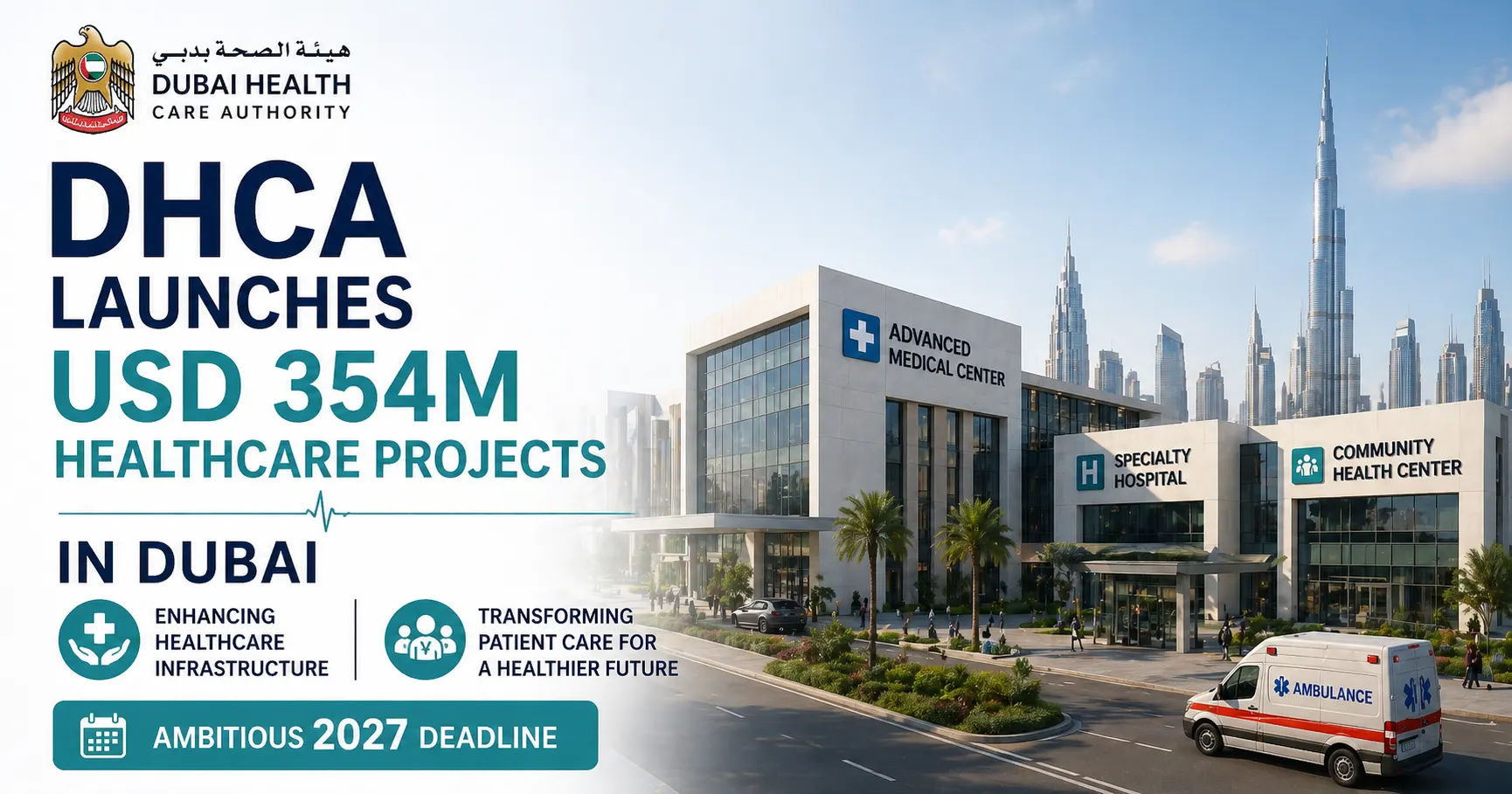
A USD 354 million construction pipeline just broke ground in one of Dubai‘s most strategically positioned free zones — and the completion clock is already ticking toward November 2027. For investors tracking healthcare infrastructure in the Gulf, the signal here is less about bricks and more about where capital is being directed next.
Dubai Healthcare City Authority has formally commenced work on two flagship developments, PIXEL DHCC and IBN SINA+, as part of its AED 1.3 billion expansion agenda. The projects aim to strengthen Dubai’s positioning as a global healthcare investment destination while aligning with national economic diversification targets.
What Is DHCA’s Expansion and Why It Matters for MENA
Dubai Healthcare City has operated as the region’s largest free zone dedicated to healthcare and wellness for over two decades. Yet the infrastructure within it has aged, and demand for purpose-built clinical and commercial space has outpaced supply as medical tourism and specialist care grow across the Gulf.
The AED 1.3 billion development pipeline represents DHCA’s most significant capital commitment in years. It responds to a structural gap: the UAE’s healthcare sector needs modern, sustainability-certified facilities that attract foreign operators and institutional investors simultaneously. Without new supply, the free zone risks losing tenants to newer developments in Dubai South or Abu Dhabi‘s healthcare clusters.
I see this as a direct response to competitive pressure within the GCC healthcare real estate market, where Saudi Arabia’s NEOM and Riyadh health districts are drawing attention and capital.
PIXEL DHCC and IBN SINA+ Construction Details Confirmed
PIXEL DHCC will be a nine-storey commercial building spanning 13,000 square metres. Designed by P&T Architects and Engineers Ltd, it targets LEED Platinum certification — a first for any asset within Dubai Healthcare City. The building will offer flexible office configurations with ground-floor retail, positioning it for healthcare companies, medtech firms, and wellness brands seeking premium commercial space.
IBN SINA+ is a five-storey, shell-and-core healthcare facility covering 5,800 square metres. Designed by Dubai-based DAR, it will accommodate surgical suites, diagnostic centres, outpatient clinics, and medical offices. The project extends the existing IBN SINA complex, which already operates as a clinical anchor within the DHCC ecosystem.
Both projects target completion by November 2027. The groundbreaking ceremony was attended by Issam Galadari, CEO of DHCA; Dr. Khalil Charif, Managing Partner at International Foundation Group LLC; Roula El Hachem Terrien, CEO of DAR; and James Abbott, Group Director at P&T Architects.
Galadari stated that delivery of sustainable infrastructure will enhance investor appeal and drive foreign direct investment into the free zone. He explicitly linked the initiative to the Dubai Economic Agenda D33 and the UAE Net Zero 2050 Strategy.
How the Two Projects Serve Different Market Segments
What I find notable is the deliberate split between commercial and clinical. PIXEL DHCC targets the office and retail segment — think healthcare consultancies, insurance firms, pharmaceutical regional offices, and wellness retail. IBN SINA+ targets operators who need clinical-grade space without the cost of a full fit-out from scratch, since it delivers in shell-and-core format.
| Feature | PIXEL DHCC | IBN SINA+ |
|---|---|---|
| Type | Commercial (Office + Retail) | Healthcare Facility |
| Floors | 9 | 5 |
| Area | 13,000 sq m | 5,800 sq m |
| Designer | P&T Architects | DAR |
| Certification | LEED Platinum | Not specified |
| Delivery Format | Fitted | Shell and Core |
| Completion | November 2027 | November 2027 |
This dual approach allows DHCA to serve both the demand side (clinical operators needing space) and the ecosystem side (support services, corporate tenants, and retail that make a healthcare district function as a community rather than a collection of clinics).
What This Does Not Change
The AED 1.3 billion figure represents the full pipeline, not just these two projects. DHCA has not disclosed the individual cost breakdown for PIXEL or IBN SINA+ separately, nor has it confirmed leasing rates or anchor tenants. The shell-and-core delivery of IBN SINA+ means operators will bear additional fit-out costs, which could slow occupancy timelines post-completion.
Additionally, LEED Platinum certification for PIXEL remains a target, not a confirmed outcome — final certification depends on construction execution and operational performance metrics assessed after delivery. The broader complementary infrastructure projects mentioned by DHCA lack specific timelines or budgets at this stage.
For investors expecting immediate yield, the November 2027 completion date means no rental income for at least 18 months from today.
The primary beneficiaries in the near term are healthcare operators seeking purpose-built clinical space in a regulated free zone, and commercial tenants in the medtech and wellness sectors looking for premium, sustainability-certified offices. Foreign investors targeting Dubai’s healthcare sector gain a tangible new entry point once leasing opens, likely in mid-2027. DHCA itself benefits from renewed relevance in a competitive landscape.
Dubai’s Healthcare Investment Push Enters Its Infrastructure Phase
I think what this signals is a maturation of Dubai’s healthcare strategy. The emirate spent years building regulatory frameworks and attracting operators. Now the capital is flowing into physical infrastructure — the kind that locks in tenants for decades and creates compounding ecosystem effects. With Saudi Arabia investing hundreds of billions into its own healthcare cities, Dubai’s response is not to match scale but to offer speed, sustainability credentials, and an established regulatory environment. The USD 354 million DHCA pipeline is a bet that quality and certification will win over sheer size.
If you’re evaluating healthcare real estate exposure in the MENA region, these two projects deserve a place on your watchlist — particularly once DHCA releases leasing terms and confirms anchor tenants, which I expect will surface in the first half of 2027.