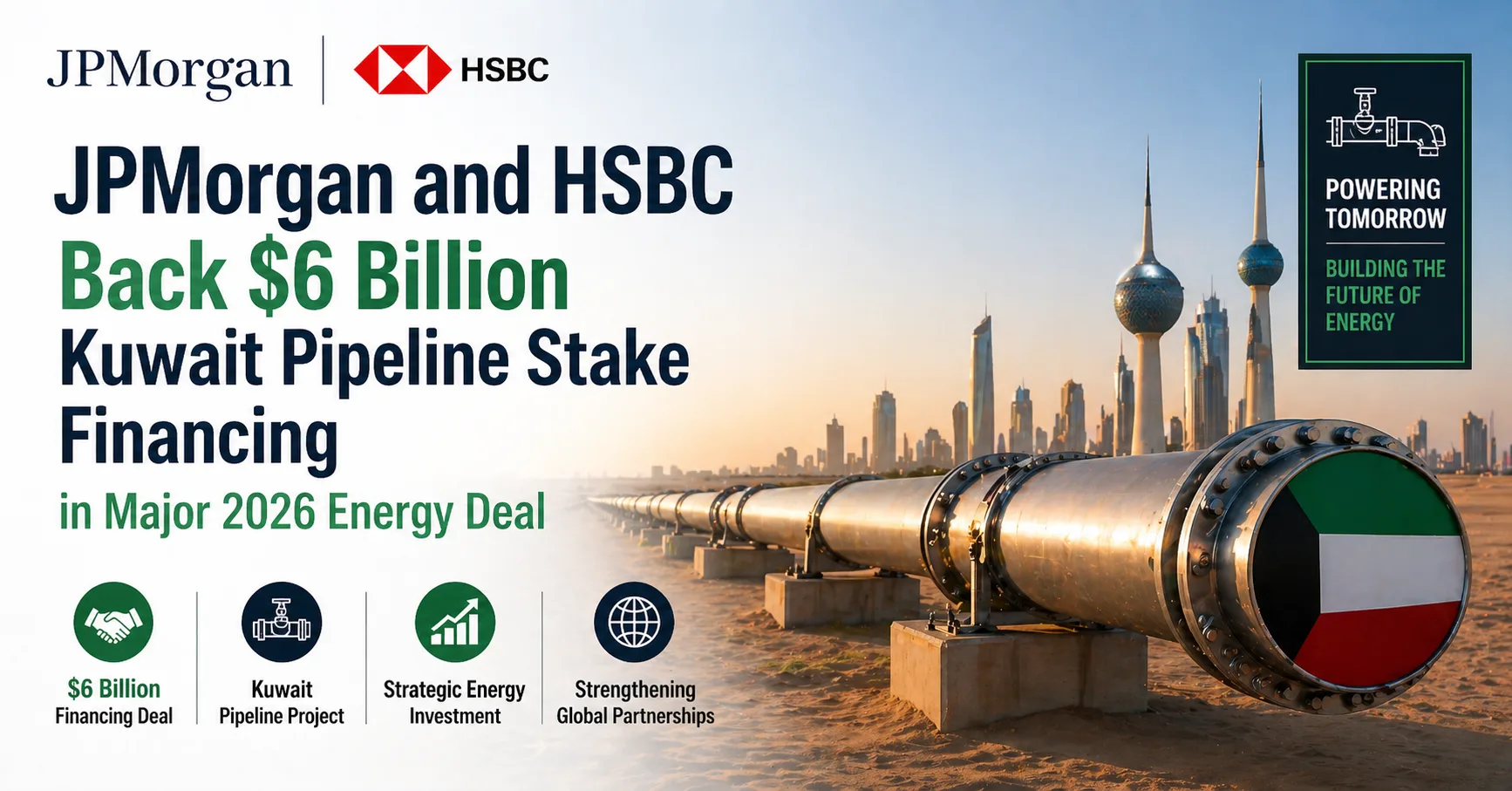
Six billion dollars in committed financing for a single pipeline stake tells you exactly where global banks see the next wave of Gulf infrastructure value. When JPMorgan and HSBC line up alongside Kuwaiti lenders for a deal of this size, the signal extends well beyond one transaction.
Kuwait Petroleum Corporation is preparing to sell a stake in its crude oil pipeline network, a deal valued at roughly $7 billion by investors. A syndicate led by HSBC and now joined by JPMorgan, the National Bank of Kuwait, and Kuwait Finance House has assembled a $6 billion financing package to back prospective buyers. The sale process hit turbulence earlier this month but remains active, with a revised bid deadline now set.
What Kuwait’s Pipeline Network Means for MENA Energy Finance
Kuwait’s pipeline infrastructure is not a peripheral asset. The network transports crude oil and refined products across the country, connecting oilfields to export terminals on the Arabian Gulf coast. That makes it a strategic artery for one of OPEC’s key producers.
For years, Gulf national oil companies kept pipeline assets tightly held. That changed as Saudi Aramco, ADNOC, and Bahrain’s Bapco Energies completed their own pipeline-linked transactions, unlocking billions in capital while retaining operational control. Kuwait is now following that playbook.
I see this as part of a broader pattern across the region. Sovereign energy companies are monetizing midstream infrastructure to fund diversification, reduce balance sheet concentration, and attract long-term institutional capital. The financing structures around these deals have become a product category of their own in Gulf banking.
$6 BN Syndicate Takes Shape as Bid Deadline Shifts to Late April
The financing package carries a 20-year tenure with indicative pricing of 170 basis points over the Secured Overnight Financing Rate. One source described the pricing as competitive under current regional conditions, which is notable given the geopolitical disruption that briefly stalled the process.
Kuwait Petroleum Corporation pushed back the deadline for preliminary bids to April 28 from April 7. The extension came after investors requested additional time following the US-Israeli conflict with Iran, which created significant regional uncertainty. The state energy group reported “severe material damage” at some operating units following drone attacks, though it did not identify the specific assets affected.
A ceasefire between the United States and Iran was announced on April 8, which helped stabilize sentiment. Still, investors have sought guarantees to cover potential disruptions in volume linked to Kuwait’s pipeline network and the Strait of Hormuz, according to one source familiar with the discussions.
HSBC and JPMorgan declined to comment. Kuwait Petroleum Corporation and the two Kuwaiti lenders did not respond to requests for comment.
| Detail | Value |
|---|---|
| Total Financing Package | $6 billion |
| Estimated Transaction Value | ~$7 billion |
| Loan Tenure | 20 years |
| Indicative Pricing | 170 bps over SOFR |
| Lead Arrangers | HSBC, JPMorgan |
| Kuwaiti Lenders | National Bank of Kuwait, Kuwait Finance House |
| Revised Bid Deadline | April 28, 2026 |
| Original Bid Deadline | April 7, 2026 |
How the Financing Structure Works in Practice
A 20-year loan at 170 basis points over SOFR is designed for infrastructure-grade returns. Buyers of pipeline stakes typically structure these as yield-generating assets, similar to toll roads or utilities, where predictable cash flows from transport fees service the debt over decades.
The syndicate model here is familiar from recent Gulf deals. International banks like HSBC and JPMorgan bring global distribution capability and credit structuring expertise. Local lenders like National Bank of Kuwait and Kuwait Finance House provide regional liquidity and regulatory familiarity. Together, they de-risk the package for institutional buyers who may include sovereign wealth funds, pension funds, or infrastructure-focused private equity.
I find the pricing particularly telling. At 170 basis points over SOFR, the syndicate is pricing in a degree of geopolitical risk but not a crisis premium. That suggests confidence in the ceasefire holding and in Kuwait’s long-term export capacity.
What This Does Not Resolve
The ceasefire calmed markets, but it did not eliminate the structural risks investors flagged. Volume guarantees tied to the Strait of Hormuz remain a live negotiation point. Any future disruption to shipping lanes would directly affect the value proposition of a pipeline network built to feed Gulf export terminals.
Kuwait Petroleum Corporation has not disclosed which operating units sustained damage from the drone attacks. That ambiguity matters for due diligence. Buyers will need clarity on asset condition, insurance coverage, and repair timelines before committing capital at the $7 billion valuation level. The deal is progressing, but it is not yet closed.
The investors who stand to benefit most are those with long-duration mandates and appetite for Gulf infrastructure exposure. Sovereign wealth funds and global pension allocators fit that profile. For Kuwaiti banks, participation in the syndicate deepens their role in the country’s energy transition financing. The timeline depends on how quickly bid evaluation proceeds after the April 28 deadline, with a final close likely extending into the second half of 2026.
Gulf Pipeline Deals Signal a New Phase in Energy Capital Recycling
This transaction sits within a clear regional trajectory. Saudi Aramco’s pipeline deals raised tens of billions. ADNOC has used similar structures to fund its downstream and clean energy expansion. Now Kuwait is entering the same market, and the participation of global banks confirms that international capital sees these assets as investable at scale.
For MENA finance professionals, the pattern is worth watching closely. Pipeline monetization is becoming a repeatable capital markets product across the Gulf, and the financing architectures being built today will likely serve as templates for the next generation of energy infrastructure deals in the region.
If you’re tracking Gulf energy finance or positioning a portfolio around MENA infrastructure, this is a deal worth following through to close. The syndicate composition, the pricing, and the investor protections being negotiated here will set benchmarks for what comes next across the region.