
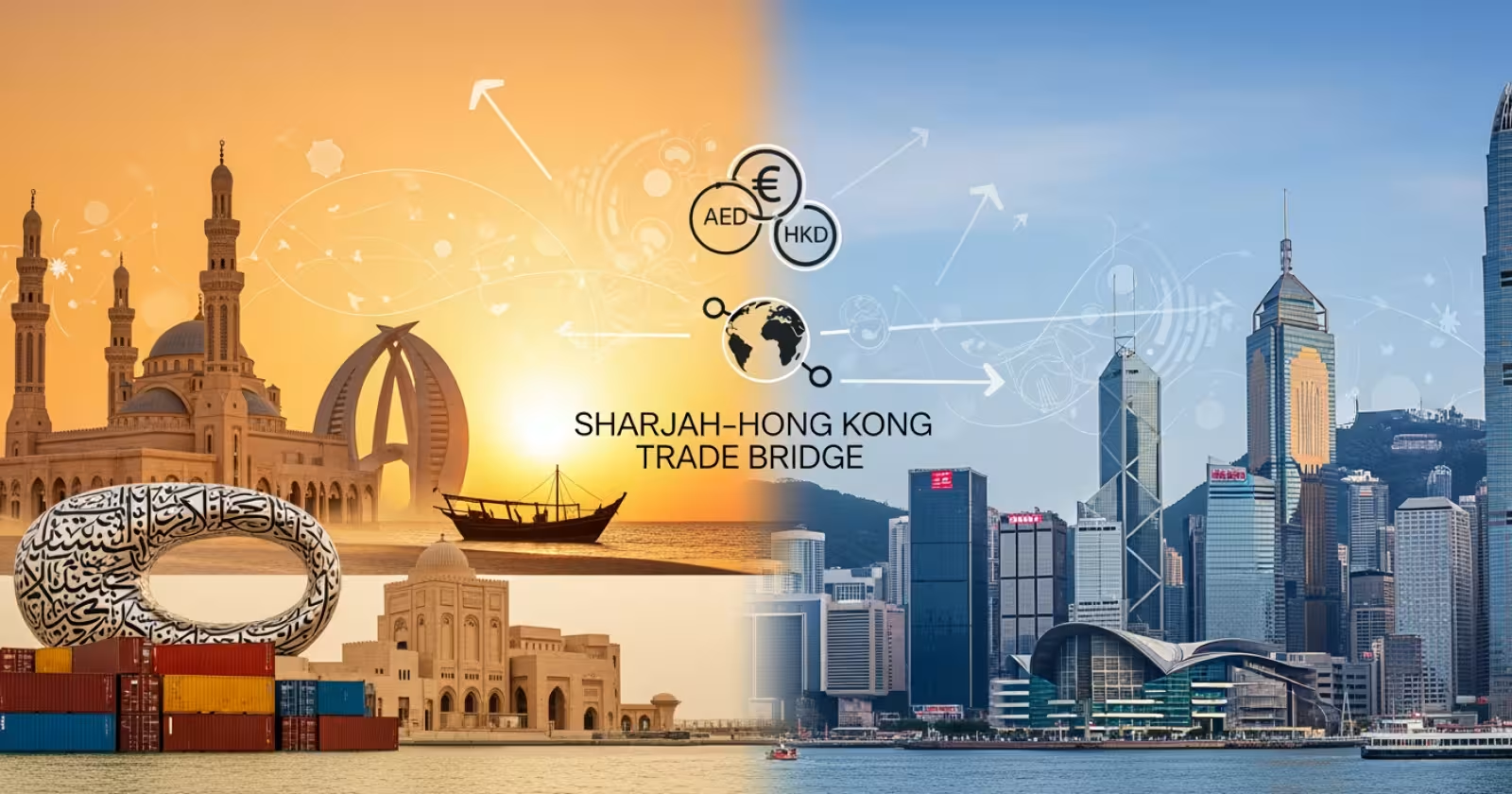
When two trade hubs on opposite ends of Asia’s commercial corridor start talking about opening offices on each other’s turf, the conversation has moved well past courtesy visits. That is exactly where Sharjah and Hong Kong now find themselves, with formal discussions underway to convert diplomatic goodwill into structured investment channels.
The Sharjah Chamber of Commerce and Industry sat down with the Hong Kong Economic and Trade Office in Dubai to map out new investment partnerships, deepen exhibition-sector ties, and potentially establish a permanent Hong Kong trade presence inside the emirate. The talks signal a deliberate effort to pull Asian enterprise capital into Sharjah’s free zones and manufacturing base.
What Sharjah-Hong Kong Trade Ties Mean for MENA Investment
Sharjah has spent the past several years positioning itself as a cost-competitive alternative to Dubai for manufacturing, logistics, and mid-market trade. Its free zones offer lower setup costs, and the emirate’s industrial base covers everything from construction materials to food processing. Hong Kong, meanwhile, remains one of Asia’s primary re-export hubs and a global center for jewelry, gemstones, and financial services.
The overlap is not accidental. I find the alignment between Sharjah’s manufacturing and trade infrastructure and Hong Kong’s strengths in luxury goods, finance, and advanced manufacturing to be one of the more practical bilateral corridors emerging in the Gulf right now. For MENA investors and business owners, this kind of institutional bridge-building tends to precede actual capital deployment by 12 to 18 months.
The relationship also builds on existing arbitration cooperation. The Sharjah International Commercial Arbitration Center, known as Tahkeem, formalized a partnership with Hong Kong focused on alternative dispute resolution frameworks. That kind of legal infrastructure matters when cross-border deals start scaling.
Sharjah Chamber and Hong Kong Map Out Sector-Specific Partnerships
The meeting took place at the Chamber’s headquarters and brought together Abdul Aziz Al Shamsi, Assistant Director-General for Communication and Business Sector, and Simon Chan, Director-General of the Hong Kong Economic and Trade Office in Dubai. Senior officials from both sides joined the discussions.
Both parties referenced a prior Hong Kong trade delegation visit led by the Secretary for Justice, followed by a business mission comprising 20 senior executives who explored partnership opportunities across multiple sectors. Those engagements covered advanced manufacturing, artificial intelligence, construction robotics, energy, healthcare, real estate, financial services, and the luxury segment including jewelry, diamonds, and watches.
Al Shamsi confirmed that economic relations between Sharjah and Hong Kong continued to gain momentum, supported by growing collaboration across these sectors. The Hong Kong delegation, for its part, praised Sharjah’s business-enabling infrastructure, strategic location, and competitive free zones.
| Sector | Sharjah Strength | Hong Kong Strength |
|---|---|---|
| Jewelry and Luxury Goods | Middle East Watch and Jewelry Show, Jewels of Emirates Show | Global gemstone and watch trading hub |
| Advanced Manufacturing | Industrial free zones, lower operating costs | Precision manufacturing, robotics expertise |
| Financial Services | Growing fintech and arbitration infrastructure | Asia-Pacific financial gateway |
| Real Estate | Competitive property prices, freehold zones | Institutional investor capital |
| AI and Robotics | Construction and logistics applications | R&D and commercialization networks |
Exhibitions as a Strategic Investment Channel
A significant portion of the discussions centered on the exhibitions sector. Both sides explored increasing Hong Kong’s participation in Sharjah-hosted events, particularly the Middle East Watch and Jewelry Show and the Jewels of Emirates Show. These are not small-scale trade fairs. The jewelry and watch segment represents one of the highest-value verticals in Gulf exhibition calendars.
In parallel, the meeting reviewed ways to strengthen UAE representation at Hong Kong exhibitions, leveraging Hong Kong’s global standing in jewelry and gemstones. I see this as a smart two-way play. Exhibition participation is often the first step before companies commit to permanent market entry, and formalizing that pipeline gives both sides a structured path to convert interest into deals.
The Hong Kong delegation also described the partnership as supported by a strong pipeline of aligned opportunities, pointing to Sharjah’s trade potential and its position as a gateway to broader MENA markets.
What This Does Not Change
It is worth being clear about what remains unconfirmed. No specific investment figures were disclosed. No formal agreement to open a Hong Kong Economic and Trade Office in Sharjah has been signed, though both sides discussed the possibility. The talks are exploratory, and institutional meetings of this kind do not always convert into binding commitments.
Sharjah also faces competition from other emirates actively courting Asian capital. Dubai and Abu Dhabi both maintain deeper institutional ties with Hong Kong and larger exhibition infrastructure. The emirate’s pitch rests on cost competitiveness and sector-specific alignment rather than scale.
For businesses already operating in Sharjah’s free zones, the immediate impact is limited. The benefits, if they materialize, will flow through increased exhibition traffic, new entrants from Hong Kong’s business community, and potentially smoother dispute resolution for cross-border contracts.
Investors and entrepreneurs with exposure to jewelry, advanced manufacturing, or financial services stand to gain the most. If Hong Kong does establish a formal trade office in Sharjah, it would create a direct institutional channel for Asian enterprises looking at the emirate. The timeline for that, however, remains undefined.
Sharjah’s Quiet Play for Asian Enterprise Capital
I think this story fits into a broader pattern that does not get enough attention. While Abu Dhabi and Dubai dominate headlines with sovereign fund deals and mega-projects, Sharjah is building a quieter but increasingly structured network of bilateral trade corridors. The Hong Kong engagement is one thread in a wider effort to attract mid-market Asian capital into the emirate’s industrial and commercial base.
For the MENA region, the direction is clear. Trade diversification away from traditional Western corridors and toward Asia-Pacific partners is accelerating at the emirate level, not just at the federal level. Sharjah’s approach, focused on exhibitions, arbitration frameworks, and sector-specific alignment, may lack the headline appeal of billion-dollar sovereign deals, but it targets the commercial middle ground where most actual business gets done.
If you are tracking Sharjah Chamber investment developments or exploring UAE-Asia trade opportunities, this is a corridor worth watching closely. The institutional groundwork is being laid now, and the businesses that position early along these routes tend to capture the most value when formal agreements follow.