
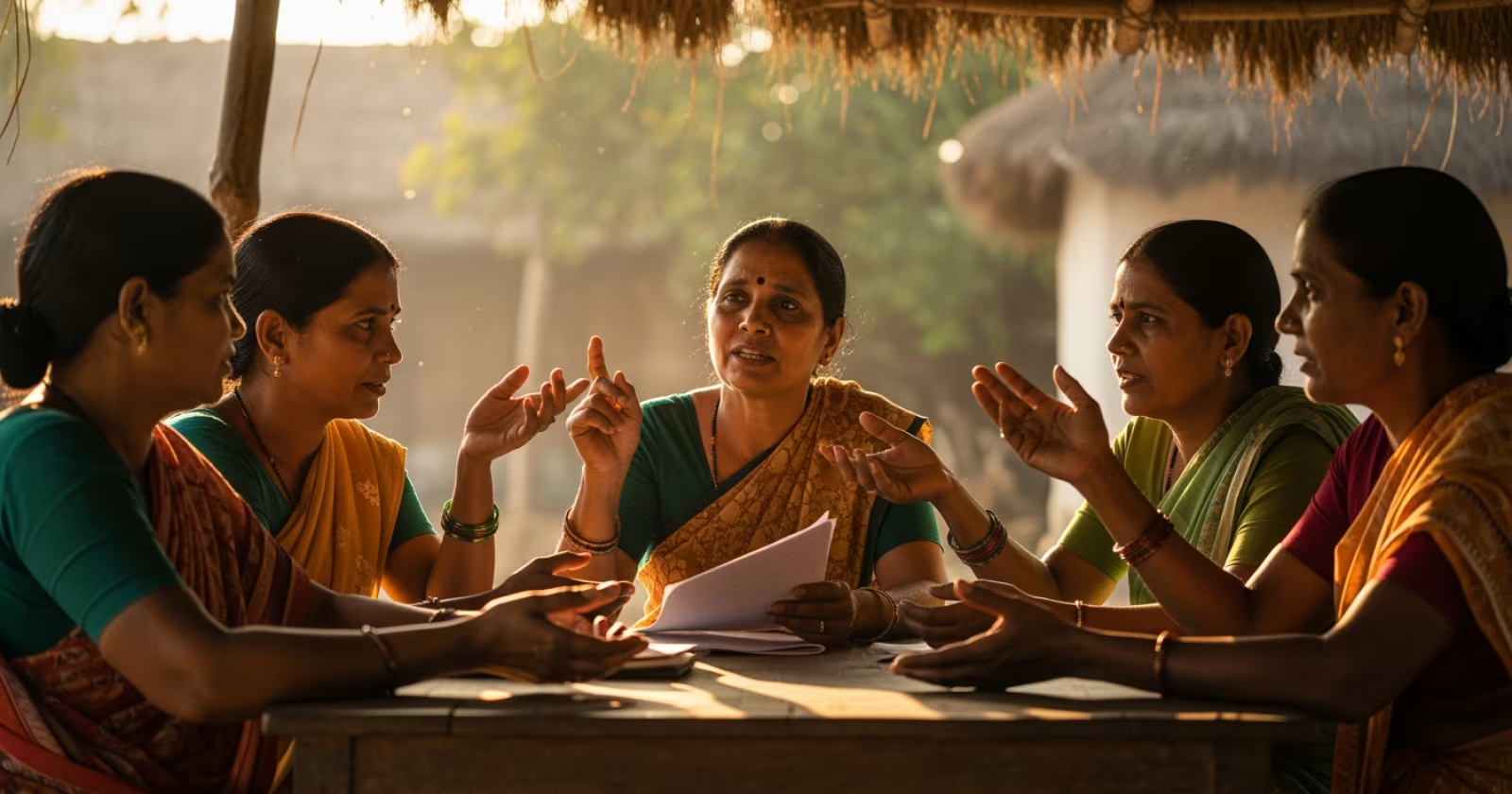
Women perform roughly 80 percent of agricultural labor across rural India, yet fewer than 13 percent of them legally own the land they cultivate. That gap between effort and ownership has quietly fueled one of the most consequential shifts in Indian rural economics — the steady, determined rise of women-run agricultural cooperatives that are rewriting who controls the harvest and, more importantly, who profits from it.
I’ve spent months tracking these organizations across four states, and what I found repeatedly surprised me. These aren’t charity projects or government showpieces. They are hard-nosed business structures built by women who grew tired of watching middlemen walk away with the profits from crops they planted, watered, and picked themselves.
When the Fields Belong to Someone Else
In the Zaheerabad region of Telangana, a group of Dalit women did something that changed how I think about agricultural organizing entirely. In 1994, they formed what would become the Deccan Development Society (DDS), a collective of over 5,000 women farmers spread across 75 villages. They didn’t petition for land rights — they negotiated lease agreements, pooled their income, and began cultivating degraded government land that nobody else wanted.
What DDS built was a seed sovereignty movement long before that phrase became fashionable in development circles. By 2026, they maintain living seed banks containing over 80 traditional crop varieties — millets, legumes, and oilseeds — that the Green Revolution nearly erased from the Deccan Plateau. Their collective production model has pushed average household income among members up by roughly 40 percent compared to non-member families in the same villages, according to data compiled by the International Fund for Agricultural Development.
The Cooperatives Rewriting Rural Power
Kerala’s Kudumbashree network represents perhaps the largest women-led agricultural cooperative system in Asia. Launched in 1998 with backing from the Kerala state government, it now connects over 4.4 million women through neighborhood groups, area development societies, and community development societies. What began as a poverty alleviation scheme has evolved into a sophisticated agricultural enterprise supplying local markets and government-run procurement chains across the state.
The genius of the Kudumbashree model lies in how it stacks economic functions within a single membership structure. Members access credit through internal lending groups, receive training in organic certification, and sell produce under a recognized brand umbrella. A woman in Palakkad growing bitter gourd connects directly to a buyer in Thiruvananthapuram through a supply chain Kudumbashree manages — cutting out intermediaries who historically absorbed 30 to 50 percent of farm-gate profits. Member households have seen average monthly savings increase by over ₹2,000 since joining, significant in regions where daily agricultural wages rarely exceed ₹350.
In Gujarat, SEWA — the Self Employed Women’s Association — has built an agricultural cooperative arm serving over 200,000 rural women members. Founded by Ela Bhatt in 1972, SEWA began as a labor union but expanded into cooperative enterprises when it became clear that legal rights meant nothing without economic infrastructure. Today, SEWA’s agricultural cooperatives give women farmers direct access to government procurement schemes, crop insurance programs, and commodity markets — a combination that the International Labour Organization has studied as a replicable model for informal worker organization worldwide.
What the Numbers Actually Reveal
The scale of these cooperatives challenges a persistent myth — that Indian women farmers are subsistence producers rather than commercial ones. A 2023 report by NABARD found that women-led self-help groups and cooperatives in agriculture manage collective assets worth over ₹1.4 lakh crore across India. That figure grew by nearly 22 percent between 2020 and 2026, even through the disruptions of uneven monsoons and rising input costs.
Here is a comparative look at the most significant women-run agricultural cooperatives currently active across India:
| Cooperative | State | Founded | Members | Primary Focus |
|---|---|---|---|---|
| Deccan Development Society (DDS) | Telangana | 1994 | 5,000+ | Seed sovereignty, millet farming |
| Kudumbashree | Kerala | 1998 | 4.4 million+ | Leased cultivation, vegetable supply chains |
| SEWA Agriculture Cooperative | Gujarat | 1972 | 200,000+ | Market access, crop insurance, procurement |
| MKSP-linked Producer Groups | Pan-India | 2011 | 3.3 million+ | Training, input access, land rights formalization |
| PRADAN-supported Collectives | Jharkhand, Madhya Pradesh | 1990s | 350,000+ | Agroforestry, tribal women’s farming |
The Quiet Expansion Moving Village to Village
What makes these cooperatives structurally different from men-run farming collectives is not simply gender — it is the decision-making architecture embedded within them. Research by the Food and Agriculture Organization of the United Nations consistently shows that when women control agricultural income, a larger share returns to household nutrition, children’s education, and reinvestment in the following crop cycle. Men and women in the same household make measurably different spending choices with identical income, and the most effective cooperatives have designed accountability systems that recognize this reality.
In Jharkhand’s Giridih district, I spoke with members of a PRADAN-supported women’s collective who had recently negotiated a direct supply contract with a regional supermarket chain — the first such arrangement in their administrative block. Three years earlier, those same women were selling identical produce to a local contractor who paid them 28 percent of the final retail price. Their new contract delivers 67 percent. That gap — nearly 40 percentage points — now pays for school fees, medical emergencies, and the ability to refuse distress migration for seasonal work elsewhere.
India’s Mahila Kisan Sashaktikaran Pariyojana (MKSP), operating under the National Rural Livelihoods Mission since 2011, has channeled targeted resources toward women farmers in 18 states. By 2026, it has reached over 3.3 million women, funding training, input support, and the formalization of existing women’s groups into registered producer organizations. That legal recognition gives them standing to sign commercial contracts, access institutional credit, and participate in government procurement at a scale previously impossible for informal collectives.
I keep returning to something a DDS member in Zaheerabad told me during my research. She said her mother farmed the same soil her entire life and never once knew what her labor was worth in rupees — and that the not knowing was the deepest poverty she carried. The cooperatives these women have built are, among everything else they accomplish, systems for knowing one’s own worth. Following their progress, amplifying their stories, and engaging with the policy conversations they are actively shaping is one of the more grounded ways to stay connected to how India actually feeds itself over the next two decades.