
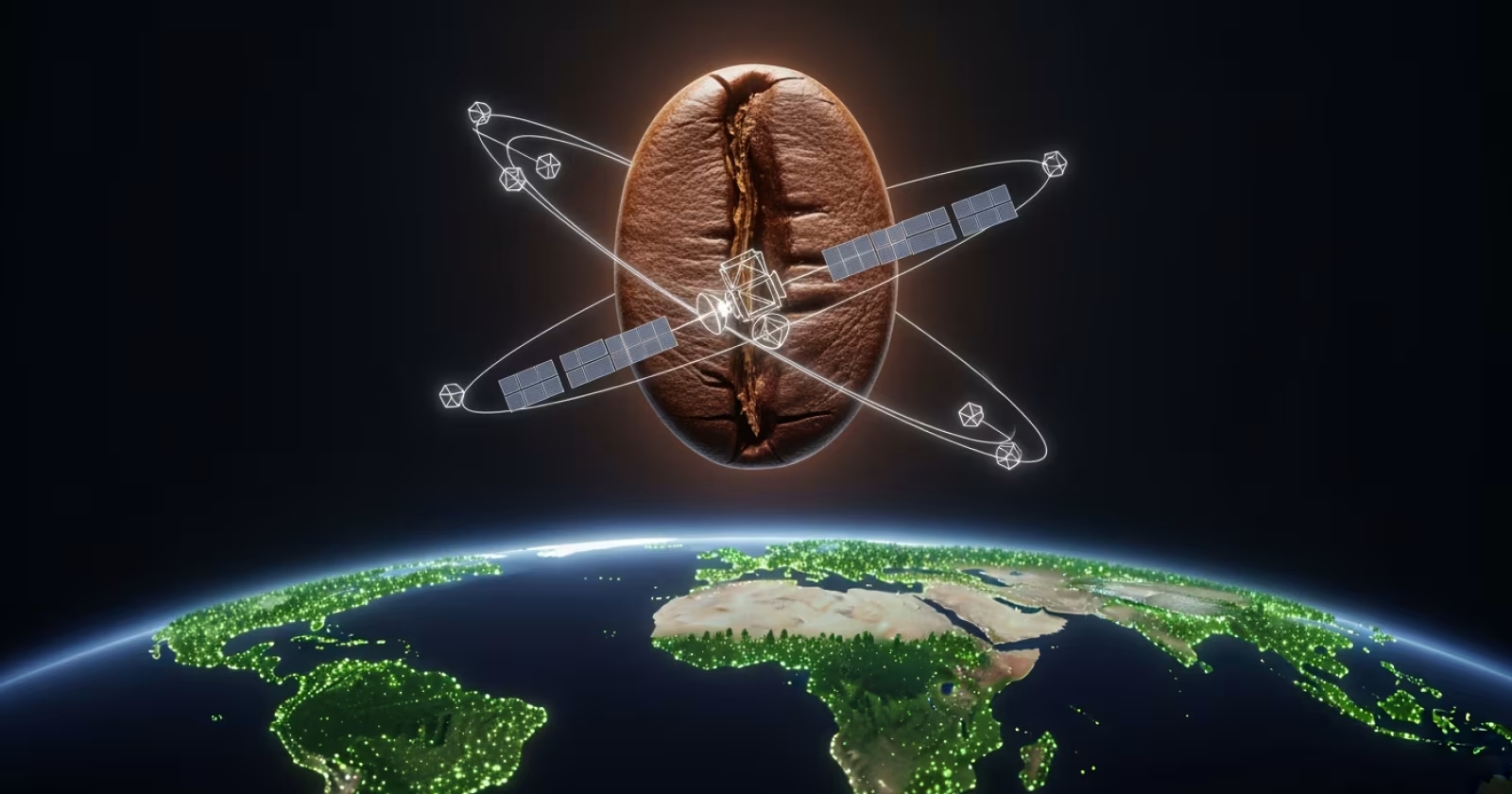
The EU Deforestation Regulation is about to lock millions of smallholder coffee farmers out of European markets — not because they’re clearing forests, but because the maps say they are. That mapping failure is now the target of a multi-company satellite programme that could reshape how the global coffee supply chain proves its sustainability credentials.
A coalition of major coffee companies and commodities traders has launched the Coffee Canopy Partnership, a satellite and AI-powered system designed to accurately map coffee farms and detect nearby forest loss. The initiative directly addresses a compliance gap created by the EU Deforestation Regulation, which bars coffee grown on land classified as forest after December 2020 from entering EU markets. For Australian importers, roasters, and retailers sourcing from East Africa, the implications are worth tracking closely.
What the EU Deforestation Regulation Means for Coffee Supply Chains
The EU Deforestation Regulation (EUDR) is one of the most consequential pieces of trade legislation to hit the global coffee industry in decades. Under its terms, coffee cannot be sold in the EU if it was produced on land that was forested after 31 December 2020.
For large corporations, the regulation is expected to enter into force on 30 December 2026. Micro and small enterprises face a later deadline of 30 June 2027. The compliance burden falls on importers and traders to provide verified geolocation data for every lot they bring to market.
The problem is that existing land classification maps are unreliable. Agroforestry systems and shade-grown coffee plots — farming methods that actively preserve tree cover — are frequently misclassified as natural forest. That misclassification could disqualify sustainable producers from EU trade, regardless of their actual environmental practices.
| Business Category | EUDR Effective Date | Key Compliance Obligation |
|---|---|---|
| Large corporations | 30 December 2026 | Geolocation data required for all coffee lots entering EU |
| Micro and small enterprises | 30 June 2027 | Same obligations, extended deadline |
| Coffee produced before Dec 2020 | Exempt | No deforestation classification applies |
Coffee Canopy Partnership Brings Satellite Precision to Deforestation Tracking
The Coffee Canopy Partnership was announced by JDE Peet’s, now part of Keurig Dr Pepper following the company’s US$24.9 billion acquisition. Joining JDE Peet’s in the initiative are Tchibo, Louis Dreyfus Company, Sucden, Neumann Kaffee Gruppe, Touton, and Sucafina — a group that collectively represents a significant share of global green coffee trade.
The system uses satellite imagery supplied by Airbus, combined with AI models, to map individual coffee farms and identify areas of forest loss in surrounding landscapes. The stated aim is to produce accurate, ground-truthed maps that can be used by farmers, governments, and the coffee industry to restore forests and prevent future deforestation.
The programme will initially focus on East Africa, covering Ethiopia, Tanzania, Kenya, Uganda, Burundi, and Rwanda. Worldwide coverage of all coffee-growing regions is targeted for 2027.
How the Satellite and AI System Actually Works in Practice
Airbus satellite imagery provides high-resolution visual data on land cover across coffee-growing regions. AI models then process that imagery to distinguish between natural forest, agroforestry systems, and cleared land — a distinction that existing government maps frequently get wrong.
The system is designed to be open for consultation by farmers, governments, and the coffee industry. That openness matters: if the maps are to be used as compliance evidence under the EUDR, they need to be contestable and updatable, not static datasets that lock in historical errors.
For shade-grown and agroforestry producers, accurate classification is the difference between market access and exclusion. I’d argue that the open-consultation model is the most commercially significant design choice the partnership has made — it’s what separates a useful compliance tool from another proprietary dataset that nobody trusts.
What the Coffee Canopy Partnership Does Not Resolve
The initiative addresses the mapping problem, but it does not change the underlying regulation. Coffee grown on land that was genuinely deforested after December 2020 will still be excluded from EU markets, regardless of how accurate the new maps become.
The programme also starts with East Africa only. Latin America and Southeast Asia — which together account for the majority of global coffee production — are not covered in the initial phase. Worldwide coverage is targeted for 2027, but that timeline is aspirational, not confirmed.
Whether EU customs authorities will accept Coffee Canopy Partnership data as sufficient EUDR compliance evidence has also not been confirmed. The system is industry-led, not government-endorsed, and that distinction will matter at the border.
Smallholder farmers in Ethiopia, Tanzania, Kenya, Uganda, Burundi, and Rwanda stand to gain most in the near term, particularly those using agroforestry or shade-grown methods that have historically been misclassified. Traders and importers sourcing from East Africa — including those supplying Australian roasters — gain a potential compliance pathway ahead of the December 2026 deadline for large corporations. The timeline is tight, and the mapping work needs to be credible before it can be useful.
Satellite Verification and the Next Phase of Sustainable Sourcing
What strikes me about this initiative is the broader signal it sends: sustainability compliance in FMCG is moving from self-reported data to satellite-level verification. The Coffee Canopy Partnership is one of the first industry-led programmes to operationalise that shift at meaningful scale.
For Australian coffee importers and private label buyers at Coles and Woolworths, the EUDR may not apply directly. But the same mapping infrastructure will increasingly be expected by global retail partners, ESG-focused investors, and domestic consumers who want verified proof rather than pledges. The coffee industry’s willingness to fund its own compliance infrastructure — rather than wait for government mapping programmes — signals that the sector understands what’s at stake commercially.
If you’re sourcing from East Africa or advising brands that do, now is the time to understand how the Coffee Canopy Partnership’s data will interact with your existing due diligence processes — because the December 2026 deadline for large corporations leaves less runway than it looks.
If the Coffee Canopy Partnership’s maps hold up to regulatory scrutiny, the harder question for the rest of the agricultural supply chain is why it took satellite technology to fix a problem that paper maps created decades ago.