India has roughly 640,000 villages, and for decades the dominant assumption was that serious commerce lived only in its cities — in the glass towers of Bangalore, on the trading floors of Mumbai, and inside the wholesale markets of Delhi. That assumption is cracking apart with remarkable force, and the people dismantling it are women running micro-enterprises, farmers selling directly to distant consumers, and first-generation entrepreneurs who never had access to a business school or a nearby bank branch. The scale of what is now unfolding across rural India makes the old story about where wealth gets created look not just incomplete but fundamentally wrong.
A Network That Was There All Along
The infrastructure enabling this shift is not new — it was assembled over three decades of patient, unglamorous work. India’s Self-Help Group network, built with sustained support from NABARD, the National Bank for Agriculture and Rural Development, now links more than 12 million groups across the country, representing roughly 140 million women. These groups pool micro-savings, extend credit among members, and increasingly operate collective enterprises producing everything from organic spices in Koraput, Odisha, to handwoven silk in Kanchipuram, Tamil Nadu.
NABARD’s figures for 2026-26 placed total bank credit mobilized through SHG linkage programs at over ₹1.5 lakh crore — a sum that rivals the loan books of several mid-sized Indian commercial banks. What separates these groups from earlier welfare programs is the commercial discipline embedded inside their structure. Each group maintains ledgers, tracks repayments, and increasingly uses digital platforms to move products beyond the village boundary.
I spent time with a cluster of SHGs in Sitapur district, Uttar Pradesh, and found something that no urban accelerator has quite managed to manufacture. These women already understood supply chains, seasonal demand patterns, and the mechanics of customer trust — they had built all three organically, without a consultant, a pitch deck, or a co-working space in sight. The sophistication was real, even if nobody had written a case study about it.
The Phones That Rewired Rural Commerce
India’s rural mobile internet subscriber base crossed 450 million in early 2026, according to figures from the Telecom Regulatory Authority of India. That number explains why platforms like Meesho — which built its entire early growth model on rural and semi-urban resellers — managed to reach 150 million transacting users faster than any other e-commerce company in the country’s history. The village was not an afterthought in that story; it was the engine.
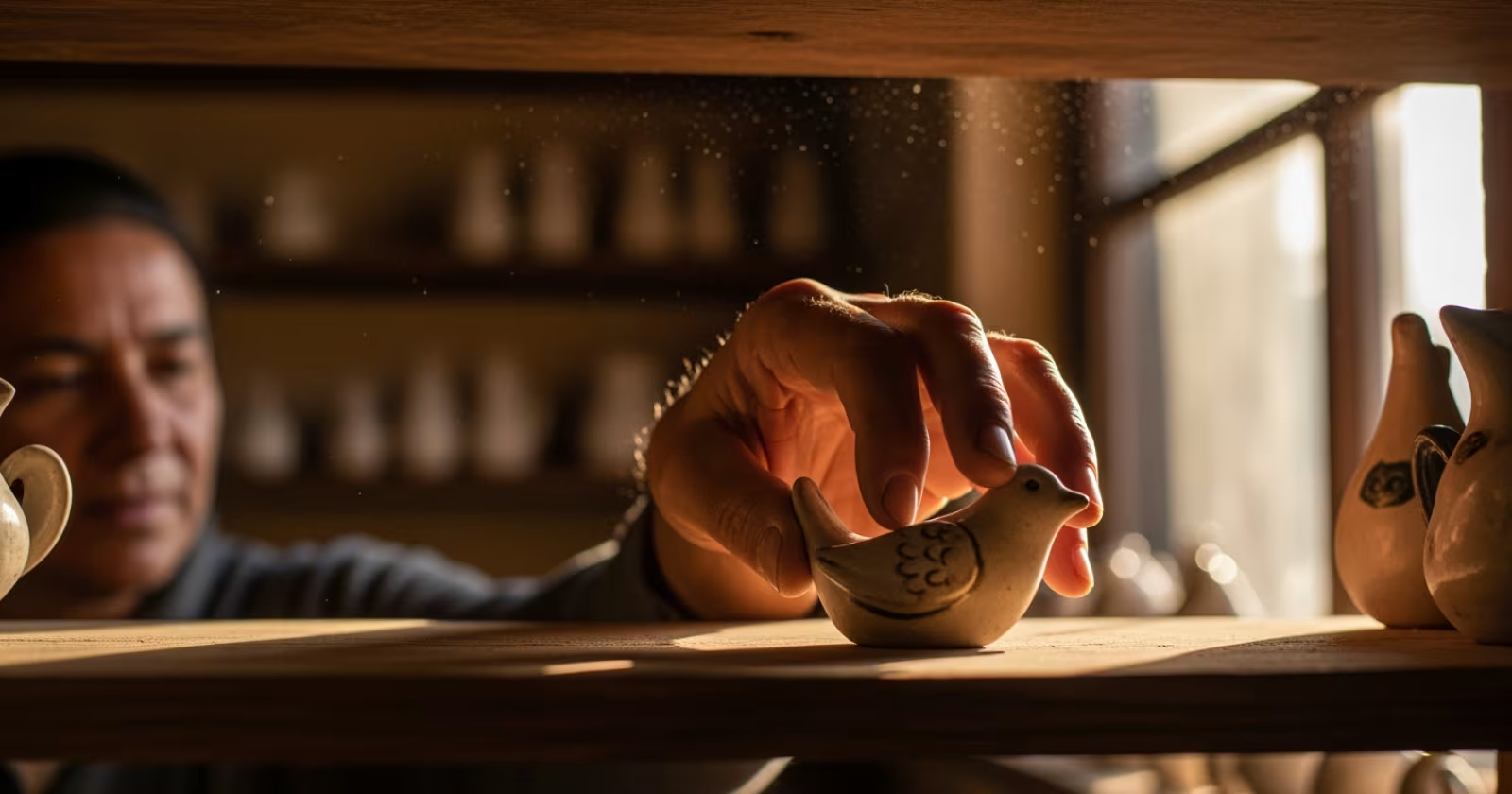
The Open Network for Digital Commerce (ONDC) is extending this momentum by allowing village artisans and small producers to list products on shared infrastructure, free from any single platform’s commission structure. A potter in Khurja, Uttar Pradesh, can now reach buyers across multiple apps simultaneously — something that would have required a broker, a middleman, and at least a six-week delay as recently as 2022. The friction that once swallowed rural margins is shrinking fast.
Unified Payments Interface transactions in rural India grew by 61 percent year-on-year through the first quarter of 2026, according to the National Payments Corporation of India. That rate of adoption signals that cash is losing its status as the default currency of village commerce. Once that shift takes hold broadly, the cost of doing business drops sharply for small sellers who previously absorbed significant risks from handling and storing physical money at scale.
| Program or Platform | Primary Focus | Scale in 2026 |
|---|---|---|
| PM MUDRA Yojana | Micro-enterprise lending | ₹27 lakh crore disbursed cumulatively |
| NABARD-SHG Linkage | Women’s collective credit | 140 million members across 12 million groups |
| Common Service Centres | Rural digital access and commerce | 500,000+ active locations |
| ONDC | Open e-commerce infrastructure | 7 million+ active sellers |
| Meesho | Rural reselling and e-commerce | 150 million transacting users |
| UPI Rural Adoption | Digital payments in villages | 61% year-on-year growth (Q1 2026) |
What the Government Built That Actually Worked
Common Service Centres, a government-backed network of digital access points operating from over 500,000 rural locations, have evolved into quiet commercial hubs rather than mere utility windows. Entrepreneurs managing these centers process government documents, handle insurance paperwork, and increasingly act as first-layer distribution points for e-commerce companies that cannot justify building last-mile logistics in villages with populations below 3,000. The model works because the infrastructure already exists and the trust is already local.
The PM MUDRA Yojana scheme, which provides collateral-free loans of up to ₹10 lakh to micro-enterprises, had disbursed a cumulative ₹27 lakh crore by the close of fiscal year 2026-26. Roughly 68 percent of those loans went to women borrowers, and a disproportionate share flowed into rural districts — a structural signal about where India’s new generation of business founders is actually forming. These are not beneficiaries receiving charity; they are operators building real, taxable enterprises.
ITC’s e-Choupal program, which began by connecting soybean farmers in Madhya Pradesh to real-time commodity prices in 2000, has since grown into a full-service commerce platform serving millions of farmers across 10 states. The original insight — that rural producers bleed value because they lack market information — remains the engine driving its expansion more than two decades later. When the information gap closes, the income gap tends to follow.
The Friction That Remains Real
None of this is frictionless. Road infrastructure in parts of Bihar, Jharkhand, and interior Chhattisgarh still adds logistics costs that compress small producer margins to near zero. Cold chain gaps mean that perishable agricultural products — which represent the majority of what rural India actually grows and makes — frequently degrade before reaching a paying buyer. These are not abstract policy challenges; they represent billions of rupees in annual losses absorbed by people already operating on the thinnest of margins.
Digital literacy gaps, particularly among women over 45 in remote villages, mean that smartphone ownership does not automatically translate into active commercial participation. Organizations like the Digital Empowerment Foundation have worked for years to close this gap through intensive on-ground training programs. But the scale of the challenge means progress is sharply uneven — one district in Rajasthan can be fully integrated into digital commerce while a neighboring district operates entirely on cash and word-of-mouth.
What strikes me most about all of this is how little of it appears in mainstream business reporting. The companies generating press releases are almost always urban. The startups raising venture capital are overwhelmingly city-based. But the most consequential economic experiment happening in India right now — testing whether 850 million rural citizens can build sustainable livelihoods on their own terms — is unfolding in places most investors have never visited and most journalists rarely report from.
For anyone serious about tracking India’s real economic direction, following NABARD’s SHG linkage data quarter by quarter, monitoring ONDC’s rural seller growth, and watching where PM MUDRA capital flows next offers a far more accurate picture of the country’s trajectory than startup funding rounds or stock market indices ever will. The most important numbers are coming out of the villages. They always were.